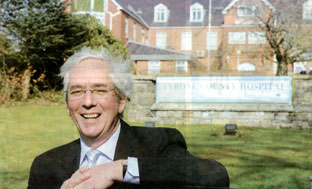
THE GOOD DOCTOR
The good doctor
THE THURSDAY INTERVIEW
MARK McKELVEY
Dr John Maginness may have moved to Omagh because of work, but over the past tbree decades the town has become an adopted home for himself and his family.
They have fallen in love with the area, the people and the Tyrone County Hospital (TCH), taking great pride in the many wonderful achievements by staff there during that time.
Having recently retired, Dr Maginness regards the TCH as more than just a hospital.
He says it's a "centre of excellence" that has always strived to provide the best service possible for the local community.
Dr Maginness puts much of the hospital's success down to the dedicated efforts of the staff who have given their hearts to the people because they love doing their jobs.
Originally from Belfast. Dr Maginness moved to Omagh with his wife Mary and two young boys in 1980 and have made the locality their home ever since, while having another son and daughter.
"We have made Omagh our home and we have been welcomed throughout the community in the schools, churches, by our good neighbours and off course in the hospital," he said.
Dr Maginness was appointed as a consultant anaesthetist in September 1980, during a period he describes as a transition between the postwar staff nearing the end of their working life, and the new intake of young consultants such as Dominic Pinto, Kate Law, Shashikant Kaluskar and Clive Russell.
"The legacy left by the post-war period was very good as they worked single-handedly at times for many years. The hospital became rejuvenated throughout the 1980s and transformed in many ways to a much more modern and vibrant facility doing an awful lot of work, with the renovated maternity wards, surgical wards, ENT department and theatres and intensive care re-established.
"In anaesthetics there were four or five of us, and we had very good working relationships with the intent of looking after our patients and giving as good an anaesthetic service as you could possibly get."
As the hospital's Christmas Day Santa for the past 15 years. Dr Maginness is well known throughout the hospital community for his compassion and good humour.
He was also a strong advocate for the retention of acute services at the TCH and remains a vociferous opponent of the eradication of services at the hospital.
With great sadness, Dr Maginness witnessed the "rapid decline" in the loss of services provided at the TCH over the last four or five years.
"Especially in the last two years since the new trust took over," he remarked.
"The blue light policy of going straight to Enniskillen and by-passing the TCH is a load of nonsense."
He added. "These 'management people' speak of a corporate memory. But I think they have a loss of memory as they really do not communicate with those who know what has gone on in the past. They just look at the current spreadsheets with very little credence or acknowledgement, particularly to the nursing staff who get the brunt of their great new ideas.
"I think they (management) create the conditions themselves in regards to safety so it becomes a self-fulfilling prophecy which resulted in the gradual dismantlement of what was already there. They can't say it is because they can't recruit staff."
Despite the removal of all acute services, Dr Maginness emphasised that there are still elements that remain very good at the hospital.
He pays particular praise to the work of the cardiac assessment unit and those receiving cataract operations and saving sight.
He continued, "What Ms Law and Mr Kaluskar had for the past 30 years before retiring recently was a first rate, internationally recognised ENT unit. It is less so now as it is more based in Altnagelvm because we cannot do inpatient surgery work anymore, but the work they were doing was outstanding.
"The staff should get the highest of praise as they do the work in a most professional and dedicated manner"
Despite last month's news that funding is being made available for the new £190 million Enhanced Area Hospital in Omagh, Dr Maginnos feels the Department of Health could save 90 per-cent of that funding if they simply invested in the existing structures and people at the TCH.
"We have a very fine building that has stood for 111 years so far. It is a fine building that has been extensively renovated. It has a suite of two great theatres, a day unit theatre, a first rate x-ray department, excellent cardiac wards, palliative care and rehabilitation and a fantastic laboratory.
"You don't need to spend £190 million building a new hospital. A fraction of that money could be spent maintaining the current hospital building and more importantly retaining the staff to run it."
.lust prior to moving to Omagh, Dr Maginness worked at the Daisy Hill Hospital in Newry during the height of the Troubles responding to incidents such as the Miami Show-band Massacre and the Kingsmill Massacre.
"It was a steep learning curve working as a junior doctor in those difficult times. You had to learn on the job very quickly, particularly dealing with severe trauma."
Locally, Dr Maginness was also involved in the aftermath of several major bombings during the 1980s and 90s, helping to save numerous lives thanks to the efforts in the TCH. Having experienced so much bloodshed during in his work in Belfast, Newry and Omagh, Dr Maginness hoped such extreme acts of violence were a thing of the past by 1998 following the Good Friday Agreement.
However, on August 15 of that year, Dr Maginness had just arrived in Belfast to visit his mother-in law when he discovered news of the devastating Real IRA bomb attack in Omagh.
He immediately turned around and made his way back to the TCH.
He said. "I was selfish enough to speak to my own daughter to make sure all our children were safe and made an immediate return. I went straight to the hospital arriving at about 6pm, going straight to the theatres We just carried on working as normal as a team. We treated each individual as we normally would and carried out normal emergency practices. You could hear a pin drop in our hospital at times and even on that day it was quite quiescent."
That afternoon 173 female and 55 males were admitted to the TCH, with major life-saving operations taking place throughout the night as medical staff from near and far came to offer their help and support.
Dr Maginness expressed his pride in the way the hospital staff united to respond to this tragedy, expressing how well the patients were treated and what was achieved in times of adversity.
He said, "It was a huge team effort par excellence. Due mainly because the people already knew how to work together having responded to previous traumas in our day to day work.
"From the hospital point of view, it was a sign of great camaraderie working together very efficiently for our patients. We treated everyone who came through the doors the exact same way we would like to be treated ourselves. That was the basis of our philosophy."
Although he officially retired last September. Dr Maginness is still working one day each week for eye surgery.
He jokes that his "long-suffering" wife Mary now has him full-time, and stressed they are as much in love today as they were when they first met and got married in Belfast in the 1970s.
The couple recently welcomed their first grandchild to the family and with another on the way. Dr Maginness said he and his wife are grateful to have the strength and health to enjoy his years of retirement.
Further Information
Related Images