INQUEST HEARS HOW OFFICERS PUT THEIR LIVES AT RISK
Inquest hears how officers put their own lives at risk
By JACQUELINE COURTNEY
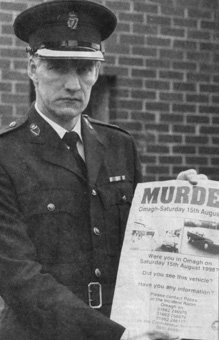
All bombers had to say was where car was - Supt Baxter
THE Sub-Divisional Commander of Omagh RUC came to the defence of his officers whom he said had put their lives at risk trying to protect the community.
Superintendent James Baxter told coroner John Leckey on Monday that only the bombers could have made any difference that day and it was they who should be held responsible for what had happened.
His Voice, trembling with emotions, he almost broke down when he hit out at the bombers who caused mass murder in the town on one of the busiest shopping days.
"All they had to say was there was a car bomb outside Kells shop on Market Street, the colour and make of the car, and the registration number of the car. But they did not do that.
"My officers went into High Street expecting that a bomb had been planted there. Everyone of those officers put their lives at risk trying to protect this community," said the outraged officer.
His comments followed questioning of police officers about how they responded to the confusing telephoned warnings.
His voice pulsated with passion as he said: "The person who planted the bomb got out of a car on one of the busiest shopping days, saw women and children on the street and walked away. He did nothing to prevent people being murdered in Omagh.
On seeing how emotionally upset the Superintendent was, the Coroner asked him if he was alright and suggested a short adjournment.
Witness said he preferred to continue.
Earlier the police chief had condemned the confusing telephone call warnings which his officers had to interpret and responded to.
Continuing witness said the situation was made more difficult on August 15th 1988 when "we were supposed to be in the middle of the peace process.
Looking back, he said, everyone was hoping that we were looking forward to a peaceful future. No on ever thought someone would indiscriminately attack a busy shopping town, he said.
He also pointed out that since the bomb Omagh had been subjected to 68 bomb scares.
The most recent was last Wednesday when the same codeword was used as the one given on the day of the atrocity.
It took his officers 42 minutes to clear the entire town centre, he said.
He immediately pointed out that on the day of the bombing there were only 29 minutes from the time when officers in Omagh learned of the bomb warnings until the bomb exploded.
There were in the region of 180 premises for officers to evacuate and check, around 150 vehicles to account for and hundreds of people in premises and shops, he said.
"There is no way that an area of that size could be evacuated in less that 29 minutes," he said.
He rejected suggestions that there should have been a contingency plan in place for Omagh for bomb alerts.
He said he would not issue rigid instructions to any of his officers in relation to how or where to set up cordon points. Officers were trained to act on their own initiative.
Bearing in mind the history, where terrorists have placed secondary devices to catch out police officers, he said, it could result in directing officers to their death.
Witness added that he had been involved in many terrorist incidents more than he cared to remember.
By JACQUELINE COURTNEY
All bombers had to say was where car was - Supt Baxter
THE Sub-Divisional Commander of Omagh RUC came to the defence of his officers whom he said had put their lives at risk trying to protect the community.
Superintendent James Baxter told coroner John Leckey on Monday that only the bombers could have made any difference that day and it was they who should be held responsible for what had happened.
His Voice, trembling with emotions, he almost broke down when he hit out at the bombers who caused mass murder in the town on one of the busiest shopping days.
"All they had to say was there was a car bomb outside Kells shop on Market Street, the colour and make of the car, and the registration number of the car. But they did not do that.
"My officers went into High Street expecting that a bomb had been planted there. Everyone of those officers put their lives at risk trying to protect this community," said the outraged officer.
His comments followed questioning of police officers about how they responded to the confusing telephoned warnings.
His voice pulsated with passion as he said: "The person who planted the bomb got out of a car on one of the busiest shopping days, saw women and children on the street and walked away. He did nothing to prevent people being murdered in Omagh.
On seeing how emotionally upset the Superintendent was, the Coroner asked him if he was alright and suggested a short adjournment.
Witness said he preferred to continue.
Earlier the police chief had condemned the confusing telephone call warnings which his officers had to interpret and responded to.
Continuing witness said the situation was made more difficult on August 15th 1988 when "we were supposed to be in the middle of the peace process.
Looking back, he said, everyone was hoping that we were looking forward to a peaceful future. No on ever thought someone would indiscriminately attack a busy shopping town, he said.
He also pointed out that since the bomb Omagh had been subjected to 68 bomb scares.
The most recent was last Wednesday when the same codeword was used as the one given on the day of the atrocity.
It took his officers 42 minutes to clear the entire town centre, he said.
He immediately pointed out that on the day of the bombing there were only 29 minutes from the time when officers in Omagh learned of the bomb warnings until the bomb exploded.
There were in the region of 180 premises for officers to evacuate and check, around 150 vehicles to account for and hundreds of people in premises and shops, he said.
"There is no way that an area of that size could be evacuated in less that 29 minutes," he said.
He rejected suggestions that there should have been a contingency plan in place for Omagh for bomb alerts.
He said he would not issue rigid instructions to any of his officers in relation to how or where to set up cordon points. Officers were trained to act on their own initiative.
Bearing in mind the history, where terrorists have placed secondary devices to catch out police officers, he said, it could result in directing officers to their death.
Witness added that he had been involved in many terrorist incidents more than he cared to remember.
Further Information
Publisher: ULSTER HERALD
Ref: UH/1463
Published Date: 21-Sep-00
Related Images