A WOMAN IN LOVE
A women in love
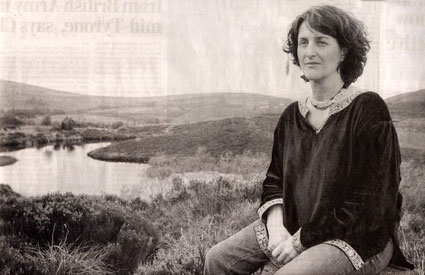
When Mary Ronayne Keane looks at Hugh O'Neill she does not see only the great Irish military and political strategist who brought England beyond the brink of ruin in the Nine Years War. Nor does she see only the Irish chieftain who pays the price of his arrogance in the bitterness and loss of exile. Instead, the Cork artist sees a great man wracked by inner self doubts, a hugely attractive, towering figure touched by greatness and by near despair.
Mary Roynane Keane has a woman's perspective on a man she admires greatly, a man with whom she has had a deep and intimate relationship for more than three years. She steps behind the public persona of the Great O'Neill, into the private chambers he shared with Mabel Bagenal, the love of his life, and presents a mortal who entertains his doubts in privacy.
Hugh O'Neill emerges as a man caught in a deadly dilemma and who made the only choice he could; yet he still entertains all the scruples of one who brought ruination, dispossession and near annihilation on the people he swore to protect and lead.
"This isn't the historical character; this is the man, the emotional person behind the closed doors as seen by a woman," says Ronayne Keane, the creator of The Flight of the Earls musical drama Hugh O'Neill: Sinner, Saint or Sovereign, which will be performed in the Ulster-American Folk Park over three nights from tomorrow (Friday) until Sunday.
"Some historians could kill me for what I have done. I have taken a great Irish historical figure I have absorbed all the facts about his life and then I have built the flesh and bones and the emotions of a real man on that."
Ronayne Keane believes she could do no more nor less than that. She has tried in a way to assume the perspective of Mabel, wife of O'Neill and sister of his most persistent enemy, Sir Henry Bagenal. Twenty years his junior, yet his intellectual peer, Mabel sought to deflect O'Neill from making that one crucial decision that led to defeat at Kinsale, to keep him in Tyrone and the fastness of Ulster.
"Any woman worth her salt can go beyond the skin and bones and the arrogance of her man. She would want to protect him, not for strategy, but as a woman and as his partner.
"But he could do anything he wanted at that point and this was the one impetuous move he might have made in his life."
At the age of 37, Mary Roynane Keane quit her job. She withdrew from workaday life and immersed herself in the greatest project of her life composing a musical drama on the life of Hugh O'Neill. Her parents were aghast and, for several years, they watched in dismay as she spent her days poring over books and historical documents and trying to find the rhythms, melodies and words to convey the story she wanted and needed to tell.
"I had studied music at the Royal Irish Academy and at the London Academy of Music and then I went on to teach music and into choral direction. I set up folk music groups and choral arrangements, including Gregorian and Plain chant, but that was never enough."
Indeed, even as a choral director, Mary found herself introducing elements of her own composition into the scores, without telling anyone: "They would have killed me if they had known."
All the while, she had the urge to create and compose, yet it was held back mostly by the influence of her mother who had deflected her from childhood creativity in a small episode she has never forgotten.
"I was playing at something and I wanted my mother to come and listen to it. She said, 'Don't mind that rubbish. You have no business playing that; get back to preparing for your exams.'
"My mother only wanted me to get the qualifications and be secure yet my grandfather, the other great influence in my life, had no time for bits of paper."
Her grandfather, indeed, may have been the muse who brought her to O'Neill. A huge figure in her life, he was an accomplished Irish traditional musician.
"He worked in a quarry all his life and, when I think of him, I see his great hands; they were truly gigantic. Yet he played the banjo and mandolin and the whistle, flute and uileann pipes with more ornamentation and speed than I could even imagine. I remember him with the tin whistle. His hands were so big that you couldn't see the whistle; all you could see was the fingers moving, producing this music that was so beautiful and moving."
Mary's parents had lived in Philadelphia and came home to Ireland in 1961 just before Mary, the middle child of a family of three (two brothers), was born. They stayed in Ireland until the family was grown up, and then moved back to America in 1987 where they stayed for another ten years.
In 1997, they returned to Cork and her mother Nell now 73 was discontent with idle retirement. So she set up a B&B which has been thriving since.
Her father John, meanwhile, has creative skills. He is a handweaver who has taught his intricate craft to many others. He set up the handweaving projects in Bunratty Castle and in Donegal and among his former students is Richard Hurst of the Ulster-American Folk Park.
But Mary was already a family renegade. None of her aunts married and, when she did, they all thought she was far too young and that should concentrate on her music teaching career. Yet her husband and "partner" David father of their two sons David (or Davog), 18, and Kevin, 11 - has been a bedrock of support.
"We grew up together and he knew me practically all my life. He knows me as well as anybody can know somebody else."
That intimate knowledge is reciprocated in her private life with her husband. He was reared by an aunt after his mother died when he was only three years old. The lasting impact of his loss of mother provided a stunning insight for Mary into her fascination with Hugh O'Neill, a fascination inspired by her exploration of local history revolving around the Anglo Norman castle at Barrystown.
Mary chose The Ghosts of Barrystown as her first subject for non-liturgical composition and wrote a musical drama on the history and legacy of that Norman invasion in the locality. It was staged in 1999 at Barrystown Castle to wide acclaim. It was a musical drama based on the power of ancestry, of family ties with place and of the weight of emotions.
"Barrystown was written to test the water for O'Neill," she admits. "I had to find out if I was able to command the attention of an audience for two hours and where was the easiest place to turn to? My home."
During the research, she came across an episode in December 1601 when Hugh O'Neill arrived to pursuade Lord David Barry to align with him against Lord Mountjoy's English forces: "I discovered that O'Neill pitched his tent in the field right beside my house. I became fascinated with that long trek to Kinsale and with the man who led it."
What Mary Ronayne Keane has latched on to, however, is the inner man glossed over by historians. She knew that Hugh O'Neill had been fostered out as a child to the O'Hagan clan, guardians of the O'Neill coronation site at Tullyhogue. Then he was sent to "live among the English" where he was educated, before returning home to assume the leadership of his people, both under English law as the Earl of Tyrone and under Brehon law as The O'Neill.
"He grows up away from his family and he never really knew his mother," said Mary. "Perhaps that is where his self-doubts and his arrogance began. If he lived today, we would say that he came from a very abusive background, a dysfunctional family, and he was certainly treated badly by his family, by his uncle Shane O'Neill in particular.
"So there was a vulnerability there from the outset and you must understand that when you look at the human behind all the historical accounts we have been given. He was not just a historical figure; he was a man who never had a mother or a close, caring family. What did that do to him we can only guess."
The sense of place and belonging runs deep in Mary Ronayne Keane and, strangely, it has widened her horizons beyond her Cork home to Tyrone and the Sperrin Mountains in particular. Her paternal ancestors, the Ronaynes, came from Tyrone. Descended from French, they were seafarers who settled on Tyrone's Lough Neagh shore and took up work in the flax industry of the 17th century. In the later 1600s, they were dispossessed and banished. They went to Cork where they became seafarers again, working their way up from smuggling wine and brandy for the lesser gentry to mercantile respectability.
Yet the draw of the Sperrins is still there for Mary Roynane Keane who seems almost enchanted in their presence. While working on the final touches of her opus at the Tyrone Guthrie Centre at Annaghmakerrig in Co. Monaghan, she was drawn time and again back to Tyrone and the Sperrins. In the Flight of the Earls, the gentle mountain range is a constant presence for the composer and for her subject in exile, O'Neill.
When local Omagh soprano Eleanor O'Neill who has been a member of the Omagh Lunula Choir opened the proceedings at the August 15 ecumenical memorial service for the 1998 Omagh bomb victims at the Garden of Rembembrance last month, her song was introduced as a traditional 17th century composition. Yet while Sperrini Slan Go Deo is the lament of O'Neill leaving his homeland in 1607, the music and words were written only within the last couple of years by Mary Ronayne Keane. It is a haunting melody that captures the story of this region.
So bringing her work home to Tyrone has a huge emotional impact on a composer who has gone further than anyone to capture the essence of O'Neill. With the help of Co-operation Ireland, Cork County Council and Omagh District Council the three performances at the Folk Park have been made possible. The choirs have gathered and, after almost four centuries of exile, Hugh O'Neill returns in triumph to the county town of Tyrone. Mary Ronayne Keane, who made that possible is now willing to let go of her fascination and jealous love of a man she has comforted through his exile, doubts and heartbreak.
When Mary Ronayne Keane looks at Hugh O'Neill she does not see only the great Irish military and political strategist who brought England beyond the brink of ruin in the Nine Years War. Nor does she see only the Irish chieftain who pays the price of his arrogance in the bitterness and loss of exile. Instead, the Cork artist sees a great man wracked by inner self doubts, a hugely attractive, towering figure touched by greatness and by near despair.
Mary Roynane Keane has a woman's perspective on a man she admires greatly, a man with whom she has had a deep and intimate relationship for more than three years. She steps behind the public persona of the Great O'Neill, into the private chambers he shared with Mabel Bagenal, the love of his life, and presents a mortal who entertains his doubts in privacy.
Hugh O'Neill emerges as a man caught in a deadly dilemma and who made the only choice he could; yet he still entertains all the scruples of one who brought ruination, dispossession and near annihilation on the people he swore to protect and lead.
"This isn't the historical character; this is the man, the emotional person behind the closed doors as seen by a woman," says Ronayne Keane, the creator of The Flight of the Earls musical drama Hugh O'Neill: Sinner, Saint or Sovereign, which will be performed in the Ulster-American Folk Park over three nights from tomorrow (Friday) until Sunday.
"Some historians could kill me for what I have done. I have taken a great Irish historical figure I have absorbed all the facts about his life and then I have built the flesh and bones and the emotions of a real man on that."
Ronayne Keane believes she could do no more nor less than that. She has tried in a way to assume the perspective of Mabel, wife of O'Neill and sister of his most persistent enemy, Sir Henry Bagenal. Twenty years his junior, yet his intellectual peer, Mabel sought to deflect O'Neill from making that one crucial decision that led to defeat at Kinsale, to keep him in Tyrone and the fastness of Ulster.
"Any woman worth her salt can go beyond the skin and bones and the arrogance of her man. She would want to protect him, not for strategy, but as a woman and as his partner.
"But he could do anything he wanted at that point and this was the one impetuous move he might have made in his life."
At the age of 37, Mary Roynane Keane quit her job. She withdrew from workaday life and immersed herself in the greatest project of her life composing a musical drama on the life of Hugh O'Neill. Her parents were aghast and, for several years, they watched in dismay as she spent her days poring over books and historical documents and trying to find the rhythms, melodies and words to convey the story she wanted and needed to tell.
"I had studied music at the Royal Irish Academy and at the London Academy of Music and then I went on to teach music and into choral direction. I set up folk music groups and choral arrangements, including Gregorian and Plain chant, but that was never enough."
Indeed, even as a choral director, Mary found herself introducing elements of her own composition into the scores, without telling anyone: "They would have killed me if they had known."
All the while, she had the urge to create and compose, yet it was held back mostly by the influence of her mother who had deflected her from childhood creativity in a small episode she has never forgotten.
"I was playing at something and I wanted my mother to come and listen to it. She said, 'Don't mind that rubbish. You have no business playing that; get back to preparing for your exams.'
"My mother only wanted me to get the qualifications and be secure yet my grandfather, the other great influence in my life, had no time for bits of paper."
Her grandfather, indeed, may have been the muse who brought her to O'Neill. A huge figure in her life, he was an accomplished Irish traditional musician.
"He worked in a quarry all his life and, when I think of him, I see his great hands; they were truly gigantic. Yet he played the banjo and mandolin and the whistle, flute and uileann pipes with more ornamentation and speed than I could even imagine. I remember him with the tin whistle. His hands were so big that you couldn't see the whistle; all you could see was the fingers moving, producing this music that was so beautiful and moving."
Mary's parents had lived in Philadelphia and came home to Ireland in 1961 just before Mary, the middle child of a family of three (two brothers), was born. They stayed in Ireland until the family was grown up, and then moved back to America in 1987 where they stayed for another ten years.
In 1997, they returned to Cork and her mother Nell now 73 was discontent with idle retirement. So she set up a B&B which has been thriving since.
Her father John, meanwhile, has creative skills. He is a handweaver who has taught his intricate craft to many others. He set up the handweaving projects in Bunratty Castle and in Donegal and among his former students is Richard Hurst of the Ulster-American Folk Park.
But Mary was already a family renegade. None of her aunts married and, when she did, they all thought she was far too young and that should concentrate on her music teaching career. Yet her husband and "partner" David father of their two sons David (or Davog), 18, and Kevin, 11 - has been a bedrock of support.
"We grew up together and he knew me practically all my life. He knows me as well as anybody can know somebody else."
That intimate knowledge is reciprocated in her private life with her husband. He was reared by an aunt after his mother died when he was only three years old. The lasting impact of his loss of mother provided a stunning insight for Mary into her fascination with Hugh O'Neill, a fascination inspired by her exploration of local history revolving around the Anglo Norman castle at Barrystown.
Mary chose The Ghosts of Barrystown as her first subject for non-liturgical composition and wrote a musical drama on the history and legacy of that Norman invasion in the locality. It was staged in 1999 at Barrystown Castle to wide acclaim. It was a musical drama based on the power of ancestry, of family ties with place and of the weight of emotions.
"Barrystown was written to test the water for O'Neill," she admits. "I had to find out if I was able to command the attention of an audience for two hours and where was the easiest place to turn to? My home."
During the research, she came across an episode in December 1601 when Hugh O'Neill arrived to pursuade Lord David Barry to align with him against Lord Mountjoy's English forces: "I discovered that O'Neill pitched his tent in the field right beside my house. I became fascinated with that long trek to Kinsale and with the man who led it."
What Mary Ronayne Keane has latched on to, however, is the inner man glossed over by historians. She knew that Hugh O'Neill had been fostered out as a child to the O'Hagan clan, guardians of the O'Neill coronation site at Tullyhogue. Then he was sent to "live among the English" where he was educated, before returning home to assume the leadership of his people, both under English law as the Earl of Tyrone and under Brehon law as The O'Neill.
"He grows up away from his family and he never really knew his mother," said Mary. "Perhaps that is where his self-doubts and his arrogance began. If he lived today, we would say that he came from a very abusive background, a dysfunctional family, and he was certainly treated badly by his family, by his uncle Shane O'Neill in particular.
"So there was a vulnerability there from the outset and you must understand that when you look at the human behind all the historical accounts we have been given. He was not just a historical figure; he was a man who never had a mother or a close, caring family. What did that do to him we can only guess."
The sense of place and belonging runs deep in Mary Ronayne Keane and, strangely, it has widened her horizons beyond her Cork home to Tyrone and the Sperrin Mountains in particular. Her paternal ancestors, the Ronaynes, came from Tyrone. Descended from French, they were seafarers who settled on Tyrone's Lough Neagh shore and took up work in the flax industry of the 17th century. In the later 1600s, they were dispossessed and banished. They went to Cork where they became seafarers again, working their way up from smuggling wine and brandy for the lesser gentry to mercantile respectability.
Yet the draw of the Sperrins is still there for Mary Roynane Keane who seems almost enchanted in their presence. While working on the final touches of her opus at the Tyrone Guthrie Centre at Annaghmakerrig in Co. Monaghan, she was drawn time and again back to Tyrone and the Sperrins. In the Flight of the Earls, the gentle mountain range is a constant presence for the composer and for her subject in exile, O'Neill.
When local Omagh soprano Eleanor O'Neill who has been a member of the Omagh Lunula Choir opened the proceedings at the August 15 ecumenical memorial service for the 1998 Omagh bomb victims at the Garden of Rembembrance last month, her song was introduced as a traditional 17th century composition. Yet while Sperrini Slan Go Deo is the lament of O'Neill leaving his homeland in 1607, the music and words were written only within the last couple of years by Mary Ronayne Keane. It is a haunting melody that captures the story of this region.
So bringing her work home to Tyrone has a huge emotional impact on a composer who has gone further than anyone to capture the essence of O'Neill. With the help of Co-operation Ireland, Cork County Council and Omagh District Council the three performances at the Folk Park have been made possible. The choirs have gathered and, after almost four centuries of exile, Hugh O'Neill returns in triumph to the county town of Tyrone. Mary Ronayne Keane, who made that possible is now willing to let go of her fascination and jealous love of a man she has comforted through his exile, doubts and heartbreak.
Further Information
Publisher: ULSTER HERALD
Ref: UH/1101
Published Date: 19-Sep-02
Related Images