FULL HORROR UNFOLDS ON A HOME TOWN SATURDAY AFTERNOON
Full horror unfolds on a home town Saturday afternoon
THE dull thud just after 3pm seemed just a few hundred yards away. The windows in the house shook in their frames. There was no doubt it was a bomb, similar to many the town had suffered over almost three decades. At first guess it was the nearby police barracks on the Gortin Road.
Armed with a notebook and pen, I'm joined on the mile long journey to the scene by my son who, at the time, was training to be a medic. The drive into town was eerily quiet. The Gortin Road was practically deserted for a normal Saturday afternoon. It wasn't until we turned onto Drumragh Avenue that the full horror began to unfold.
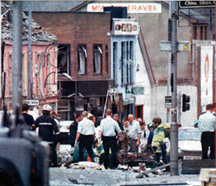
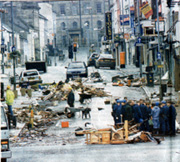
In the distance, a plume of dark smoke hung over the scene where ten minutes earlier almost 500lbs of explosive packed into a Vauxhall Cavalier had torn through a street packed with men, women and children. A scene of devastation began to emerge. Emergency services and onlookers were tending the dead and dying. Priority was being given to those severely injured and barely alive. Blankets and towels blown from shop fronts covered what remained of those killed outright.
The full enormity began to sink in when we reached the pavement adjacent to the Cozy Korner bar. Blood, in the early stages of congealing, formed a sticky, crimson flooring beneath the feet. Tip-toeing a path through it, you avoided the shards of glass and metal.
The front portion of S D Kells had totally collapsed. Men and women tore at the rubble with bare hands in a desperate attempt to reach those trapped. A priest weaved through the broken windows at the corner of Nicholl & Shiels shop offering succour and the Last Rites to the injured and dying.
A few yards up the street a water mains had burst. Rescuers milled around it as if attempting to pull something from its depth. The river of water spurting from it carried personal effects, a child's pram and body parts down the incline. There's a limb - of sorts - being washed in the wake of water, rolling gently down the slope. It's difficult to make out if it's part of someone's arm or leg.
Four firemen stumble past carrying a makeshift stretcher. An arm falls limply and dangles from the remains of the dead body that lay beneath the covers. Two rescuers carry a severely injured female cradled in their locked arms. It's impossible to determine her age. Her face and hair are dusty, blackened and bloodied. Her shattered leg, or what remains of it, swings loosely. Her numbed expression is somewhere beyond pain.
In the melee, I spot local councillor and former fireman Paddy McGowan. "Between 12 and 15 dead," he shouts over the din of sirens and screams. '12-15' I shakily scribble on notepaper. The next question fails to materialise.
Across the street someone is panning a video camera. For a split second, it somehow resembles a film set.
A police inspector approaches from Campsie. He painstakingly explains about a bomb scare at the courthouse. People were unwittingly shepherded into the path of the bomb, he says almost apologetically. Before he finishes, his own constables order us out of the vicinity. Another bomb could go off. No-one waits to question.
Later in the evening, outside A&E at Tyrone County Hospital, I speak to survivors and those who rushed to help. Some are reluctant or too shocked to talk. Others are anxious to tell their story or maybe offload their burdens of the day. Up in the wards, I'm not aware that my trainee medic son is helping emergency services deal with a traumatic day.
Among the walking wounded was a young man who sustained facial injuries. His head is swathed in bandages and blood has already begun to seep through the dressing. We sit together on a low wall and as we speak I notice a plaque above his head. It bears the inscription of Scottish poet Thomas Campbell - 'To live in hearts we leave behind is not to die.'
31 hearts died in Omagh that day. All live in those hearts left behind.
j.mccusker@ulsterherald.com
THE dull thud just after 3pm seemed just a few hundred yards away. The windows in the house shook in their frames. There was no doubt it was a bomb, similar to many the town had suffered over almost three decades. At first guess it was the nearby police barracks on the Gortin Road.
Armed with a notebook and pen, I'm joined on the mile long journey to the scene by my son who, at the time, was training to be a medic. The drive into town was eerily quiet. The Gortin Road was practically deserted for a normal Saturday afternoon. It wasn't until we turned onto Drumragh Avenue that the full horror began to unfold.
In the distance, a plume of dark smoke hung over the scene where ten minutes earlier almost 500lbs of explosive packed into a Vauxhall Cavalier had torn through a street packed with men, women and children. A scene of devastation began to emerge. Emergency services and onlookers were tending the dead and dying. Priority was being given to those severely injured and barely alive. Blankets and towels blown from shop fronts covered what remained of those killed outright.
The full enormity began to sink in when we reached the pavement adjacent to the Cozy Korner bar. Blood, in the early stages of congealing, formed a sticky, crimson flooring beneath the feet. Tip-toeing a path through it, you avoided the shards of glass and metal.
The front portion of S D Kells had totally collapsed. Men and women tore at the rubble with bare hands in a desperate attempt to reach those trapped. A priest weaved through the broken windows at the corner of Nicholl & Shiels shop offering succour and the Last Rites to the injured and dying.
A few yards up the street a water mains had burst. Rescuers milled around it as if attempting to pull something from its depth. The river of water spurting from it carried personal effects, a child's pram and body parts down the incline. There's a limb - of sorts - being washed in the wake of water, rolling gently down the slope. It's difficult to make out if it's part of someone's arm or leg.
Four firemen stumble past carrying a makeshift stretcher. An arm falls limply and dangles from the remains of the dead body that lay beneath the covers. Two rescuers carry a severely injured female cradled in their locked arms. It's impossible to determine her age. Her face and hair are dusty, blackened and bloodied. Her shattered leg, or what remains of it, swings loosely. Her numbed expression is somewhere beyond pain.
In the melee, I spot local councillor and former fireman Paddy McGowan. "Between 12 and 15 dead," he shouts over the din of sirens and screams. '12-15' I shakily scribble on notepaper. The next question fails to materialise.
Across the street someone is panning a video camera. For a split second, it somehow resembles a film set.
A police inspector approaches from Campsie. He painstakingly explains about a bomb scare at the courthouse. People were unwittingly shepherded into the path of the bomb, he says almost apologetically. Before he finishes, his own constables order us out of the vicinity. Another bomb could go off. No-one waits to question.
Later in the evening, outside A&E at Tyrone County Hospital, I speak to survivors and those who rushed to help. Some are reluctant or too shocked to talk. Others are anxious to tell their story or maybe offload their burdens of the day. Up in the wards, I'm not aware that my trainee medic son is helping emergency services deal with a traumatic day.
Among the walking wounded was a young man who sustained facial injuries. His head is swathed in bandages and blood has already begun to seep through the dressing. We sit together on a low wall and as we speak I notice a plaque above his head. It bears the inscription of Scottish poet Thomas Campbell - 'To live in hearts we leave behind is not to die.'
31 hearts died in Omagh that day. All live in those hearts left behind.
j.mccusker@ulsterherald.com
Further Information
Publisher: ULSTER HERALD
Ref: UH10An/39
Published Date: 14-Aug-08
Related Images