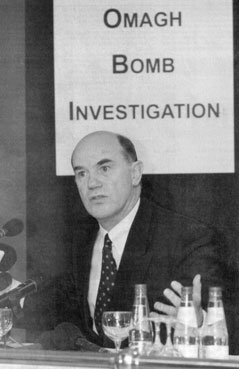
SIR RONNIE DEFENDS HIS INVESTIGATION
Sir Ronnie defends his investigation
BY ROSETTA DONNELLY
THE Police Service of Northern Ireland came to Omagh on Thursday last to give its detailed response to the Ombudsman's Nuala O'Loan's highly critical report into the police investigation of the Omagh bomb.
Chief Constable Ronnie Flanagan steam-rolled into town with an entourage of police officers and experts - enough to daunt the bravest of souls.
The meeting was chaired by Victims Commissioner Sir Kenneth Bloomfield and was attended by senior officers from An Garda Siochana, Deputy Commissioner Kevin Carthy and Chief Superintendent Tadgh Sullivan.
During the five-hour meeting with the families, Ronnie Flanagan attempted to restore confidence in the Omagh bomb inquiry amid a background of increasing concern over the police handling of the investigation.
Sir Ronnie delivered his widely leaked reply to Mrs O'Loan's highly critical report , claiming it "has done a grave disservice, and caused great hurt, to the PSNI and to individual officers within it, and has inflicted unnecessary grief and anxiety on the relatives of those murdered at Omagh and those injured". Sir Ronnie defended assessments of two warnings prior to the 1998 Real IRA attack including that of a former agent, who uses the pseudonym Kevin Fulton. He said the failure of the Force Intelligence Bureau, to pass on details of two of the five meetings to Special Branch over information received by the former agent "represented an unacceptable breakdown in procedures".
Speaking after a meeting with relatives, which he described as "sombre", Sir Ronnie continued to defend the actions of his officers and the handling of information prior and after the bombing and insisted his response was not an attempt at "damage limitation".
"It was not about defending any one person or reputation. It was not about defending a reputation of an organisation, it was about giving victims information on which they can hopefully begin in a measured way and a calm, reflective way, to make judgments," he said.
As expected, Sir Ronnie announced the appointment of a senior detective from Merseyside police to act as an adviser in the inquiry, who will oversee the implementation of recommendations in the internal RUC review. That review by Chief Superintendent Brian McVicker uncovered serious flaws in the investigation.
"A review is not something that stands absolutely apart from an ongoing investigation but is an equal part of that ongoing investigation," Sir Ronnie said.
"From the documentation I have provided to the Police Board, to the secretary of state, to the ombudsman and indeed to the victims today, it covers the points that action was taken and continues to be taken in terms of the recommendations in the review report, conducted by Mr McVicker.
"Mr McVicker is a very experienced officer and came up with a whole range of recommendations which either had been acted upon, are being acted upon or will be acted upon. They will all be addressed and one of the things I am doing is bringing in an adviser to the current senior investigating officer, a very experienced detective from Merseyside and the remit that officer will have and whatever team he decides he needs will include ensuring that all the issues raised in the review report are properly and fully addressed."
In relation to families' suspicions over whether Fulton's tip-off of an imminent Real IRA attack just days before the bombing and a second warning of a gun and rocket attack in Omagh on August 15 were properly assessed, he said: "That is absolutely natural and absolutely understandable. I guess I would feel the same way if I were in there position. So I never expected that in terms of being able to offer that reassurance that people need today and in the afternoon.
"But as the investigation goes on and I will keep in continuous contact with them, I hope that they will come to feel that sense of reassurance.
"I was there that day, I want nothing more than to bring to justice those who committed this terrible crime.
"The sadness is of course we know who committed this crime, so some of the other suggestions about who should be elevated to firm suspects don't actually fit into the degree of knowledge that we have. What we need to do is find the evidence and we are still progressing forensically in that direction.
"Of course we need public support and there are people out there who know exactly who carried out the atrocity.
"It is wrong to conclude we will probably never get these people. This investigation is not without hope." Sir Ronnie dismissed claims that a book detailing threatened paramilitary attacks - had mysteriously disappeared from the top drawer of a senior officer's desk during the internal
review of the Omagh investigation.
"I don't think it ever existed for that year quite frankly. The current threat book that applies to Omagh came into existence in March 1999..
"The current book dates from March 1999, our own internal review commenced in April 2000, the ombudsman investigation commenced in August last year in 2001, so to suggest that this was missing in suspicious circumstances is absolutely wrong.
"What we have found since in looking at that and in the district commander in having time to reflect is that the system of creating a threat book came into being only after an instruction issued by his chief inspector in Omagh in December 1998. Up to that point ,they handled the threats on an action sheet by action sheet basis and brief accordingly."
Speaking afterwards, Mr Flanagan claimed that the meeting of the victims "was the most important day" of his life. He said he was there to see the people who really mattered in the investigation.
BY ROSETTA DONNELLY
THE Police Service of Northern Ireland came to Omagh on Thursday last to give its detailed response to the Ombudsman's Nuala O'Loan's highly critical report into the police investigation of the Omagh bomb.
Chief Constable Ronnie Flanagan steam-rolled into town with an entourage of police officers and experts - enough to daunt the bravest of souls.
The meeting was chaired by Victims Commissioner Sir Kenneth Bloomfield and was attended by senior officers from An Garda Siochana, Deputy Commissioner Kevin Carthy and Chief Superintendent Tadgh Sullivan.
During the five-hour meeting with the families, Ronnie Flanagan attempted to restore confidence in the Omagh bomb inquiry amid a background of increasing concern over the police handling of the investigation.
Sir Ronnie delivered his widely leaked reply to Mrs O'Loan's highly critical report , claiming it "has done a grave disservice, and caused great hurt, to the PSNI and to individual officers within it, and has inflicted unnecessary grief and anxiety on the relatives of those murdered at Omagh and those injured". Sir Ronnie defended assessments of two warnings prior to the 1998 Real IRA attack including that of a former agent, who uses the pseudonym Kevin Fulton. He said the failure of the Force Intelligence Bureau, to pass on details of two of the five meetings to Special Branch over information received by the former agent "represented an unacceptable breakdown in procedures".
Speaking after a meeting with relatives, which he described as "sombre", Sir Ronnie continued to defend the actions of his officers and the handling of information prior and after the bombing and insisted his response was not an attempt at "damage limitation".
"It was not about defending any one person or reputation. It was not about defending a reputation of an organisation, it was about giving victims information on which they can hopefully begin in a measured way and a calm, reflective way, to make judgments," he said.
As expected, Sir Ronnie announced the appointment of a senior detective from Merseyside police to act as an adviser in the inquiry, who will oversee the implementation of recommendations in the internal RUC review. That review by Chief Superintendent Brian McVicker uncovered serious flaws in the investigation.
"A review is not something that stands absolutely apart from an ongoing investigation but is an equal part of that ongoing investigation," Sir Ronnie said.
"From the documentation I have provided to the Police Board, to the secretary of state, to the ombudsman and indeed to the victims today, it covers the points that action was taken and continues to be taken in terms of the recommendations in the review report, conducted by Mr McVicker.
"Mr McVicker is a very experienced officer and came up with a whole range of recommendations which either had been acted upon, are being acted upon or will be acted upon. They will all be addressed and one of the things I am doing is bringing in an adviser to the current senior investigating officer, a very experienced detective from Merseyside and the remit that officer will have and whatever team he decides he needs will include ensuring that all the issues raised in the review report are properly and fully addressed."
In relation to families' suspicions over whether Fulton's tip-off of an imminent Real IRA attack just days before the bombing and a second warning of a gun and rocket attack in Omagh on August 15 were properly assessed, he said: "That is absolutely natural and absolutely understandable. I guess I would feel the same way if I were in there position. So I never expected that in terms of being able to offer that reassurance that people need today and in the afternoon.
"But as the investigation goes on and I will keep in continuous contact with them, I hope that they will come to feel that sense of reassurance.
"I was there that day, I want nothing more than to bring to justice those who committed this terrible crime.
"The sadness is of course we know who committed this crime, so some of the other suggestions about who should be elevated to firm suspects don't actually fit into the degree of knowledge that we have. What we need to do is find the evidence and we are still progressing forensically in that direction.
"Of course we need public support and there are people out there who know exactly who carried out the atrocity.
"It is wrong to conclude we will probably never get these people. This investigation is not without hope." Sir Ronnie dismissed claims that a book detailing threatened paramilitary attacks - had mysteriously disappeared from the top drawer of a senior officer's desk during the internal
review of the Omagh investigation.
"I don't think it ever existed for that year quite frankly. The current threat book that applies to Omagh came into existence in March 1999..
"The current book dates from March 1999, our own internal review commenced in April 2000, the ombudsman investigation commenced in August last year in 2001, so to suggest that this was missing in suspicious circumstances is absolutely wrong.
"What we have found since in looking at that and in the district commander in having time to reflect is that the system of creating a threat book came into being only after an instruction issued by his chief inspector in Omagh in December 1998. Up to that point ,they handled the threats on an action sheet by action sheet basis and brief accordingly."
Speaking afterwards, Mr Flanagan claimed that the meeting of the victims "was the most important day" of his life. He said he was there to see the people who really mattered in the investigation.
Further Information
Publisher: ULSTER HERALD
Ref: UH/0944
Published Date: 31-Jan-02
Related Images