PROVIDING SUPPORT FOR GRIEF AND A VOICE FOR JUSTICE
Providing support for grief and a voice for justice
ROSETTA DONNELLY REPORTS
The media in its mass can be intimidating prospect for any person and the intensity of media interest in last week's events in Omagh showed a polished performance by the Omagh Victim Support Group. The group, with Micheal Gallagher as its chairman, has come a long way from the days following the bomb.
In the aftermath of the worst single atrocity of the Troubles, the bereaved relatives shared little beyond their pain, grief and shock.
Those killed and injured in the Omagh bomb came from a wide cross-section of the community social, cultural, political and religious. Some of them even were visitors to these shores, caught by a freak chance in a devastating horror in a bustling Irish country town they happened upon during a sunny summer afternoon.
To begin to provide a voice for the bereaved relatives was always going to be difficult. Not only did they barely know one another after the initial trauma, their grief was expressed in widely different ways.
There was the absolute need for many families to keep reminding the world of the atrocity in Omagh in the hope of bringing the bombers to justice. Opposing this was the absolute desire by the majority of families who wanted to grieve quietly for their loved ones and refrain completely from speaking to the media.
It was right that each group should be allowed to do whatever it feels comfortable with and few could level any criticism at any of these approaches.
Yet, such was the extent of the media interest in the families of those killed and injured in the 1998 outrage, the Sperrin Lakeland Trust set up an intermediary who liaised with the media and advised on who was and who was not willing to talk.
PUBLIC FACE
Over the years, a few people associated with the Omagh Victims Support Group have emerged as the public faces of the Omagh families - Michael Gallagher, Stanley McCombe, Marian Radford, Lawrence Rush and Kevin Skelton. But even they do not always speak as one.
Lawrence Rush, who is regarded as a bit of maverick, is credited with fighting imaginatively and pugnaciously for the Omagh case.
When speaking to the media he almost always states that he is not speaking for the group. However, his comments are often reported incorrectly as representing those of the others in the group.
This can lead to disagreement amongst the families over how the media, and consequently the rest of the world, views them.
Following the explosion, the UlsterHerald was contacted by some families who said the Omagh Victims Support Group represented only some of the families of those killed and injured.
Whilst there might be differences among the families over what is said by those who front the group, most will acknowledge their valuable contribution to all the bereaved. By having these people at the front, it means the media will leave the other families who do not want the limelight.
Michael Gallagher, who has been trying to stand down as chairman of the Victim Support group, says he fully appreciates the difficulty of the families who are not members of the group.
The Victims Support Group has only received �4,000 in funding over the past three years and, therefore, it has no full-time staff or professional advisors to cater for everyone's needs.
The support group is also busy bringing a civil suit against those named as the suspect bombers in the BBC Panorama programme of November 2000 and Michael said this can be tiring in the extreme.
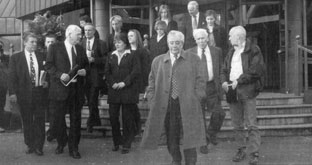
Last week, outside Dublin's Special Criminal Court, Michael and the other members gave a measured response to the 14-year sentence handed down to Colm Murphy. There was no jubilation, no bitter recrimination. The divergent views of the group were expressed in a unifying way. It was a measure of how adept they have become in pursuing their united aim the truth and justice for their lost loved ones.
Yet with some of the country's most critical journalists analysing their every word and nuance, press conferences are a daunting prospect.
Michael said he was drained after the Dublin briefing and one of the most exhausting weeks of his life.
"I felt as if I had been digging ditches the whole way to Dublin, I was that tired," he said.
Yet even then, there was no lull after the storm. When he spoke to the UlsterHerald on Tuesday, Michael was in London setting off to do a round of media interviews, including breakfast time GMTV, to highlight the civil suit they are bringing against the Real IRA suspects.
ROSETTA DONNELLY REPORTS
The media in its mass can be intimidating prospect for any person and the intensity of media interest in last week's events in Omagh showed a polished performance by the Omagh Victim Support Group. The group, with Micheal Gallagher as its chairman, has come a long way from the days following the bomb.
In the aftermath of the worst single atrocity of the Troubles, the bereaved relatives shared little beyond their pain, grief and shock.
Those killed and injured in the Omagh bomb came from a wide cross-section of the community social, cultural, political and religious. Some of them even were visitors to these shores, caught by a freak chance in a devastating horror in a bustling Irish country town they happened upon during a sunny summer afternoon.
To begin to provide a voice for the bereaved relatives was always going to be difficult. Not only did they barely know one another after the initial trauma, their grief was expressed in widely different ways.
There was the absolute need for many families to keep reminding the world of the atrocity in Omagh in the hope of bringing the bombers to justice. Opposing this was the absolute desire by the majority of families who wanted to grieve quietly for their loved ones and refrain completely from speaking to the media.
It was right that each group should be allowed to do whatever it feels comfortable with and few could level any criticism at any of these approaches.
Yet, such was the extent of the media interest in the families of those killed and injured in the 1998 outrage, the Sperrin Lakeland Trust set up an intermediary who liaised with the media and advised on who was and who was not willing to talk.
PUBLIC FACE
Over the years, a few people associated with the Omagh Victims Support Group have emerged as the public faces of the Omagh families - Michael Gallagher, Stanley McCombe, Marian Radford, Lawrence Rush and Kevin Skelton. But even they do not always speak as one.
Lawrence Rush, who is regarded as a bit of maverick, is credited with fighting imaginatively and pugnaciously for the Omagh case.
When speaking to the media he almost always states that he is not speaking for the group. However, his comments are often reported incorrectly as representing those of the others in the group.
This can lead to disagreement amongst the families over how the media, and consequently the rest of the world, views them.
Following the explosion, the UlsterHerald was contacted by some families who said the Omagh Victims Support Group represented only some of the families of those killed and injured.
Whilst there might be differences among the families over what is said by those who front the group, most will acknowledge their valuable contribution to all the bereaved. By having these people at the front, it means the media will leave the other families who do not want the limelight.
Michael Gallagher, who has been trying to stand down as chairman of the Victim Support group, says he fully appreciates the difficulty of the families who are not members of the group.
The Victims Support Group has only received �4,000 in funding over the past three years and, therefore, it has no full-time staff or professional advisors to cater for everyone's needs.
The support group is also busy bringing a civil suit against those named as the suspect bombers in the BBC Panorama programme of November 2000 and Michael said this can be tiring in the extreme.
Last week, outside Dublin's Special Criminal Court, Michael and the other members gave a measured response to the 14-year sentence handed down to Colm Murphy. There was no jubilation, no bitter recrimination. The divergent views of the group were expressed in a unifying way. It was a measure of how adept they have become in pursuing their united aim the truth and justice for their lost loved ones.
Yet with some of the country's most critical journalists analysing their every word and nuance, press conferences are a daunting prospect.
Michael said he was drained after the Dublin briefing and one of the most exhausting weeks of his life.
"I felt as if I had been digging ditches the whole way to Dublin, I was that tired," he said.
Yet even then, there was no lull after the storm. When he spoke to the UlsterHerald on Tuesday, Michael was in London setting off to do a round of media interviews, including breakfast time GMTV, to highlight the civil suit they are bringing against the Real IRA suspects.
Further Information
Publisher: ULSTER HERALD
Ref: UH/0939
Published Date: 31-Jan-02
Related Images