DEFYING DISABILITY TO SERVE
Defying disability to serve
BY: ADRIAN MULLAN
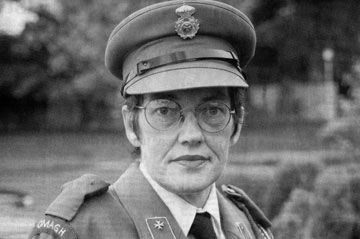
You could be forgiven for thinking that Denise Hughes is a dynamo; she's an adjutant with the Order of Malta, Deputy Officer in-charge and is responsible for that organisation's public relations for the Omagh area. However, all that activity belies the fact that Denise is fighting a crippling condition known as Sympathetic Nerve Damage which severely limits her physical activity.
Sometimes the pain is so bad that she has to receive a spinal injection for relief, but none of that can alter the fact that Denise was born to care for others.
DENISE HUGHES
UP CLOSE AND PERSONAL
NAME: Denise Anne Hughes HOME: Creggan Park, Omagh
FAVOURITE GENRE OF BOOKS: "I like murder mysteries by authors like Patricia Cornwell, James Herbert and Paul Eddy."
FONDEST MEMORIES: The births of my children."
PERSON WHO MOST INFLUENCED YOU: Consultant Frances Robinson in the Pain Clinic at the County Hospital. She has shown me the light at the end of the tunnel. It was she who got me out of the wheelchair and back on my feet. When I have severe pain that drugs will not ease, she brings me in for a spinal injection.
HOLIDAY DESTINATION: We'd go to Whitby in Yorkshire. It's an old and a new town, where Dracula landed. Whereever you go, they have mobility shops; you can get a loan of a wheelchair. I can only walk for short periods of time
As a child growing in in Ballymagorry, Strabane the then Denise Devine had the happiest of times. One of a family of five here was never any shortage of home made fun. Between walking on stilts made out of pea or bean cans (made by her father), to collecting berries, or teasing neighbours by tying thread to their door knockers and giving the phantom knock there was little time to be bored.
At other times, Denise played with her friends by the waterfall at the old mill or swung on a tyre tied to a tree beside the burn. Every Halloween, her father built a bonfire and her mother would bake wonderful fare for the occasion. And every Friday evening, her mother would regale them with ghost stories and old folklore.
Denise was an accident prone child with a severe stammer. Sometimes her mother despaired at the number of times she'd have to be taken to hospital. Indeed, on one occasion, her mother told her, "If you fall again, be sure it's into an ambulance." She couldn't believed it when, a few days later, Denise was ferried home by ambulance after breaking her arm.
At her Primary School in Cloghcor, she earned a beating from the teacher when, instead of saying a poem about Our Lady for the visiting ecclesiastical inspector, Denise instead gave a rendition of, "My auntie Mary had a canary up the leg of drawers..."
School life was strict but enjoyable and Denise excelled at art and drama. During those classes, her stammer which she thinks held her back to some extend at school wasn't really a factor.
From her earliest days, she wanted to be a nurse. It was a vocation she was to pursue relentlessly and even at the age of ten she joined the St John's Ambulance Service in Strabane and remained with them until she was 18.
As an adult her caring vocation took her into the nursing profession and Denise trained both as a general and psychiatric nurse. Though she nursed in hospitals all over the North, she finished her "working life" as a nurse in the Tyrone and Fermanagh Hospital.
Nursing at the height of the Troubles, she saw sights that would cause anyone's blood to run cold. However the most distressing experience for her was having to stand helplessly by three young men burned to death in a van following a road accident.
"I was working in the Accident and Emergency Department one Christmas Eve. In those days, nurses went out with the ambulance there were no paramedics. We were called to a field in Ballymena where a red van had crashed and caught fire. The three men inside were trapped and screaming to get out. We had to stand back because our lives would have been in danger I still think about that."
Another time that stands out was when a child was brought into the Casualty Unit in Ballymena haven taken Dijoxin, a drug to slow the heart. She was given the antidote immediately but had absorbed the drug into her system and died in the middle of the night.She was just three years old.
However, it wasn't all sorrow and heartbreak and when working as a psychiatric nurse Denise experienced great job satisfaction when she was able to combine her general and psychiatry training to "treat the whole body".
"Under the old Mental Health Act, it was lovely being able to nurse clients back to normality."
Care in the Community altered things immeasurably and says Denise while it was good in the sense that people who were previously put into the institution and forgotten about now have their cases reviewed every two years. Yet it also means that sometimes people's conditions can deteriorate without anyone noticing.
Under the old Mental Health Act people were institutionalised for a wide range of reasons, not all of them related to a person's mental health. Some people were put in psychiatric institutions for becoming pregnant out of wedlock, or for conditions such as epilepsy.
When it came to moving geriatric staff from the hospital to the nursing homes, Denise and her colleagues fought for the rights of the elderly people, many of whom had no families of their own.
"As nurses, we tried to stand up for them. We said that they had rights under the Patients' Charter. Many of them had come to regard nurses and other staff members as their family."
Denise took the fight further and when the new Mental Health Act came in she lobbied management for the creation of a garden at the hospital for elderly clients. After plaguing the management they finally conceded the garden which was created at a cost of £10,000. However, two years later the ward was closed.
As a psychiatric nurse, she did witness occasional violations of patients rights in the mid 1970s and she remarks, "Things have changed now in psychiatric care compared with what it was like years ago."
Denise says that nurses also experienced violence against them but adds that a good nurse would understand that it was the mental state of the client that was responsible for such behaviour.
Indeed, she was one of the last nurses to put a patient into a straight-jacket before such items became obsolete, under changes in the Mental Health laws.
"This was a way of protecting both the client and the staff from harm and anyone who was put in a straight-jacket had a 24-hour watch on them."
Denise met her her husband John in 1973 and it was love at first sight. She was sitting at the canteen of the Tyrone and Fermanagh along with some of her colleagues when John Hughes walked in.
"I didn't even know his name but I said to my colleagues 'I'm going to marry him.' They said 'What if he's married or engaged already? I said, well, if he's married, that's that. If he's engaged, lots of engagements break off"
As it transpired John was neither married nor engaged at the time and he and Denise were engaged and married within 18 months.
However, before they were married John's aunts Molly and Annie Hughes, who were from a distinguished old Omagh family, had to give Denise the once-over. She met with the family's approval and the couple were married and moved to Antrim where John had just secured a job with Enkalon.
They stayed in Antrim for ten years, during which time Denise worked in Ballymena's Masarene Hospital and Hollywell Hospital.
The couple have three children Sharon, 25, who has followed in her mother's footsteps and has just qualified as a Registered General Nurse, Catherine 21, who is in her final year at Jon Moore's University Liverpool, studying biomedical science and Christopher, who is 13 and attends Drumragh College.
"When I came back to Omagh, I took a virus one weekend and had a late baby. The doctor's thought I had a virus but I was actually expecting a child. So we nicknamed him 'virus' and I was called a 'geriatric mother'."
Denise took up with the Order of Malta 12 year ago as a volunteer and has gone through the rank since.
A voluntary organisation, she points out that last year the Order gave 6,000 man hours to the community. The Omagh unit was formed in 1963 and has come to the aid of the community on many occasions
Indeed, during Omagh's darkest hour, the 1998 bombing, the Order of Malta were on hand to provide care and assistance.
Denise remembers the day of the bomb "The Order were on duty in Glaslough at the other side of Monaghan but, as soon as they got permission to stand down, they went to Omagh."
"Upon arrival we set up a field hospital at Omagh Leisure Centre dealing with minor injuries and giving support to families before they went to the next stage counselling, prior to identifying the remains of loved ones."
Similarly, at Glaslough two years ago, when two motorcyclists were killed and a third was critically injured, the Order was on hand to give what assistance it could.
Says Denise, "We were very very proud at how well our members managed on that tragic occasion
The level of training of the Order's staff has surprised many, including the UTV team who came to film a programme about the information which emerged from a recent training video.
"They thought we just dealt with cuts and bruises I informed them of the major range of injuries that we do deal with."
In fact, throughout Ireland, the Order of Malta has staff trained from basic First Aid level to that of EM level.
Since the onset of her illness, the Order has been a lifeline to Denise, who spent two years in a wheel-chair. These days her involvement is more limited to management type duties.
It is now seven years since she was first afflicted with her illness and though it has dramatically affected the quality of her life Denise refuses to give in to it.
"I have resigned myself to the fact that I will never work again and that was hard. But I'm not brain dead. I have a lot of knowledge that I can pass on in terms of teaching, training and in PR."
Further Information
Related Images