OUT OF THE FRYING PAN ..
Out of the frying pan
BY: NIGEL MCDONAGH
The job of a firefighter can be one of the most dangerous in the world a fact devastatingly reinforced by the horrific terrorist attacks on New York last month. On September 11, hundreds of brave firefighters perished while attempting to save the lives of people trapped in the World Trade Centre buildings.
The Northern Ireland Fire Service can certainly empathise with its colleagues in New York having to contend with terrorist attacks, not to mention the usual fire incidents and road accidents, during the 30 years of the Troubles.
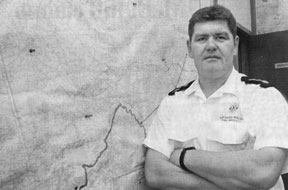
One man who knows all about the risks and perils involved with being a firefighter here is John Langtry, the Assistant District Commander for the Omagh District and who helped direct the rescue operation on that terrible day in August 15, 1998 when a Real IRA car bomb detonated in Omagh.
Born and bred in Bangor Co Down, John Langtry has been in the Fire Service for most of his adult life since he joined as a fresh faced 20-year old.
Surprisingly, John admits that he harboured no ambitions whatsoever to become a firefighter as a youngster and was only prompted to join following a suggestion by his mother.
"I was never a wee Fireman Sam wearing a helmet and shouting 'nee-naw' when I was young. When I see them out there now I think to myself I really was just not like that at all.
"Half of my family were teachers and half were doctors or dentists and my great ambition was to be something in the medical profession, but it just didn't work out," says John.
Prior to joining the Fire Service John worked as a rep for a wine and spirit firm. But it was the tragic death of a work colleague that eventually led to his career in the Fire Service.
"Wine at that stage was kicking off and was the new 'Rock n' Roll' and we were making inroads into it.
"I had formed a partnership with a colleague from the wine firm but unfortunately he was killed in a road accident and I wasn't able to continue on my own. So it was then that I joined the Fire Brigade," he says.
John initially enlisted for a year as a temporary measure. He intended to leave but soon found that he enjoyed the work and he joined full-time in 1981 at the age of 21.
His first posting was certainly a 'baptism of fire' (if you'll excuse the pun) as he was sent to a station in a highly volatile part of Belfast that was subsequently blown up on three occasions. Central Station was then situated on the corner of Chichester Street and Oxford Street facing the Law Courts which were obviously a prime target for bombers.
"That particular period was not exactly at the height of the Troubles, unlike the early 70s which was a really nasty time to be a firefighter, but there were still plenty of incidents going on in Belfast from bombing buildings to bombing people in cars," reveals John.
"The station itself was bombed three times when I was there which was pretty hectic. We had a special bomb alert and whenever that sounded you dropped down the stairs and got out through the back gate as quickly as you could," he adds.
Not only did John and his colleagues have to contend with bomb attacks but, because Central Station was so precariously close to security buildings, they sometimes found themselves caught up in a crossfire between gunmen and the police and army.
It is hard to imagine how you would cope working in such a threatening and hazardous environment, but John says that youth helped him to 'brush aside things like that'. Although, looking back, memories of such incidents can still give him pause for thought.
"Certainly at the time I would have been worried for my life, but youth is helpful and you tend to laugh off these things a lot easier when you're younger. But it didn't stop us from doing our job.
"However, when you are older with a family and responsibilities, perhaps you think about things a bit deeper and maybe see the bigger picture and how differently things could have turned out," he says.
The experience and knowledge of his senior colleagues was of tremendous benefit to John during those early days in Belfast where he describes the 'Watch' at Central as first class with excellent camaraderie and teamwork.
Yet nothing but personal experience would prepare him for the awful scenes of human death and injury resulting from road accidents and Fires which, he admits, are unfortunate ordeals that firefighters have to cope with on a regular basis.
"I think what you find across the services is that we go to do a job and do it to the best of our ability and, if someone has died or is seriously injured before we got there, then we do what we can to deal with them in a compassionate manner.
"The ultimate goal is to get there and save someone's life and that is a situation we find ourselves in practically on a daily basis, particularly with road accidents," says John.
"Every incident like that brings its own measure of experience for firefighters who are exposed to some very unpleasant scenes. But at the time, there is a job to be done and you get on and do it. Being busy like that helps you get through it and it's really only afterwards when you stop and think about it," he adds.
After 11 years as a firefighter in Belfast, John moved up through the ranks and was promoted to Station Officer in the Fire Safety Department.
In 1991, he move back to his hometown of Bangor where his new role gave him responsibility for ensuring fire safety in buildings throughout the north and south areas of Co. Down.
Three years later, John was promoted to District Officer for Omagh where he was responsible for fire safety, training, water supply and operational matters for the Omagh and Newtownstewart stations and surrounding areas.
He was joined by his wife and daughters the following year in 1995 and the family bought a home and settled in Omagh.
During his time in Belfast, John witnessed the aftermath of many violent incidents resulting from the Troubles, including a young man being blown up in his car.
But the scenes and scale of carnage he witnessed in Omagh on August 15 1998 when a Real IRA car bomb exploded killing 29 people and two unborn babies and injuring hundreds more were by far the most horrific.
John was off-duty when the bomb detonated, yet he was on the scene within five minutes of the initial explosion. At that stage a fire crew from Omagh had arrived and John immediately took command before the subsequent arrival of a more senior officer.
"Our primary role that day was search and rescue and I was in command of one side of the street clearing the buildings and searching for casualties. There was a lot of First Aid needed to be done and a lot of casualties to be ferried and we had to fight the fires and free those that had to be cut out.
"Because of the enormity of the task that we faced and the initial limits to our personnel we needed to pull ourselves back from what was going on and concentrate on those roles," recalls John.
"Going up and down through that street you were checking people and people were trying to stop you for First Aid. Everyone has seen the TV footage and knows the terrible scale of the situation.
"The firefighters did such a magnificent job that day considering they knew people involved and for them to stick to their task made me very proud of them," he adds.
John admits that the Omagh bomb had a major and lasting impact on both himself and his colleagues to the extent, that some firefighters left the service.
"You can't come through an incident like that and remain unchanged and I think one of the ways it would have changed me is that it has made me mort compassionate.
"A lot of people go through life not really worried about what is ahead of them but we would see death sometimes on a daily basis and would perhaps be more aware that life can be short. Basically, you make the most of the time you have and I think the Omagh incident was one that reinforced that," he says.
Away from the pressures of the Fire Service, John still remains active and likes to relax by playing golf doing a bit of sailing, taking his golden retriever for walks in the countryside and playing the guitar badly
But his main passion has always been rugby a passion born from his days as a schoolboy in Bangor during which he played for the Ulster Schoolboys squad.
"I've been playing since I was eleven and rugby has been a big part of my life for the past 25 years. I have trained as a rugby coach and certainly hope to remain involved in the sport for quite a few years yet," he says.
John has recently added yet another string to his bow in the form of an Open University degree and, after six years of study, he graduated this year with a First Class Honours in Psychology.
An area of interest for him, John has been gathering research into "people's behaviour to fires" and is currently contemplating undertaking a Master's in that field with the view of helping to further his career in the Fire Service which he reluctantly admits will probably mean leaving Omagh.
His present role within the Fire Service may not allow him to get as much hands on involvement as he used to but John gets a tremendous amount of satisfaction from other areas of responsibility such as taking command of his firefighters and in particular, educating children on fire safety.
"Children really do take the message in and it's really satisfying when I go back to youth organisations and find that the children there have remembered what I have told them two to three years before and can give it straight back," he says.
The esteem and high regard he holds for his profession is such that John would have no qualms about encouraging his daughters to join the Fire Service if they so wished.
"The commitment and dedication that firefighters have and the responsibility and skills they develop is first class and those four aspects are useful in life no matter what you do. I would have no hesitation in recommending the Fire Service as a career to anyone," says John.
And is there any truth in the ancient myth that firefighters tend to have a lot of success with females?
"When I joined the Service I had already met my wife Leslie so I don't really know. But there may be some other firefighters who would use it as a point of interest let's say," he laughs.
BY: NIGEL MCDONAGH
The job of a firefighter can be one of the most dangerous in the world a fact devastatingly reinforced by the horrific terrorist attacks on New York last month. On September 11, hundreds of brave firefighters perished while attempting to save the lives of people trapped in the World Trade Centre buildings.
The Northern Ireland Fire Service can certainly empathise with its colleagues in New York having to contend with terrorist attacks, not to mention the usual fire incidents and road accidents, during the 30 years of the Troubles.
One man who knows all about the risks and perils involved with being a firefighter here is John Langtry, the Assistant District Commander for the Omagh District and who helped direct the rescue operation on that terrible day in August 15, 1998 when a Real IRA car bomb detonated in Omagh.
Born and bred in Bangor Co Down, John Langtry has been in the Fire Service for most of his adult life since he joined as a fresh faced 20-year old.
Surprisingly, John admits that he harboured no ambitions whatsoever to become a firefighter as a youngster and was only prompted to join following a suggestion by his mother.
"I was never a wee Fireman Sam wearing a helmet and shouting 'nee-naw' when I was young. When I see them out there now I think to myself I really was just not like that at all.
"Half of my family were teachers and half were doctors or dentists and my great ambition was to be something in the medical profession, but it just didn't work out," says John.
Prior to joining the Fire Service John worked as a rep for a wine and spirit firm. But it was the tragic death of a work colleague that eventually led to his career in the Fire Service.
"Wine at that stage was kicking off and was the new 'Rock n' Roll' and we were making inroads into it.
"I had formed a partnership with a colleague from the wine firm but unfortunately he was killed in a road accident and I wasn't able to continue on my own. So it was then that I joined the Fire Brigade," he says.
John initially enlisted for a year as a temporary measure. He intended to leave but soon found that he enjoyed the work and he joined full-time in 1981 at the age of 21.
His first posting was certainly a 'baptism of fire' (if you'll excuse the pun) as he was sent to a station in a highly volatile part of Belfast that was subsequently blown up on three occasions. Central Station was then situated on the corner of Chichester Street and Oxford Street facing the Law Courts which were obviously a prime target for bombers.
"That particular period was not exactly at the height of the Troubles, unlike the early 70s which was a really nasty time to be a firefighter, but there were still plenty of incidents going on in Belfast from bombing buildings to bombing people in cars," reveals John.
"The station itself was bombed three times when I was there which was pretty hectic. We had a special bomb alert and whenever that sounded you dropped down the stairs and got out through the back gate as quickly as you could," he adds.
Not only did John and his colleagues have to contend with bomb attacks but, because Central Station was so precariously close to security buildings, they sometimes found themselves caught up in a crossfire between gunmen and the police and army.
It is hard to imagine how you would cope working in such a threatening and hazardous environment, but John says that youth helped him to 'brush aside things like that'. Although, looking back, memories of such incidents can still give him pause for thought.
"Certainly at the time I would have been worried for my life, but youth is helpful and you tend to laugh off these things a lot easier when you're younger. But it didn't stop us from doing our job.
"However, when you are older with a family and responsibilities, perhaps you think about things a bit deeper and maybe see the bigger picture and how differently things could have turned out," he says.
The experience and knowledge of his senior colleagues was of tremendous benefit to John during those early days in Belfast where he describes the 'Watch' at Central as first class with excellent camaraderie and teamwork.
Yet nothing but personal experience would prepare him for the awful scenes of human death and injury resulting from road accidents and Fires which, he admits, are unfortunate ordeals that firefighters have to cope with on a regular basis.
"I think what you find across the services is that we go to do a job and do it to the best of our ability and, if someone has died or is seriously injured before we got there, then we do what we can to deal with them in a compassionate manner.
"The ultimate goal is to get there and save someone's life and that is a situation we find ourselves in practically on a daily basis, particularly with road accidents," says John.
"Every incident like that brings its own measure of experience for firefighters who are exposed to some very unpleasant scenes. But at the time, there is a job to be done and you get on and do it. Being busy like that helps you get through it and it's really only afterwards when you stop and think about it," he adds.
After 11 years as a firefighter in Belfast, John moved up through the ranks and was promoted to Station Officer in the Fire Safety Department.
In 1991, he move back to his hometown of Bangor where his new role gave him responsibility for ensuring fire safety in buildings throughout the north and south areas of Co. Down.
Three years later, John was promoted to District Officer for Omagh where he was responsible for fire safety, training, water supply and operational matters for the Omagh and Newtownstewart stations and surrounding areas.
He was joined by his wife and daughters the following year in 1995 and the family bought a home and settled in Omagh.
During his time in Belfast, John witnessed the aftermath of many violent incidents resulting from the Troubles, including a young man being blown up in his car.
But the scenes and scale of carnage he witnessed in Omagh on August 15 1998 when a Real IRA car bomb exploded killing 29 people and two unborn babies and injuring hundreds more were by far the most horrific.
John was off-duty when the bomb detonated, yet he was on the scene within five minutes of the initial explosion. At that stage a fire crew from Omagh had arrived and John immediately took command before the subsequent arrival of a more senior officer.
"Our primary role that day was search and rescue and I was in command of one side of the street clearing the buildings and searching for casualties. There was a lot of First Aid needed to be done and a lot of casualties to be ferried and we had to fight the fires and free those that had to be cut out.
"Because of the enormity of the task that we faced and the initial limits to our personnel we needed to pull ourselves back from what was going on and concentrate on those roles," recalls John.
"Going up and down through that street you were checking people and people were trying to stop you for First Aid. Everyone has seen the TV footage and knows the terrible scale of the situation.
"The firefighters did such a magnificent job that day considering they knew people involved and for them to stick to their task made me very proud of them," he adds.
John admits that the Omagh bomb had a major and lasting impact on both himself and his colleagues to the extent, that some firefighters left the service.
"You can't come through an incident like that and remain unchanged and I think one of the ways it would have changed me is that it has made me mort compassionate.
"A lot of people go through life not really worried about what is ahead of them but we would see death sometimes on a daily basis and would perhaps be more aware that life can be short. Basically, you make the most of the time you have and I think the Omagh incident was one that reinforced that," he says.
Away from the pressures of the Fire Service, John still remains active and likes to relax by playing golf doing a bit of sailing, taking his golden retriever for walks in the countryside and playing the guitar badly
But his main passion has always been rugby a passion born from his days as a schoolboy in Bangor during which he played for the Ulster Schoolboys squad.
"I've been playing since I was eleven and rugby has been a big part of my life for the past 25 years. I have trained as a rugby coach and certainly hope to remain involved in the sport for quite a few years yet," he says.
John has recently added yet another string to his bow in the form of an Open University degree and, after six years of study, he graduated this year with a First Class Honours in Psychology.
An area of interest for him, John has been gathering research into "people's behaviour to fires" and is currently contemplating undertaking a Master's in that field with the view of helping to further his career in the Fire Service which he reluctantly admits will probably mean leaving Omagh.
His present role within the Fire Service may not allow him to get as much hands on involvement as he used to but John gets a tremendous amount of satisfaction from other areas of responsibility such as taking command of his firefighters and in particular, educating children on fire safety.
"Children really do take the message in and it's really satisfying when I go back to youth organisations and find that the children there have remembered what I have told them two to three years before and can give it straight back," he says.
The esteem and high regard he holds for his profession is such that John would have no qualms about encouraging his daughters to join the Fire Service if they so wished.
"The commitment and dedication that firefighters have and the responsibility and skills they develop is first class and those four aspects are useful in life no matter what you do. I would have no hesitation in recommending the Fire Service as a career to anyone," says John.
And is there any truth in the ancient myth that firefighters tend to have a lot of success with females?
"When I joined the Service I had already met my wife Leslie so I don't really know. But there may be some other firefighters who would use it as a point of interest let's say," he laughs.
Further Information
Publisher: ULSTER HERALD
Ref: UH/0854
Published Date: 18-Oct-01
Related Images