GOVERNMENT TAKE ACTION TO BEAT FACELESS COWARDS
Government take action to beat faceless cowards
by Liam O'Neill Political Editor
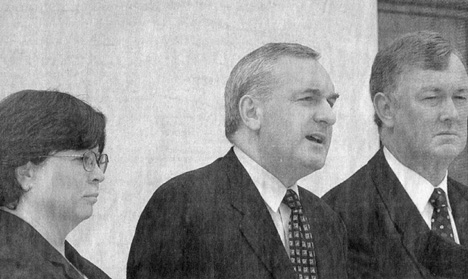
AS he introduced the toughest security package to fight terrorism in 20 years, Taoiseach, Bertie Ahern, yesterday committed the Government to doing everything in its power to defeat the faceless cowards who planted the Omagh bomb that killed 28 people, including a number of children.
Announcing details of the package, agreed at a lengthy Cabinet meeting, the Taoiseach said the Government was in no doubt the Omagh bomb was intended as a direct attack on the Good Friday Agreement and on the principles of democracy.
"The Government is determined to do everything in its power, working closely with the British Government, to defeat and suppress this murderous conspiracy against the people of Ireland," he said.
The new security proposals, which will be seen as draconian, are built around a series of amendments to the Offences Against the State Act, 1939-85.
Internment was considered by the Ministers, but the legislative changes were judged to be the most effective way of dealing with the situation. Internment, as experience had shown, had potential drawbacks. The Taoiseach emphasised, however, that the option of internment remained and was one which the Government would avail of should that be judged the right course of action.
The Dail is to be recalled within the next fortnight to deal with the amending legislation and its detailed drafting will now commence.
In broad terms, it will provide for restrictions on the right to silence, extend the maximum period of detention from 48 hours to four days and create a number of new offences.
The legislation will:
>allow inferences to be drawn from the failure of a suspect to answer relevant questions. These would be capable of corroborating evidence, including the opinion of a chief superintendent, that a person was a member of an unlawful organisation;
>provide restrictions on the right to silence for persons charged with terrorist offences. The restrictions would allow the court to draw inferences where an accused person failed to mention particular facts to the Gardai during questioning or on being charged, which they subsequently relied upon in their defence;
>create a number of offences under the Act. These include directing an unlawful organisation; possessing items for purposes connected with specified firearms or explosives offences; with holding information concerning a terrorist-type offence; unlawfully collecting information; and training persons in the making or use of firearms or explosives. The allowed period of detention under section 30 of the Offences Against the State Act, 1939 will be increased from 48 to 72 hours by providing for continued detention for a further period of 24 hours on the authorisation of a District Judge.
These changes and initiatives will supplement existing provisions of the law, not only in the context of the Offences Against the State Acts, but also in the general criminal law. These include provisions to confiscate property, including land used for the purpose of committing or facilitating the commission of any offence.
In addition, provisions of the Bail Act, 1997 will be brought into force by order of the Minister for Justice for persons charged before the Special Criminal Court. They will allow the courts to take into account the possibility of the commission of offences if an accused were granted bail.
The issue of proscribing organisations such as the Real IRA, which was responsible for the Omagh outrage, was considered by the Government. However, the legal advice was that it was not necessary to make suppression orders against such organisations, the Taoiseach said.
Following the bombing, it was decided to improve the operational capacity of the Garda along the Border and the Government yesterday decided that additional resources would be provided to the Garda for this purpose.
Courtesy of Irish Examiner
by Liam O'Neill Political Editor
AS he introduced the toughest security package to fight terrorism in 20 years, Taoiseach, Bertie Ahern, yesterday committed the Government to doing everything in its power to defeat the faceless cowards who planted the Omagh bomb that killed 28 people, including a number of children.
Announcing details of the package, agreed at a lengthy Cabinet meeting, the Taoiseach said the Government was in no doubt the Omagh bomb was intended as a direct attack on the Good Friday Agreement and on the principles of democracy.
"The Government is determined to do everything in its power, working closely with the British Government, to defeat and suppress this murderous conspiracy against the people of Ireland," he said.
The new security proposals, which will be seen as draconian, are built around a series of amendments to the Offences Against the State Act, 1939-85.
Internment was considered by the Ministers, but the legislative changes were judged to be the most effective way of dealing with the situation. Internment, as experience had shown, had potential drawbacks. The Taoiseach emphasised, however, that the option of internment remained and was one which the Government would avail of should that be judged the right course of action.
The Dail is to be recalled within the next fortnight to deal with the amending legislation and its detailed drafting will now commence.
In broad terms, it will provide for restrictions on the right to silence, extend the maximum period of detention from 48 hours to four days and create a number of new offences.
The legislation will:
>allow inferences to be drawn from the failure of a suspect to answer relevant questions. These would be capable of corroborating evidence, including the opinion of a chief superintendent, that a person was a member of an unlawful organisation;
>provide restrictions on the right to silence for persons charged with terrorist offences. The restrictions would allow the court to draw inferences where an accused person failed to mention particular facts to the Gardai during questioning or on being charged, which they subsequently relied upon in their defence;
>create a number of offences under the Act. These include directing an unlawful organisation; possessing items for purposes connected with specified firearms or explosives offences; with holding information concerning a terrorist-type offence; unlawfully collecting information; and training persons in the making or use of firearms or explosives. The allowed period of detention under section 30 of the Offences Against the State Act, 1939 will be increased from 48 to 72 hours by providing for continued detention for a further period of 24 hours on the authorisation of a District Judge.
These changes and initiatives will supplement existing provisions of the law, not only in the context of the Offences Against the State Acts, but also in the general criminal law. These include provisions to confiscate property, including land used for the purpose of committing or facilitating the commission of any offence.
In addition, provisions of the Bail Act, 1997 will be brought into force by order of the Minister for Justice for persons charged before the Special Criminal Court. They will allow the courts to take into account the possibility of the commission of offences if an accused were granted bail.
The issue of proscribing organisations such as the Real IRA, which was responsible for the Omagh outrage, was considered by the Government. However, the legal advice was that it was not necessary to make suppression orders against such organisations, the Taoiseach said.
Following the bombing, it was decided to improve the operational capacity of the Garda along the Border and the Government yesterday decided that additional resources would be provided to the Garda for this purpose.
Courtesy of Irish Examiner
Further Information
Publisher: THE EXAMINER
Ref: TEX/113
Published Date: 20-Aug-98
Related Images