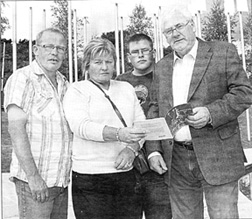
ROAD TO JUSTICE A LONG AND DIFFICULT JOURNEY
Road to justice 'a long and difficult journey'
AS Justice Declan Morgan delivered his findings on the Omagh civil action in Belfast High Court on Monday, years of fighting for justice finally culminated in the positive result that for so long, relatives of those who were murdered in the 1998 Omagh bomb attack, had hoped for.
Describing the road to justice as a "long and difficult journey", Michael Gallagher, the father of Aiden Gallagher, who was killed when the bomb exploded in the town on August 15, 1998, told the Tyrone Constitution this week that there had been times when his family had wondered "would we ever get there?"
"We just felt for Aiden's sake it was important that we should carry on. If we could at least get a judgment where there would be some people held to account, we felt it would be worthwhile.
"It was important to the families to carry on, and it was a tremendous struggle to carry on at times, but we were all relieved that we got the wonderful judgment that we did this week."
When the civil action was first launched in March 2001 by the families of the Omagh bomb victims, against five Real IRA suspects alleged to have been involved in the atrocity, it was the first of its kind.
Relatives of those who had been murdered in the bomb attack were forced to wait almost a decade before the five bomb suspects' other criminal prosecutions were concluded, in case their civil action prejudiced any trial.
In 2003 the British Government made legal history when it introduced the Access to Justice Order to provide �800,000 to the families' legal fund. However, this had been challenged by one of the suspects, Michael McKevitt, who had been refused legal aid at the time to contest the action.
The withdrawal of a number of the bereaved families from the action in June 2007 and the acquittal of south Armagh man, Sean Hoey, in December 2007 dealt two major blows to the case, but in April 2007, after over seven years of delays and setbacks, the Omagh civil action was underway.
"There were major financial hurdles to overcome, so many highs and lows, difficulties with the PSNI in providing evidence and the enormous task of trying to pursue Irish authorites in engaging in the process, but the families worked closely together over past eight years, and we were a great source of support to each other," said Mr Gallagher.
Reflecting on the road to justice, Godfrey Wilson, whose daughter, Lorraine, was killed in the car bomb attack, paid tribute to those who had supported the families through their struggle.
"The families put on a united front, and it shows what determination can achieve - if the heart and the mind is in it, it can be done. I wish my mother could have been there on Monday to see it, she passed away last month, but I'm sure she is with Lorraine now, keeping her company.
"Justice has been served through a civil court. We felt we were being crippled with the collapse of the criminal case, and this time round, we felt we were going to be hurt again, but I'm glad we stuck through it. I would rather see them behind bars for what they have done, but I believe the people that did this have been brought to justice."
Describing Monday's result as a "very sound verdict", Mr Gallagher extended thanks to all those who had helped them in their struggle.
"What I would say is the RUC officers retired, the PSNI serving and retired officers and gardai officers, both retired and serving, were excellent witnesses and supported us enormously as did the general public - and we are very grateful for that.
"Without all of these people and a good legal team, we couldn't have achieved the result we did.
"The next challenge is to make sure the judgment is enforced, which throws up an enormous difficulty in itself, because the assets of these people are mainly in the Republic of Ireland."
AS Justice Declan Morgan delivered his findings on the Omagh civil action in Belfast High Court on Monday, years of fighting for justice finally culminated in the positive result that for so long, relatives of those who were murdered in the 1998 Omagh bomb attack, had hoped for.
Describing the road to justice as a "long and difficult journey", Michael Gallagher, the father of Aiden Gallagher, who was killed when the bomb exploded in the town on August 15, 1998, told the Tyrone Constitution this week that there had been times when his family had wondered "would we ever get there?"
"We just felt for Aiden's sake it was important that we should carry on. If we could at least get a judgment where there would be some people held to account, we felt it would be worthwhile.
"It was important to the families to carry on, and it was a tremendous struggle to carry on at times, but we were all relieved that we got the wonderful judgment that we did this week."
When the civil action was first launched in March 2001 by the families of the Omagh bomb victims, against five Real IRA suspects alleged to have been involved in the atrocity, it was the first of its kind.
Relatives of those who had been murdered in the bomb attack were forced to wait almost a decade before the five bomb suspects' other criminal prosecutions were concluded, in case their civil action prejudiced any trial.
In 2003 the British Government made legal history when it introduced the Access to Justice Order to provide �800,000 to the families' legal fund. However, this had been challenged by one of the suspects, Michael McKevitt, who had been refused legal aid at the time to contest the action.
The withdrawal of a number of the bereaved families from the action in June 2007 and the acquittal of south Armagh man, Sean Hoey, in December 2007 dealt two major blows to the case, but in April 2007, after over seven years of delays and setbacks, the Omagh civil action was underway.
"There were major financial hurdles to overcome, so many highs and lows, difficulties with the PSNI in providing evidence and the enormous task of trying to pursue Irish authorites in engaging in the process, but the families worked closely together over past eight years, and we were a great source of support to each other," said Mr Gallagher.
Reflecting on the road to justice, Godfrey Wilson, whose daughter, Lorraine, was killed in the car bomb attack, paid tribute to those who had supported the families through their struggle.
"The families put on a united front, and it shows what determination can achieve - if the heart and the mind is in it, it can be done. I wish my mother could have been there on Monday to see it, she passed away last month, but I'm sure she is with Lorraine now, keeping her company.
"Justice has been served through a civil court. We felt we were being crippled with the collapse of the criminal case, and this time round, we felt we were going to be hurt again, but I'm glad we stuck through it. I would rather see them behind bars for what they have done, but I believe the people that did this have been brought to justice."
Describing Monday's result as a "very sound verdict", Mr Gallagher extended thanks to all those who had helped them in their struggle.
"What I would say is the RUC officers retired, the PSNI serving and retired officers and gardai officers, both retired and serving, were excellent witnesses and supported us enormously as did the general public - and we are very grateful for that.
"Without all of these people and a good legal team, we couldn't have achieved the result we did.
"The next challenge is to make sure the judgment is enforced, which throws up an enormous difficulty in itself, because the assets of these people are mainly in the Republic of Ireland."
Further Information
Publisher: TYRONE CONSTITUTION
Ref: TC/1980
Published Date: 11-Jun-09
Related Images