FORMER CHURCH MODERATOR TELLS OF HARROWING MEMORIAL CONSULTATION
Former church Moderator tells of 'harrowing' memorial consultation
I think it's the most difficult thing I've ever done in my life'
by Emma Stewart
The controversial wording for the Omagh bomb memorial was unanimously agreed by Omagh District Council, following a consultation process described by Rev Dr John Dunlop as "the most difficult thing I've ever done in my life".
Having met in confidence with over 80 of those affected by the 1998 atrocity - some of whom had never before spoken publicly - an independent panel of three, led by the former Presbyterian Moderator, decided that the lengthy and emotive engraving would incorporate the contentious phrase 'dissident republican car bomb'.
Acknowledging the concerns of those Omagh families who had feared that such a reference would be obliterated in the new development, Dr Dunlop added: "I think what we've done is to write it into the record".
In a move many had not envisaged, the memorial text will sweep across three locations - at the bomb site, on a street wall at the garden, and on the walls inside the garden itself.
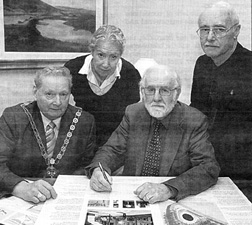
As Dr Dunlop, Mrs Olive Hobson, Quaker House, Belfast, and Rev Brian Lennon, Community Dialogue NI, unveiled their findings to members of Omagh District Council on Thursday evening of last week, copies of the report were simultaneously hand delivered or emailed to the homes of the bereaved families, and to those who had participated in the discussions.
Recognising the atmosphere of mistrust that had previously surrounded discussions over the narrative, Dr Dunlop was firm in his assurances of impartiality.
"We came and we listened very carefully. I suppose it has to be said that we didn't come with any kind of baggage. We hadn't a previous position on anything. We came in ourselves with a clean sheet of paper, and the council gave us a clean sheet of paper and said 'nothing is ruled in, nothing is ruled out - you go away and talk to these people and come back with a recommendation. "
Commending the council on their 'high degree of unity and maturity', he expressed hoped that this "leadership from the council will now transmit itself down, and that civic society in Omagh - people of influence - will stand up and say, it is now time to move on together."
Responding to criticism of the council's decision to appoint an independent panel, rather than come to agreement locally, he said: "Well they passed the buck to us, but the buck came back tonight, and the buck was set down in front of the council and they had to decide what they're going to do with it. Because ultimately the decision lies with the council."
Acknowledging the responsibility implied by their task, Dr Dunlop said: "I think it's the most difficult thing I've ever done in my life. Because for the last four months we've been sitting listening to the most harrowing stories from people.
"I saw the Omagh bomb and the funerals and the big service at the Courthouse - watched it all on television, and I found that very moving, But really to come now and have somebody tell you what it's still like to live through the consequences of the bomb, you realise how distressed these people actually are.
"When you come here and you realise that people lost their limbs, that people lost their sight, that people are going to be injured for the rest of their lives. That people lost the people they love... to listen to these stories cannot other than be a harrowing experience."
He continued: "We talked to people who were dealing with the people on the street, who were picking up bits of bodies, who were putting people into buses. And then the stories that people were telling us about going to the hospitals, searching the hospital wards, not knowing were they in Enniskillen, were they in Belfast, or the Ulster or the Royal - or were they dead? And that long, long night of waiting - these are incredible stories of pain."
Impressed by those who came forward to share their, highly personal, stories and opinions, the panel identified the wide variance in feeling over the issues implied in selecting a narrative.
"One or two people just didn't want anything to do with the memorial - they just want to move on. They're living their lives privately and don't want to get involved in any public disputes".
Noting that some wanted the perpetrators 'names and shamed', Dr Dunlop also acknowledged the concerns of others who feared that 'some might take in future some perverse kind of satisfaction' from having their deeds immortalised in stone.
Expressing hopes that the families of those who were killed in the August 15 attack would agree to have the names and ages of their loved ones listed in the garden, he said: "Whenever I came down to Omagh after 10 years and I opened up the records and I began to see somebody's name and age... it is extraordinarily moving"
Highlighting his belief that specifying the number of dead doesn't have the same impact as identifying the actual individuals lost to us, he added: "It brings it home to you in a way in which a simple statement of fact can never do".
On the unusual nature of the memorial, he said that discovering 60ft of wall space was available to them, had meant that their options were 'wide open': "Your mind stops thinking about eight square feet -there's a lot of opportunity to tell a story".
Having made a conscious effort to tell the events of the day, while giving hope for the future, Dr Dunlop noted how his experiences of Omagh today have helped guide his thinking. Recognising how much the town has moved on from that fateful day, he told of time recently spent waiting for a bus surrounded by the 'vitality and energy' of throngs of schoolchildren, many of whom would have no recollection of 1998's events: "You have to mark it, but you don't have to live in the past."
"While we desperately miss the people who have died, nevertheless we are putting life together and moving on... I'm talking about extraordinarily impressive people in this community"
I think it's the most difficult thing I've ever done in my life'
by Emma Stewart
The controversial wording for the Omagh bomb memorial was unanimously agreed by Omagh District Council, following a consultation process described by Rev Dr John Dunlop as "the most difficult thing I've ever done in my life".
Having met in confidence with over 80 of those affected by the 1998 atrocity - some of whom had never before spoken publicly - an independent panel of three, led by the former Presbyterian Moderator, decided that the lengthy and emotive engraving would incorporate the contentious phrase 'dissident republican car bomb'.
Acknowledging the concerns of those Omagh families who had feared that such a reference would be obliterated in the new development, Dr Dunlop added: "I think what we've done is to write it into the record".
In a move many had not envisaged, the memorial text will sweep across three locations - at the bomb site, on a street wall at the garden, and on the walls inside the garden itself.
As Dr Dunlop, Mrs Olive Hobson, Quaker House, Belfast, and Rev Brian Lennon, Community Dialogue NI, unveiled their findings to members of Omagh District Council on Thursday evening of last week, copies of the report were simultaneously hand delivered or emailed to the homes of the bereaved families, and to those who had participated in the discussions.
Recognising the atmosphere of mistrust that had previously surrounded discussions over the narrative, Dr Dunlop was firm in his assurances of impartiality.
"We came and we listened very carefully. I suppose it has to be said that we didn't come with any kind of baggage. We hadn't a previous position on anything. We came in ourselves with a clean sheet of paper, and the council gave us a clean sheet of paper and said 'nothing is ruled in, nothing is ruled out - you go away and talk to these people and come back with a recommendation. "
Commending the council on their 'high degree of unity and maturity', he expressed hoped that this "leadership from the council will now transmit itself down, and that civic society in Omagh - people of influence - will stand up and say, it is now time to move on together."
Responding to criticism of the council's decision to appoint an independent panel, rather than come to agreement locally, he said: "Well they passed the buck to us, but the buck came back tonight, and the buck was set down in front of the council and they had to decide what they're going to do with it. Because ultimately the decision lies with the council."
Acknowledging the responsibility implied by their task, Dr Dunlop said: "I think it's the most difficult thing I've ever done in my life. Because for the last four months we've been sitting listening to the most harrowing stories from people.
"I saw the Omagh bomb and the funerals and the big service at the Courthouse - watched it all on television, and I found that very moving, But really to come now and have somebody tell you what it's still like to live through the consequences of the bomb, you realise how distressed these people actually are.
"When you come here and you realise that people lost their limbs, that people lost their sight, that people are going to be injured for the rest of their lives. That people lost the people they love... to listen to these stories cannot other than be a harrowing experience."
He continued: "We talked to people who were dealing with the people on the street, who were picking up bits of bodies, who were putting people into buses. And then the stories that people were telling us about going to the hospitals, searching the hospital wards, not knowing were they in Enniskillen, were they in Belfast, or the Ulster or the Royal - or were they dead? And that long, long night of waiting - these are incredible stories of pain."
Impressed by those who came forward to share their, highly personal, stories and opinions, the panel identified the wide variance in feeling over the issues implied in selecting a narrative.
"One or two people just didn't want anything to do with the memorial - they just want to move on. They're living their lives privately and don't want to get involved in any public disputes".
Noting that some wanted the perpetrators 'names and shamed', Dr Dunlop also acknowledged the concerns of others who feared that 'some might take in future some perverse kind of satisfaction' from having their deeds immortalised in stone.
Expressing hopes that the families of those who were killed in the August 15 attack would agree to have the names and ages of their loved ones listed in the garden, he said: "Whenever I came down to Omagh after 10 years and I opened up the records and I began to see somebody's name and age... it is extraordinarily moving"
Highlighting his belief that specifying the number of dead doesn't have the same impact as identifying the actual individuals lost to us, he added: "It brings it home to you in a way in which a simple statement of fact can never do".
On the unusual nature of the memorial, he said that discovering 60ft of wall space was available to them, had meant that their options were 'wide open': "Your mind stops thinking about eight square feet -there's a lot of opportunity to tell a story".
Having made a conscious effort to tell the events of the day, while giving hope for the future, Dr Dunlop noted how his experiences of Omagh today have helped guide his thinking. Recognising how much the town has moved on from that fateful day, he told of time recently spent waiting for a bus surrounded by the 'vitality and energy' of throngs of schoolchildren, many of whom would have no recollection of 1998's events: "You have to mark it, but you don't have to live in the past."
"While we desperately miss the people who have died, nevertheless we are putting life together and moving on... I'm talking about extraordinarily impressive people in this community"
Further Information
Publisher: TYRONE CONSTITUTION
Ref: TC/1929
Published Date: 13-Mar-08
Related Images