PAST STIRS UP EMOTIONS FOR OMAGH BEREAVED
PAST STIRS UP EMOTIONS FOR OMAGH BEREAVED
by Emma Stewart
DISCUSSIONS on how to deal with Northern Ireland's 40-year legacy of violence were given short shrift last week, as victims of the Troubles emphasised that the past cannot be laid to rest, while we continue to grieve in the present.
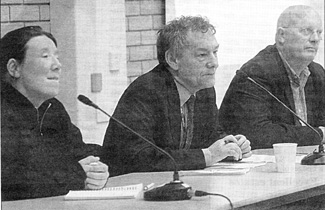
The meeting, led by Consultative Group members, Denis Bradley, Elaine Moore and David Porter, rapidly became a heated affair, as old wounds were re-opened by talk of amnesty and war.
Further criticism came with the absence of Lord Robin Eames, co-chair of the group, and the brevity of the timescale allocated for public consultation; as one attendee questioned, "we have suffered terrorism for 40 years - why has this all to be sorted out in matter of months?"
Part of a series of meetings being held across the province, the group hit the headlines last week following the suggestion that they might ask the British Government to acknowledge the Northern Ireland situation as a 'war'.
As the meeting, held in Omagh's South West College, erupted in anger at such a proposition, local representative and bereaved families were scathing of the suggestion that the group could hope to 'lay to rest' a deeply-felt history of hurt and anger.
Speaking candidly and forcefully, Lawrence Rush, whose wife Libby was murdered in the Omagh atrocity almost 10 years ago, said: "The real issue is not about party politics, they've made a mess of it up to now... it's about truth and reconciliation.
"The politicians are put in power to solve this problem and, as I said, between raving rectors, hypocrites, terrorists and criminals, they've made some job of it, so lets get down to ordinary people talking here. Lets start with the horror of Omagh, the people that went out with their lunch-boxes and never came home.
He continued: "The problem is we're supposed to apologise for having that atrocity visited on this town."
He questioned, "do we massage the truth or do we tell the truth?"
Clearly angered, he continued: "Stop being apologists... there's nobody here that's going to give absolution to the people that did this to my wife." Mr Rush concluded: "How dare they say it was a war, how dare they kill my wife, how dare you sit there and try to make reconciliation. How dare you."
Calling the panel's endeavours a 'waste of money', Ross Hussey, member of Omagh District Council, expressed disappointment at the turnout from the people of Omagh. He continued: "I have very serious doubts about the ability of this group to come to any clear answer to the questions."
Incensed by the suggestion of amnesty for those guilty of politically motivated crimes, he added: "We had a situation of ethnic cleansing throughout Northern Ireland. We had a situation where people were murdered as they went to their church, walking down the streets... that wasn't a war, that was terrorism."
"Murder is murder is murder. Nobody, nobody has the right to give these people free pardon. Nobody has a right to clean their slate... If anybody murders somebody, the least the families can expect is to see the thug, the murderer in court. To see them standing in front of them and account for their sins. That is not going to happen."
Mr Hussey concluded: "They were murderers, they were scum, that's all they were - they were not war heroes."
Kevin Skelton, whose wife Philomena was murdered in Omagh's 1998 Real IRA atrocity, expressed his disgust at the notion of an amnesty: "The innocent victims that were slaughtered on the street up there... they have a right to justice."
"As ever", he added, "The victims are shafted".
Member of Omagh District Council, Clive McFarland, while offering a cautious welcome to the panel was realistic about their chances of success: "Clearly we can't decide what the legacy of the past 40 years is, if we can't decide what actually happened. "
Underlining that it was not a war 'by any reasonable definition', he called it 'objectionable' that paramilitaries might be enabled to 're-write' the past, and 'whitewash' over their atrocities.
He continued: "Calling it a war is equally obnoxious in describing those people from the Loyalist paramilitaries as soldiers of that war, as it is of Republican terrorists - neither side fought a war. War is generally not fought by drug dealers, gangsters and criminals, which is what these groups are made up of."
Acknowledging that a 'small number' of those charged with law enforcement may also have been guilty of crimes, he said: "those people should be sought out and brought to justice equally as much as anyone who acted outside the law as a member of a terrorist organisation."
Mr McFarland concluded: "In a war no-one was ever sought out after they went home from their day's soldiering at the war, found at their country farm and murdered - that never happened. "
"You can't simply pander to those who have most to gain out of whitewashing their actions".
In stark contrast to the general mood, a singular Sinn Fein representative - Declan McAleer - put forward the case for a re-evaluation of the Northern Ireland situation, commenting, "you could argue it was a very dirty war".
Asserting that victims need 'access to the truth and access to justice', he concluded: "People are entitled to get some sort of validation of what happened to them".
West Tyrone MLA and member of Omagh District Council, Tom Buchanan, was emphatic in his condemnation of proposals that seek to wash away the horrors of the past: "What is it that terrorists need? It's not an amnesty it's the full weight and the rigours of the law applied to them. That's what they need."
He continued: "We have many homes tonight and there's an empty chair, and there's a silent voice, and there's grieving people."
Noting that the proposal of an amnesty "should leave you hanging your heads in shame", he added "it stinks of the Northern Ireland Office".
Likewise Sammy Brush, a former UDR man from Ballygawley who escaped a 1981 murder attempt, was horrified that the notion of an amnesty was even up for discussion: "I can't believe that anybody that lived through the past 40 years could in fact believe that floating an idea like that could somehow help."
Attendee, Hazlett Lynch, said such suggestions 'beggar belief, and noted that the legacy of the past is, unequivocally, "the victims, it's the people who have suffered, it's the people whose loved ones have been brutally butchered by
IRA terrorists, and their fellow travellers let me add." Adding that the notion of a moral equivalence between terrorists and victims was 'utterly offensive and repugnant', he concluded: "I would much rather be the brother of a murdered policeman than the brother of the guys who murdered him. I can sleep in my bed at night, I hope they can't."
by Emma Stewart
DISCUSSIONS on how to deal with Northern Ireland's 40-year legacy of violence were given short shrift last week, as victims of the Troubles emphasised that the past cannot be laid to rest, while we continue to grieve in the present.
The meeting, led by Consultative Group members, Denis Bradley, Elaine Moore and David Porter, rapidly became a heated affair, as old wounds were re-opened by talk of amnesty and war.
Further criticism came with the absence of Lord Robin Eames, co-chair of the group, and the brevity of the timescale allocated for public consultation; as one attendee questioned, "we have suffered terrorism for 40 years - why has this all to be sorted out in matter of months?"
Part of a series of meetings being held across the province, the group hit the headlines last week following the suggestion that they might ask the British Government to acknowledge the Northern Ireland situation as a 'war'.
As the meeting, held in Omagh's South West College, erupted in anger at such a proposition, local representative and bereaved families were scathing of the suggestion that the group could hope to 'lay to rest' a deeply-felt history of hurt and anger.
Speaking candidly and forcefully, Lawrence Rush, whose wife Libby was murdered in the Omagh atrocity almost 10 years ago, said: "The real issue is not about party politics, they've made a mess of it up to now... it's about truth and reconciliation.
"The politicians are put in power to solve this problem and, as I said, between raving rectors, hypocrites, terrorists and criminals, they've made some job of it, so lets get down to ordinary people talking here. Lets start with the horror of Omagh, the people that went out with their lunch-boxes and never came home.
He continued: "The problem is we're supposed to apologise for having that atrocity visited on this town."
He questioned, "do we massage the truth or do we tell the truth?"
Clearly angered, he continued: "Stop being apologists... there's nobody here that's going to give absolution to the people that did this to my wife." Mr Rush concluded: "How dare they say it was a war, how dare they kill my wife, how dare you sit there and try to make reconciliation. How dare you."
Calling the panel's endeavours a 'waste of money', Ross Hussey, member of Omagh District Council, expressed disappointment at the turnout from the people of Omagh. He continued: "I have very serious doubts about the ability of this group to come to any clear answer to the questions."
Incensed by the suggestion of amnesty for those guilty of politically motivated crimes, he added: "We had a situation of ethnic cleansing throughout Northern Ireland. We had a situation where people were murdered as they went to their church, walking down the streets... that wasn't a war, that was terrorism."
"Murder is murder is murder. Nobody, nobody has the right to give these people free pardon. Nobody has a right to clean their slate... If anybody murders somebody, the least the families can expect is to see the thug, the murderer in court. To see them standing in front of them and account for their sins. That is not going to happen."
Mr Hussey concluded: "They were murderers, they were scum, that's all they were - they were not war heroes."
Kevin Skelton, whose wife Philomena was murdered in Omagh's 1998 Real IRA atrocity, expressed his disgust at the notion of an amnesty: "The innocent victims that were slaughtered on the street up there... they have a right to justice."
"As ever", he added, "The victims are shafted".
Member of Omagh District Council, Clive McFarland, while offering a cautious welcome to the panel was realistic about their chances of success: "Clearly we can't decide what the legacy of the past 40 years is, if we can't decide what actually happened. "
Underlining that it was not a war 'by any reasonable definition', he called it 'objectionable' that paramilitaries might be enabled to 're-write' the past, and 'whitewash' over their atrocities.
He continued: "Calling it a war is equally obnoxious in describing those people from the Loyalist paramilitaries as soldiers of that war, as it is of Republican terrorists - neither side fought a war. War is generally not fought by drug dealers, gangsters and criminals, which is what these groups are made up of."
Acknowledging that a 'small number' of those charged with law enforcement may also have been guilty of crimes, he said: "those people should be sought out and brought to justice equally as much as anyone who acted outside the law as a member of a terrorist organisation."
Mr McFarland concluded: "In a war no-one was ever sought out after they went home from their day's soldiering at the war, found at their country farm and murdered - that never happened. "
"You can't simply pander to those who have most to gain out of whitewashing their actions".
In stark contrast to the general mood, a singular Sinn Fein representative - Declan McAleer - put forward the case for a re-evaluation of the Northern Ireland situation, commenting, "you could argue it was a very dirty war".
Asserting that victims need 'access to the truth and access to justice', he concluded: "People are entitled to get some sort of validation of what happened to them".
West Tyrone MLA and member of Omagh District Council, Tom Buchanan, was emphatic in his condemnation of proposals that seek to wash away the horrors of the past: "What is it that terrorists need? It's not an amnesty it's the full weight and the rigours of the law applied to them. That's what they need."
He continued: "We have many homes tonight and there's an empty chair, and there's a silent voice, and there's grieving people."
Noting that the proposal of an amnesty "should leave you hanging your heads in shame", he added "it stinks of the Northern Ireland Office".
Likewise Sammy Brush, a former UDR man from Ballygawley who escaped a 1981 murder attempt, was horrified that the notion of an amnesty was even up for discussion: "I can't believe that anybody that lived through the past 40 years could in fact believe that floating an idea like that could somehow help."
Attendee, Hazlett Lynch, said such suggestions 'beggar belief, and noted that the legacy of the past is, unequivocally, "the victims, it's the people who have suffered, it's the people whose loved ones have been brutally butchered by
IRA terrorists, and their fellow travellers let me add." Adding that the notion of a moral equivalence between terrorists and victims was 'utterly offensive and repugnant', he concluded: "I would much rather be the brother of a murdered policeman than the brother of the guys who murdered him. I can sleep in my bed at night, I hope they can't."
Further Information
Publisher: TYRONE CONSTITUTION
Ref: TC/1911
Published Date: 24-Jan-08
Related Images