JUDGE CRITICAL OF CROWN CASE AS SOUTH ARMAGH MAN CLEARED ON BOMB CHARGES
Judge critical of Crown case as South Armagh man cleared on bomb charges
by Emma Stewart
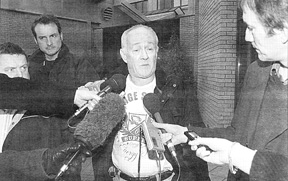
The only man to stand trial in connection with the 1998 Real IRA bombing of Omagh, was last week cleared of all charges, amid a scathing indictment of the police investigation.
Sean Gerard Hoey, 38, of Jonesborough, South Armagh, was found not guilty of a total of 58 charges, including a catalogue of terrorist offences not directly linked to the bombing.
While the families of the 29 people, and unborn twins, murdered in the August 15 atrocity struggle with a further setback in their quest for justice, Hoey's acquittal comes over 11 months after the trial concluded, and at a time of year many have deemed 'cruel'.
Reading his 24-page verdict on Thursday last, Mr Justice Weir left onlookers in no doubt that the widely publicised case was heading for collapse.
Condemning the 'deliberate and calculated deception' created by the alteration of police statements, and 'cavalier disregard' for the integrity of material evidence, he said: "I am acutely aware that the stricken people of Omagh and every other right-thinking member of the Northern Ireland community would very much wish to see whoever was responsible for the outrageous events of August 1998 and the other serious crimes in this series of terrorist incidents convicted and punished for their crimes according to law."
However, he added that he must also "bear firmly in mind the cardinal principle of the criminal law", that "Justice 'according to law' demands proper evidence", evidence that is "so convincing in truth and manifestly reliable that it reaches the standard of proof beyond reasonable doubt."
He continued: "The evidence against the accused in this case did not reach that immutable standard.
"Accordingly I find Mr Hoey not guilty on each of the remaining counts on the indictment."
After four years imprisonment, and a trial that lasted 56 days and involved hundreds of witnesses, the judgment against south-Armagh electrician, Sean Hoey, was unequivocal in its dismissal of the prosecution's case.
Mr Justice Weir began by elucidating the circumstances of the 58 charges brought, arising from "13 bomb and mortar attacks, attempts at such attacks and the finding of unexploded devices that began on 24 March, 1998 and included the infamous car bomb explosion that destroyed much of the shopping centre of Omagh on the afternoon of Saturday, 15 August, 1998".
Noting the 'appalling consequences' of that day, which saw 29 killed, including a woman pregnant with twins, he acknowledged that "hundreds of others were injured, many gravely, leaving permanent and widespread physical and psychological scars."
He continued: "The town centre was destroyed. This huge explosion was among the very worst of the numerous terrible events of that recent 30-year violent period of Northern Ireland history sometimes euphemistically referred to as "the Troubles". The prosecution contended, and there seems little doubt, that those responsible for all these incidents were so-called republicans who did not accept the implications of the Good Friday Agreement for the continuation of their terrorist campaign".
While bereaved families, who travelled to Belfast, filled the packed Laganside courtroom, a live video-link to Omagh's South-West College relayed events to a small number of disillusioned relatives.
Outlining the key 'strands' of the prosecution's case, Mr Justice Weir noted that it rested upon the contention that "the combination of those strands produces the result that the accused can be shown to be involved in the construction of the twelve devices and thereby an essential part of the conspiracy to cause each of the remaining incidents charged."
The three key elements of the case included establishing 'common authorship' of the Mark 19 detonating devices, fibre evidence and that provided by
Low Copy Number (LCN) DNA.
Not satisfied that 'common authorship' of the Mark 19 timer power units (TPUs) had been proven, he acknowledged: "It is, of course, possible that some or all of them may have been made by the same person but the evidence at its height establishes no more than that".
Likewise, he was not "satisfied either beyond a reasonable doubt or to any acceptable standard" that the fibre evidence presented could link Hoey with the offences.
In turning to the contentious LCN DNA evidence, Mr Justice Weir highlighted many concerns over problems in recovery, packing, storage and transmission of items by the Army, Police and Scenes of Crime Officers (SOCO), from the various incident sites at Lisburn, Armagh, and Altmore Forest.
He said: "It is highly important in this connection to bear in mind that, given the tiny amount of material needed to give a result using the LCN DNA technique, everyone agreed that especially stringent measures must be taken to avoid the contamination of samples".
Dissatisfied by prosecution contention that adequate precautions had been taken, he professed to be particularly disturbed by the incident at Dungannon's Altmore Forest, whereby it appeared that a subsequent 'beefing up' of police evidence had taken place by a Ms Fiona Cooper and a Detective Chief Inspector Marshall.
Noting their "mendacious attempts to retrospectively alter the Altmore Forest evidence so as to falsely make it appear that appropriate DNA protective precautions had been taken at that scene", he said, "I am left in the position that I do not know what if anything I can believe of the evidence of these two".
He continued: "Such was my disquiet at their evidence and that of others connected with this matter that upon its completion I had transcripts of the evidence on this issue sent to the Police Ombudsman.
"The effect of this, as I find deliberate and calculated deception in which others concerned in the investigation and preparation of this case for trial beyond these two witnesses may also have played a part, is to make it impossible for me to accept any of the evidence of either witness since I have no means of knowing whether they may have told lies about other aspects of the case that were not capable of being exposed as such."
Calling police arrangements for recording and storage of items at this time, 'thoroughly disorganised', he recalled the general picture given of the Newry special property store as "a complete mess", adding that "problems related to the handling storage and tracking of exhibits were not confined to the police, within FSNI [Forensic Science Northern Ireland] there were also problems".
He continued: "It is not my function to criticise the seemingly thoughtless and slapdash approach of police and SOCO officers to the collection, storage and transmission of what must obviously have been potential exhibits in a possible future criminal trial but it is difficult to avoid some expression of surprise that in an era in which the potential for fibre, if not DNA, contamination was well known to the police such items were so widely and routinely handled with cavalier disregard for their integrity."
He concluded: "Accordingly I find that that DNA evidence, the third and final strand remaining in the prosecution case, cannot satisfy me either beyond a reasonable doubt or to any other acceptable standard."
by Emma Stewart
The only man to stand trial in connection with the 1998 Real IRA bombing of Omagh, was last week cleared of all charges, amid a scathing indictment of the police investigation.
Sean Gerard Hoey, 38, of Jonesborough, South Armagh, was found not guilty of a total of 58 charges, including a catalogue of terrorist offences not directly linked to the bombing.
While the families of the 29 people, and unborn twins, murdered in the August 15 atrocity struggle with a further setback in their quest for justice, Hoey's acquittal comes over 11 months after the trial concluded, and at a time of year many have deemed 'cruel'.
Reading his 24-page verdict on Thursday last, Mr Justice Weir left onlookers in no doubt that the widely publicised case was heading for collapse.
Condemning the 'deliberate and calculated deception' created by the alteration of police statements, and 'cavalier disregard' for the integrity of material evidence, he said: "I am acutely aware that the stricken people of Omagh and every other right-thinking member of the Northern Ireland community would very much wish to see whoever was responsible for the outrageous events of August 1998 and the other serious crimes in this series of terrorist incidents convicted and punished for their crimes according to law."
However, he added that he must also "bear firmly in mind the cardinal principle of the criminal law", that "Justice 'according to law' demands proper evidence", evidence that is "so convincing in truth and manifestly reliable that it reaches the standard of proof beyond reasonable doubt."
He continued: "The evidence against the accused in this case did not reach that immutable standard.
"Accordingly I find Mr Hoey not guilty on each of the remaining counts on the indictment."
After four years imprisonment, and a trial that lasted 56 days and involved hundreds of witnesses, the judgment against south-Armagh electrician, Sean Hoey, was unequivocal in its dismissal of the prosecution's case.
Mr Justice Weir began by elucidating the circumstances of the 58 charges brought, arising from "13 bomb and mortar attacks, attempts at such attacks and the finding of unexploded devices that began on 24 March, 1998 and included the infamous car bomb explosion that destroyed much of the shopping centre of Omagh on the afternoon of Saturday, 15 August, 1998".
Noting the 'appalling consequences' of that day, which saw 29 killed, including a woman pregnant with twins, he acknowledged that "hundreds of others were injured, many gravely, leaving permanent and widespread physical and psychological scars."
He continued: "The town centre was destroyed. This huge explosion was among the very worst of the numerous terrible events of that recent 30-year violent period of Northern Ireland history sometimes euphemistically referred to as "the Troubles". The prosecution contended, and there seems little doubt, that those responsible for all these incidents were so-called republicans who did not accept the implications of the Good Friday Agreement for the continuation of their terrorist campaign".
While bereaved families, who travelled to Belfast, filled the packed Laganside courtroom, a live video-link to Omagh's South-West College relayed events to a small number of disillusioned relatives.
Outlining the key 'strands' of the prosecution's case, Mr Justice Weir noted that it rested upon the contention that "the combination of those strands produces the result that the accused can be shown to be involved in the construction of the twelve devices and thereby an essential part of the conspiracy to cause each of the remaining incidents charged."
The three key elements of the case included establishing 'common authorship' of the Mark 19 detonating devices, fibre evidence and that provided by
Low Copy Number (LCN) DNA.
Not satisfied that 'common authorship' of the Mark 19 timer power units (TPUs) had been proven, he acknowledged: "It is, of course, possible that some or all of them may have been made by the same person but the evidence at its height establishes no more than that".
Likewise, he was not "satisfied either beyond a reasonable doubt or to any acceptable standard" that the fibre evidence presented could link Hoey with the offences.
In turning to the contentious LCN DNA evidence, Mr Justice Weir highlighted many concerns over problems in recovery, packing, storage and transmission of items by the Army, Police and Scenes of Crime Officers (SOCO), from the various incident sites at Lisburn, Armagh, and Altmore Forest.
He said: "It is highly important in this connection to bear in mind that, given the tiny amount of material needed to give a result using the LCN DNA technique, everyone agreed that especially stringent measures must be taken to avoid the contamination of samples".
Dissatisfied by prosecution contention that adequate precautions had been taken, he professed to be particularly disturbed by the incident at Dungannon's Altmore Forest, whereby it appeared that a subsequent 'beefing up' of police evidence had taken place by a Ms Fiona Cooper and a Detective Chief Inspector Marshall.
Noting their "mendacious attempts to retrospectively alter the Altmore Forest evidence so as to falsely make it appear that appropriate DNA protective precautions had been taken at that scene", he said, "I am left in the position that I do not know what if anything I can believe of the evidence of these two".
He continued: "Such was my disquiet at their evidence and that of others connected with this matter that upon its completion I had transcripts of the evidence on this issue sent to the Police Ombudsman.
"The effect of this, as I find deliberate and calculated deception in which others concerned in the investigation and preparation of this case for trial beyond these two witnesses may also have played a part, is to make it impossible for me to accept any of the evidence of either witness since I have no means of knowing whether they may have told lies about other aspects of the case that were not capable of being exposed as such."
Calling police arrangements for recording and storage of items at this time, 'thoroughly disorganised', he recalled the general picture given of the Newry special property store as "a complete mess", adding that "problems related to the handling storage and tracking of exhibits were not confined to the police, within FSNI [Forensic Science Northern Ireland] there were also problems".
He continued: "It is not my function to criticise the seemingly thoughtless and slapdash approach of police and SOCO officers to the collection, storage and transmission of what must obviously have been potential exhibits in a possible future criminal trial but it is difficult to avoid some expression of surprise that in an era in which the potential for fibre, if not DNA, contamination was well known to the police such items were so widely and routinely handled with cavalier disregard for their integrity."
He concluded: "Accordingly I find that that DNA evidence, the third and final strand remaining in the prosecution case, cannot satisfy me either beyond a reasonable doubt or to any other acceptable standard."
Further Information
Publisher: TYRONE CONSTITUTION
Ref: TC/1901
Published Date: 27-Dec-07
Related Images