OMAGH BOMB MEMORIAL PROPOSALS PUT ON PUBLIC DISPLAY
Omagh bomb memorial proposals put on public display
by Jonathan Rainey
FIVE design teams from across Europe have submitted detailed proposals for the development and installation of a permanent memorial to the 1998 Omagh bomb, the Omagh Memorial Working Group has revealed.
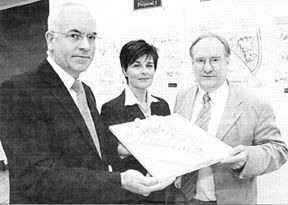
The proposals, which have been submitted by teams from Northern Ireland, the Republic, England and Spain, were unveiled by Danny McSorley, chief executive of Omagh District Council, at Strule Arts Centre on Thursday morning last. They will be publicly exhibited in the Arts Centre until Friday, July 27, and can also be viewed online in the community consultation section at www.omagh.gov.uk.
Speaking at the launch of the public exhibition, Mr McSorley said that the Omagh Memorial Working Group was committed to an 'open and inclusive' process in developing a fitting memorial to the Omagh bomb of August 15, 1998, which provided all of those directly affected by the bomb and the wider public with an opportunity to submit their views.
He said: "The Working Group would welcome and encourage the public to visit the exhibition and to submit their comments either through the facility provided at Strule Arts Centre, via the online facility or by making direct contact with the project officer."
Mr McSorley added that a private opportunity to view and comment on the design proposals had already been provided for all of those bereaved and injured by the bomb on the night before the public launch.
After the public viewing period, each of the five design teams will present their proposals to the panel of assessors, who have been tasked with selecting the most appropriate memorial design, on Monday, July 30.
The panel's decision will be made on the basis of pre-established criteria, including the extent to which the proposal integrates the bomb site and the memorial garden, as well as the overall artistic quality of the proposal.
The assessors will also give consideration to the potential of the proposal to promote healing and reflection, and to make an impact with members of the public.
Omagh Memorial Working Group will then consider the assessment panel's recommendation. The Working Group has also been tasked with considering options for an appropriate inscription.
Touching on the controversial subject of the wording of the inscription, Mr McSorley said: "Omagh Memorial Working Group would again wish to emphasize that, at this stage, no form of words for the inscription has either been agreed or rejected.
"The Working Group wishes to continue to take this matter forward in an open-minded, inclusive and constructive manner so that, ultimately, the memorial will be one which is valued and cherished by the whole community."
At the end of this process, a report will be presented to Omagh District Council for approval.
The council said it expected that the successful design would be commissioned in September, after which work will begin to obtain the various statutory approvals before construction can start on the site.
The five design teams that have submitted proposals are FAM Arquitectura y Urbanismo SL, from Madrid, Shiels, Flynn, and Making Marks, from Norfolk, Sean Hillen and Desmond Fitzgerald Architects, from Dublin, and Robinson Patterson Partnership and Peter Hutchinson, both from Belfast.
The first proposal, known as 'Building with Words', is from the Spanish design team, who also designed the memorial to the 2002 Madrid bombings.
The main element to this innovative design is a latticed steel canopy, made up of words of remembrance, that connects the site bomb and the memorial garden.
The second design, from Shiels, Flynn, and Making Marks, proposes placing a tall shard of beautifully textured piece of local limestone, carved with a few words - in three languages - to explain the date and time of the explosion. The wedge shape of the shard will form an arrow pointing towards the river bridge and the route to the new Memorial Garden.
The Norfolk team envisage a second carved shard stone marker, this time made from a Donegal limestone, standing at the entrance to an enlarged garden, with a circular water feature at the centre of an oval made of granite paving providing the focal point.
The third design, from the Dublin team, proposes using a series of mirrors to transform the memorial garden into a 'Garden of Light'.
Under their proposal, a mirror in the memorial park tracks the sun, and pours a constant beam of sunlight onto 31 small mirrors.
They are arranged to carry the light to a heart shaped sculpture at the bomb site, which is almost constantly in the shade.
The heart is cut-glass crystal apparently floating inside a pillar of glass, which will sparkle and glitter with the light.
The fourth proposal, from Belfast design team Robinson Patterson Partnership, suggests placing a stone sculpture, with a bronze bell encased inside it, at the bomb site. They propose that the names of the victims and the time and date be etched on the bell.
The bell motif is very important to this design, as this is how they aim to link the site of the bomb with the garden - by referring to the shock waves that radiated from the bomb blast in the new design of the memorial garden.
The fifth design, from architect Peter Hutchinson, who is originally from Omagh, proposes providing an underground chamber at the car bomb site, where a 'memory bank' can be created.
The cast bronze cover to the memory trunk would have the time and date of the car bomb explosion - added to it would be a circle or 'O' - an abbreviation or reference to Omagh.
In this proposal, the central permanent sculpture feature in the Memorial Garden is a disc missing in the centre. This is a reference to the memory trunk buried at the car bomb site and the 'O' is for Omagh.
Two marks on its face show the time of the bomb explosion - 3.10pm. The piece is set in a shallow pool. Water flows from the top over the piece and the polished granite of the pool base is engraved with the word Omagh.
The water shimmers and ripples and reflects as it passes over the town's name, synonymous now with the car bomb atrocity.
Outside the enclosed and walled garden the space to the riverside walkway wall and to Drumragh Avenue footpath has been retained as grass - the ground has been sculpted with topsoil and planted with clumps of silver birch - 31 in total.
If you wish to obtain further information regarding the design process or any other aspect of the memorial process, please contact Kim McLaughlin, project officer, on 028 82245321 ext 289, or email kim.mclaughlin@omagh.gov.uk.
by Jonathan Rainey
FIVE design teams from across Europe have submitted detailed proposals for the development and installation of a permanent memorial to the 1998 Omagh bomb, the Omagh Memorial Working Group has revealed.
The proposals, which have been submitted by teams from Northern Ireland, the Republic, England and Spain, were unveiled by Danny McSorley, chief executive of Omagh District Council, at Strule Arts Centre on Thursday morning last. They will be publicly exhibited in the Arts Centre until Friday, July 27, and can also be viewed online in the community consultation section at www.omagh.gov.uk.
Speaking at the launch of the public exhibition, Mr McSorley said that the Omagh Memorial Working Group was committed to an 'open and inclusive' process in developing a fitting memorial to the Omagh bomb of August 15, 1998, which provided all of those directly affected by the bomb and the wider public with an opportunity to submit their views.
He said: "The Working Group would welcome and encourage the public to visit the exhibition and to submit their comments either through the facility provided at Strule Arts Centre, via the online facility or by making direct contact with the project officer."
Mr McSorley added that a private opportunity to view and comment on the design proposals had already been provided for all of those bereaved and injured by the bomb on the night before the public launch.
After the public viewing period, each of the five design teams will present their proposals to the panel of assessors, who have been tasked with selecting the most appropriate memorial design, on Monday, July 30.
The panel's decision will be made on the basis of pre-established criteria, including the extent to which the proposal integrates the bomb site and the memorial garden, as well as the overall artistic quality of the proposal.
The assessors will also give consideration to the potential of the proposal to promote healing and reflection, and to make an impact with members of the public.
Omagh Memorial Working Group will then consider the assessment panel's recommendation. The Working Group has also been tasked with considering options for an appropriate inscription.
Touching on the controversial subject of the wording of the inscription, Mr McSorley said: "Omagh Memorial Working Group would again wish to emphasize that, at this stage, no form of words for the inscription has either been agreed or rejected.
"The Working Group wishes to continue to take this matter forward in an open-minded, inclusive and constructive manner so that, ultimately, the memorial will be one which is valued and cherished by the whole community."
At the end of this process, a report will be presented to Omagh District Council for approval.
The council said it expected that the successful design would be commissioned in September, after which work will begin to obtain the various statutory approvals before construction can start on the site.
The five design teams that have submitted proposals are FAM Arquitectura y Urbanismo SL, from Madrid, Shiels, Flynn, and Making Marks, from Norfolk, Sean Hillen and Desmond Fitzgerald Architects, from Dublin, and Robinson Patterson Partnership and Peter Hutchinson, both from Belfast.
The first proposal, known as 'Building with Words', is from the Spanish design team, who also designed the memorial to the 2002 Madrid bombings.
The main element to this innovative design is a latticed steel canopy, made up of words of remembrance, that connects the site bomb and the memorial garden.
The second design, from Shiels, Flynn, and Making Marks, proposes placing a tall shard of beautifully textured piece of local limestone, carved with a few words - in three languages - to explain the date and time of the explosion. The wedge shape of the shard will form an arrow pointing towards the river bridge and the route to the new Memorial Garden.
The Norfolk team envisage a second carved shard stone marker, this time made from a Donegal limestone, standing at the entrance to an enlarged garden, with a circular water feature at the centre of an oval made of granite paving providing the focal point.
The third design, from the Dublin team, proposes using a series of mirrors to transform the memorial garden into a 'Garden of Light'.
Under their proposal, a mirror in the memorial park tracks the sun, and pours a constant beam of sunlight onto 31 small mirrors.
They are arranged to carry the light to a heart shaped sculpture at the bomb site, which is almost constantly in the shade.
The heart is cut-glass crystal apparently floating inside a pillar of glass, which will sparkle and glitter with the light.
The fourth proposal, from Belfast design team Robinson Patterson Partnership, suggests placing a stone sculpture, with a bronze bell encased inside it, at the bomb site. They propose that the names of the victims and the time and date be etched on the bell.
The bell motif is very important to this design, as this is how they aim to link the site of the bomb with the garden - by referring to the shock waves that radiated from the bomb blast in the new design of the memorial garden.
The fifth design, from architect Peter Hutchinson, who is originally from Omagh, proposes providing an underground chamber at the car bomb site, where a 'memory bank' can be created.
The cast bronze cover to the memory trunk would have the time and date of the car bomb explosion - added to it would be a circle or 'O' - an abbreviation or reference to Omagh.
In this proposal, the central permanent sculpture feature in the Memorial Garden is a disc missing in the centre. This is a reference to the memory trunk buried at the car bomb site and the 'O' is for Omagh.
Two marks on its face show the time of the bomb explosion - 3.10pm. The piece is set in a shallow pool. Water flows from the top over the piece and the polished granite of the pool base is engraved with the word Omagh.
The water shimmers and ripples and reflects as it passes over the town's name, synonymous now with the car bomb atrocity.
Outside the enclosed and walled garden the space to the riverside walkway wall and to Drumragh Avenue footpath has been retained as grass - the ground has been sculpted with topsoil and planted with clumps of silver birch - 31 in total.
If you wish to obtain further information regarding the design process or any other aspect of the memorial process, please contact Kim McLaughlin, project officer, on 028 82245321 ext 289, or email kim.mclaughlin@omagh.gov.uk.
Further Information
Publisher: TYRONE CONSTITUTION
Ref: TC/1886
Published Date: 12-Jul-07
Related Images