COUNTY MUST KEEP ITS ACUTE SERVICES, PLEA TO REVIEW BODY
County' must keep its acute services, plea to review body
By: Olga Bradshaw
The need to retain acute hospital services in Omagh was stressed by many of the hundreds of local people who attended a meeting of a body set up to examine the future of service provision in Northern Ireland.
One speaker said that the "better future" many hoped for themselves and their families was unachievable if the main town in the area did not have an hospital. And the father of an Omagh bomb survivor told the Hayes Commission that if Tyrone County Hospital was a commercial industry it would be attracting investment and awards not being run into the ground.
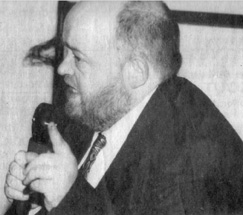
Mr. Malachy Keys, whose daughter, Donna-Marie, was horrifically maimed and given a 20 per cent chance of recovery following the bombing, made the comment at the public meeting in the Silverbirch Hotel on Thursday night last as part of the Acute Hospitals Review Group headed up by Dr. Maurice Hayes.
The Drumragh Room was filled to capacity for the occasion with people from all walks of life, including eminent consultants and medical staff from the beleaguered County Hospital.
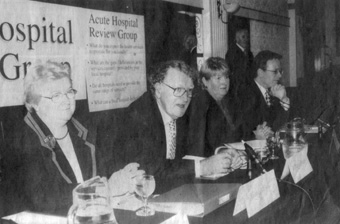
Joining Dr. Hayes were Dr. Tom Black, a GP; Libby Keys, chairperson of'the Rural Community Network; Fionnuala Cook, of the Social Services; Gary Love, retired consultant physician; and Professor Brian Edwards, of the University of Sheffield.
Mr. Keyes said he had come pure and simply to highlight to the Hayes Commission the amount of feeling within the town about the hospitals' issue.
He said a hospital was the most important thing in any community, but particularly in Omagh.
"Whenever we look back to August 1998, with the terrible bombing and the injuries and the rest, the people in the hospital gave Donna-Marie a 20 per cent chance of survival. Without the care she received she would not be here.
"The expertise and professionalism that Omagh Hospital showed on the day of the bomb was unbelievable. If the hospital was a commercial industry and the workers had shown such professionalism, they would be investing money in it. They would be getting awards for industry. Because it is a hospital the Government seems to think they can spend money where they need it," he said.
Mr. Keyes continued: "Making the trip from Omagh or Enniskillen to Belfast is like asking someone in Birmingham to travel to London. I don't think the Government is committed to Northern Ireland enough to give us a proper infrastructure."
"The lesson should have been learned from the maternity services going to Enniskillen that was a waste of time and money and everything else and I am sure that people have not put enough thought into this," he said, adding that he felt the Western Health Board was operating a policy of "divide and conquer".
Mr. Keyes continued: "If the money was reinvested it would take very little for us to have a facility that is second-to-none".
He said that people here lived in a very small rural Province and it took them twice as long to get anywhere because of the poor condition of the infrastructure.
"I was thoroughly disgusted within a few weeks of the bomb. We were talking one day and it came up that they were considering closing another department in Omagh hospital. This is a community trying to cope after a bomb and people are supposed to be looking after us. The Western Board has let people down.
"A ridiculous amount of money has been spent on reviews and I hope coming here is not a cosmetic exercise rather than doing something about it. We need to do something now and soon. We cannot go on like this any longer. Staff are demoralised and the are not getting support or help," Mr. Keyes said.
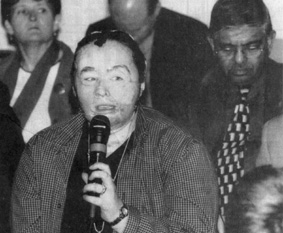
One of the first speakers was Mrs. Donna-Marie McGillion, who suffered horrific injuries in the Omagh bombing.
'Part of the future'
She told the public meeting that the hospital was part of the future for the children of the town and the people needed services that were close at hand.
She was also critical of the way in which women's health care provision was being eroded, and commented that it always seemed to be women who had to travel for treatment, which placed great strain on families and home environments.
"The main reason I am here is because we want a better future. What better future can you have if your hospital is not here?" she asked.
She also highlighted how exhausting travelling long distances were for her family, not only physically, but emotionally, and that during her treatment for her many burn and bomb blast injuries she had also found the constant travelling exhausting.
"I have heard that if the County Hospital had not been located in Omagh, and had the experts it had, there would have been another 35 or more fatalities in August 1998. I would like to thank the hospital staff for their work and I will be devastated if they go.
"We have got to look to the future and to do the best we can for our children," she added
Review's aim
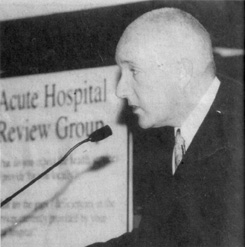
Outlining the purpose and background of the review, Dr. Hayes said that the aim was to examine the position of acute hospital services, access, standards and the quality of services and to make recommendations, as well as to sample the views of individuals and organisations.
He stressed that the role of the group was not to answer questions, but to listen to the points made from people who attended.
He said the group's remit was fairly broad from the Minister for Health and Public Safety, Ms. Bairbre de Brun, and he assured the meeting there was no hidden agenda.
He said the group would do its best to "get it right", and hoped to have its investigations concluded by Easter.
"We appreciate that it is important that we end the uncertainty for people in a lot of areas. Developments are pending and we want to give people the opportunity for moving on," Dr. Hayes said.
He went on to assure the people of Omagh that it would be a system that would put patients first and the review itself would be patients' centred. He said that services had to react to the fact that people were entitled to the best and safest care possible, and the group believed in equity of access.
"A patient should not be more at risk in the middle of Tyrone than in Belfast. We believe that there has to be a balance of services," he said, and continued: "Our thought is that there should be a system of maximum decentralisation, with a maximum of dealing with people in their own patch. We want to redress waiting lists for elective surgery and ensure people have timely access to services."
The Review Group chairman said that there were a number of places where there was concern about service provision. These were Omagh, Enniskillen, Dungannon, Magherafelt, Downpatrick and Newtownabbey.
Campaign group
The members of Rush, Simpson and Taylor campaign group in Omagh produced a circular with information and statistics about the services in the County Hospital, the Ambulance Service, first aid training programmes for schools, and the need for rapid response teams, which they circulated.
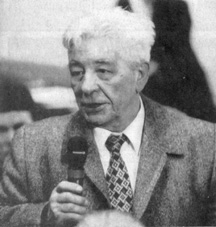
Mr. Laurence Rush, whose wife, Libbi, died in the August 15 atrocity, also thanked the hospital staff on behalf of the people of Omagh, for the work that they had done.
He stressed the fact that the County Hospital had been in existence for over 230 years, and the fact that the community had been fighting against closures since 1978.
Mr. Tom Crawford echoed the desires of many when he told the Review Group that what people in the South West and in Mid-Tyrone wanted were full maternity and paediatric services as well as any other scanning services available elsewhere.
He also questioned why local people had to travel miles to get their medical treatment.
"Ninety to 95 per cent of average treatments required should be within a 20 to 25 mile journey. People here have to travel too far," he said, adding that we no longer have rail travel in Tyrone and the fact that the roads network required massive improvements.
Mr. Crawford, like many others, told the Review Group that Omagh was the natural geographic centre for a new hospital.
Care courses
The principal of Omagh College, Mr. Seamus Devlin, also highlighted how the college was offering a wide range of nursing and professional care courses aimed at continuing professional development, and degree courses were also available in nursing.
He urged the Review Group to consider this when deciding where the hospital for the South West should be.
Mr. Peter McKenna, from Gortin, representing Age Concern, said that those who lived in rural areas and had to travel as it is also deserved to be given consideration.
He said the Gortin area covered anywhere up to 25 north of Omagh, and people in that area lived on the outside of the "golden hour" in terms of travelling for care in an emergency.
"Any movement of the hospital away from Omagh would double that," he said.
Professor Patrick Darcy urged the Review Group to look at the issue of health care provision globally and not with blinkered vision as had occured with previous reviews, while Mr Gerry O' Doherty stressed that what people needed was peace of mind.
As Mr. Michael Pollard, who is retired from the Department of the Environment, outlined a number of incidents that had occurred during his time "on the roads" for the Department.
On one occasion he said he and his staff were asked to provide assistance following a crash at Killeter in which four people were injured. It took staff and ambulance staff four hours to get the ambulance from the town to Killeter and back to Omagh.
In another situation staff were called out to assist an ambulance that had gone off the road between Dromore and Enniskillen. Roads staff ended up having to use a snow plough to tow the ambulance and the patient a pregnant woman in labour to Enniskillen.
He said he later got a letter from the woman explaining that they had made it to hospital with 10 minutes to spare.
Mr. Pollard urged the Review Group to consult with the Roads Service staff before coming to any decision.
Omagh best place for hospital
Meanwhile, Mr. Bill Reilly, president of Omagh Chamber of Commerce and Industry, urged the Review Group to look closely at the area any new-build hospital might be located.
He said any future provision should have support staff, 24-hour cover, back-up staff, education facilities and such like, and added that he did not think the Government would stretch to providing money to operate two hospitals.
"You must choose the most convenient location for a hospital which can serve the maximum number of people, giving the minimum travelling distance," he said, adding that Omagh was the natural choice considering its central location in the area.
Mr. Seamus Kerr, from Carrickmore, told the Review Group that the town lay in an area at the confluence of three Education Boards and three Health Boards, and he said the peripheral nature of Carrickmore added to its burden by compounding the problems people faced.
He said everyone aspired to having a golden hospital on their doorstep, but the fact remained that there had been a complete run down of services in the west of the Province.
Disadvantaged area
Mary T. Conway, of Owenkillew Development Association commended previous speakers for their comments, and spoke of how the Sperrins area was considered an area of disadvantage.
She said that in a recent survey, the elderly said that if services were moved from Omagh they simply would not attend for appointments due to the amount of travelling involved in getting to Omagh and then getting transport to Enniskillen or elsewhere.
Mr. Phil Newton, of the Western Cardiac Support group, sponsored by Northern Ireland Chest Heart and Stroke Association, also stressed the importance of travel and time in getting gravely ill patients to hospital on time.
He cited one drug used when people had cardiac arrest, which had to be administered within half-an-hour if the patient was going to survive, and he added that he and his colleagues would like to see new ambulances, not second-hand vehicles from England, on the road here.
'Halt downgrading'
Local politicians, Mr. Joe Byrne, Mr. Barry McElduff and Mr. Pat McDonnell also spoke, urging no further downgrading of services locally until new provision was made, while Jacqueline Teague, a staff nurse from the County Hospital, said that on recent training courses in Belfast she realised that the type of practices being used in Omagh were infinitely superior to those used in the big hospitals.
She also highlighted an instance in which she had to accompany a patient to Belfast. On arrival the patient was taken to a ward, and despite 10 members of staff being on duty, no one asked her for a verbal report on the patient. She said they asked her to leave the patient's notes and they would look at them later.
Mr. Frank McCarthy told the Review Group that he was "a blow in" whose decision to settle in Omagh had been greatly influenced by the presence of an acute services hospital in the town.
"There are many more people like myself. Omagh is a regional centre and a town with aspirations for economic development. To attract people to this own you do need an acute hospital," he said.
Those who were unable to attend the Public Meeting, and would like to make a contribution to the debate, can forward letters to the Acute Hospital Review Group, PO Box 1410, Belfast, BT1 4TA.
Alternatively, those with access in e-mail, can log on to comments@ahrg.gov.uk.
By: Olga Bradshaw
The need to retain acute hospital services in Omagh was stressed by many of the hundreds of local people who attended a meeting of a body set up to examine the future of service provision in Northern Ireland.
One speaker said that the "better future" many hoped for themselves and their families was unachievable if the main town in the area did not have an hospital. And the father of an Omagh bomb survivor told the Hayes Commission that if Tyrone County Hospital was a commercial industry it would be attracting investment and awards not being run into the ground.
Mr. Malachy Keys, whose daughter, Donna-Marie, was horrifically maimed and given a 20 per cent chance of recovery following the bombing, made the comment at the public meeting in the Silverbirch Hotel on Thursday night last as part of the Acute Hospitals Review Group headed up by Dr. Maurice Hayes.
The Drumragh Room was filled to capacity for the occasion with people from all walks of life, including eminent consultants and medical staff from the beleaguered County Hospital.
Joining Dr. Hayes were Dr. Tom Black, a GP; Libby Keys, chairperson of'the Rural Community Network; Fionnuala Cook, of the Social Services; Gary Love, retired consultant physician; and Professor Brian Edwards, of the University of Sheffield.
Mr. Keyes said he had come pure and simply to highlight to the Hayes Commission the amount of feeling within the town about the hospitals' issue.
He said a hospital was the most important thing in any community, but particularly in Omagh.
"Whenever we look back to August 1998, with the terrible bombing and the injuries and the rest, the people in the hospital gave Donna-Marie a 20 per cent chance of survival. Without the care she received she would not be here.
"The expertise and professionalism that Omagh Hospital showed on the day of the bomb was unbelievable. If the hospital was a commercial industry and the workers had shown such professionalism, they would be investing money in it. They would be getting awards for industry. Because it is a hospital the Government seems to think they can spend money where they need it," he said.
Mr. Keyes continued: "Making the trip from Omagh or Enniskillen to Belfast is like asking someone in Birmingham to travel to London. I don't think the Government is committed to Northern Ireland enough to give us a proper infrastructure."
"The lesson should have been learned from the maternity services going to Enniskillen that was a waste of time and money and everything else and I am sure that people have not put enough thought into this," he said, adding that he felt the Western Health Board was operating a policy of "divide and conquer".
Mr. Keyes continued: "If the money was reinvested it would take very little for us to have a facility that is second-to-none".
He said that people here lived in a very small rural Province and it took them twice as long to get anywhere because of the poor condition of the infrastructure.
"I was thoroughly disgusted within a few weeks of the bomb. We were talking one day and it came up that they were considering closing another department in Omagh hospital. This is a community trying to cope after a bomb and people are supposed to be looking after us. The Western Board has let people down.
"A ridiculous amount of money has been spent on reviews and I hope coming here is not a cosmetic exercise rather than doing something about it. We need to do something now and soon. We cannot go on like this any longer. Staff are demoralised and the are not getting support or help," Mr. Keyes said.
One of the first speakers was Mrs. Donna-Marie McGillion, who suffered horrific injuries in the Omagh bombing.
'Part of the future'
She told the public meeting that the hospital was part of the future for the children of the town and the people needed services that were close at hand.
She was also critical of the way in which women's health care provision was being eroded, and commented that it always seemed to be women who had to travel for treatment, which placed great strain on families and home environments.
"The main reason I am here is because we want a better future. What better future can you have if your hospital is not here?" she asked.
She also highlighted how exhausting travelling long distances were for her family, not only physically, but emotionally, and that during her treatment for her many burn and bomb blast injuries she had also found the constant travelling exhausting.
"I have heard that if the County Hospital had not been located in Omagh, and had the experts it had, there would have been another 35 or more fatalities in August 1998. I would like to thank the hospital staff for their work and I will be devastated if they go.
"We have got to look to the future and to do the best we can for our children," she added
Review's aim
Outlining the purpose and background of the review, Dr. Hayes said that the aim was to examine the position of acute hospital services, access, standards and the quality of services and to make recommendations, as well as to sample the views of individuals and organisations.
He stressed that the role of the group was not to answer questions, but to listen to the points made from people who attended.
He said the group's remit was fairly broad from the Minister for Health and Public Safety, Ms. Bairbre de Brun, and he assured the meeting there was no hidden agenda.
He said the group would do its best to "get it right", and hoped to have its investigations concluded by Easter.
"We appreciate that it is important that we end the uncertainty for people in a lot of areas. Developments are pending and we want to give people the opportunity for moving on," Dr. Hayes said.
He went on to assure the people of Omagh that it would be a system that would put patients first and the review itself would be patients' centred. He said that services had to react to the fact that people were entitled to the best and safest care possible, and the group believed in equity of access.
"A patient should not be more at risk in the middle of Tyrone than in Belfast. We believe that there has to be a balance of services," he said, and continued: "Our thought is that there should be a system of maximum decentralisation, with a maximum of dealing with people in their own patch. We want to redress waiting lists for elective surgery and ensure people have timely access to services."
The Review Group chairman said that there were a number of places where there was concern about service provision. These were Omagh, Enniskillen, Dungannon, Magherafelt, Downpatrick and Newtownabbey.
Campaign group
The members of Rush, Simpson and Taylor campaign group in Omagh produced a circular with information and statistics about the services in the County Hospital, the Ambulance Service, first aid training programmes for schools, and the need for rapid response teams, which they circulated.
Mr. Laurence Rush, whose wife, Libbi, died in the August 15 atrocity, also thanked the hospital staff on behalf of the people of Omagh, for the work that they had done.
He stressed the fact that the County Hospital had been in existence for over 230 years, and the fact that the community had been fighting against closures since 1978.
Mr. Tom Crawford echoed the desires of many when he told the Review Group that what people in the South West and in Mid-Tyrone wanted were full maternity and paediatric services as well as any other scanning services available elsewhere.
He also questioned why local people had to travel miles to get their medical treatment.
"Ninety to 95 per cent of average treatments required should be within a 20 to 25 mile journey. People here have to travel too far," he said, adding that we no longer have rail travel in Tyrone and the fact that the roads network required massive improvements.
Mr. Crawford, like many others, told the Review Group that Omagh was the natural geographic centre for a new hospital.
Care courses
The principal of Omagh College, Mr. Seamus Devlin, also highlighted how the college was offering a wide range of nursing and professional care courses aimed at continuing professional development, and degree courses were also available in nursing.
He urged the Review Group to consider this when deciding where the hospital for the South West should be.
Mr. Peter McKenna, from Gortin, representing Age Concern, said that those who lived in rural areas and had to travel as it is also deserved to be given consideration.
He said the Gortin area covered anywhere up to 25 north of Omagh, and people in that area lived on the outside of the "golden hour" in terms of travelling for care in an emergency.
"Any movement of the hospital away from Omagh would double that," he said.
Professor Patrick Darcy urged the Review Group to look at the issue of health care provision globally and not with blinkered vision as had occured with previous reviews, while Mr Gerry O' Doherty stressed that what people needed was peace of mind.
As Mr. Michael Pollard, who is retired from the Department of the Environment, outlined a number of incidents that had occurred during his time "on the roads" for the Department.
On one occasion he said he and his staff were asked to provide assistance following a crash at Killeter in which four people were injured. It took staff and ambulance staff four hours to get the ambulance from the town to Killeter and back to Omagh.
In another situation staff were called out to assist an ambulance that had gone off the road between Dromore and Enniskillen. Roads staff ended up having to use a snow plough to tow the ambulance and the patient a pregnant woman in labour to Enniskillen.
He said he later got a letter from the woman explaining that they had made it to hospital with 10 minutes to spare.
Mr. Pollard urged the Review Group to consult with the Roads Service staff before coming to any decision.
Omagh best place for hospital
Meanwhile, Mr. Bill Reilly, president of Omagh Chamber of Commerce and Industry, urged the Review Group to look closely at the area any new-build hospital might be located.
He said any future provision should have support staff, 24-hour cover, back-up staff, education facilities and such like, and added that he did not think the Government would stretch to providing money to operate two hospitals.
"You must choose the most convenient location for a hospital which can serve the maximum number of people, giving the minimum travelling distance," he said, adding that Omagh was the natural choice considering its central location in the area.
Mr. Seamus Kerr, from Carrickmore, told the Review Group that the town lay in an area at the confluence of three Education Boards and three Health Boards, and he said the peripheral nature of Carrickmore added to its burden by compounding the problems people faced.
He said everyone aspired to having a golden hospital on their doorstep, but the fact remained that there had been a complete run down of services in the west of the Province.
Disadvantaged area
Mary T. Conway, of Owenkillew Development Association commended previous speakers for their comments, and spoke of how the Sperrins area was considered an area of disadvantage.
She said that in a recent survey, the elderly said that if services were moved from Omagh they simply would not attend for appointments due to the amount of travelling involved in getting to Omagh and then getting transport to Enniskillen or elsewhere.
Mr. Phil Newton, of the Western Cardiac Support group, sponsored by Northern Ireland Chest Heart and Stroke Association, also stressed the importance of travel and time in getting gravely ill patients to hospital on time.
He cited one drug used when people had cardiac arrest, which had to be administered within half-an-hour if the patient was going to survive, and he added that he and his colleagues would like to see new ambulances, not second-hand vehicles from England, on the road here.
'Halt downgrading'
Local politicians, Mr. Joe Byrne, Mr. Barry McElduff and Mr. Pat McDonnell also spoke, urging no further downgrading of services locally until new provision was made, while Jacqueline Teague, a staff nurse from the County Hospital, said that on recent training courses in Belfast she realised that the type of practices being used in Omagh were infinitely superior to those used in the big hospitals.
She also highlighted an instance in which she had to accompany a patient to Belfast. On arrival the patient was taken to a ward, and despite 10 members of staff being on duty, no one asked her for a verbal report on the patient. She said they asked her to leave the patient's notes and they would look at them later.
Mr. Frank McCarthy told the Review Group that he was "a blow in" whose decision to settle in Omagh had been greatly influenced by the presence of an acute services hospital in the town.
"There are many more people like myself. Omagh is a regional centre and a town with aspirations for economic development. To attract people to this own you do need an acute hospital," he said.
Those who were unable to attend the Public Meeting, and would like to make a contribution to the debate, can forward letters to the Acute Hospital Review Group, PO Box 1410, Belfast, BT1 4TA.
Alternatively, those with access in e-mail, can log on to comments@ahrg.gov.uk.
Further Information
Publisher: TYRONE CONSTITUTION
Ref: TC/1583
Published Date: 16-Nov-00
Related Images