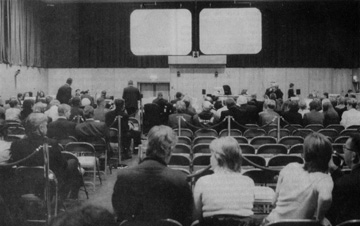
TERROR GROUP MJST TAKE FULL BLAME FOR BOMB CARNAGE
Terror group must take full blame
"THE Real IRA claimed responsibility for the car bomb, though they sought to pass the responsibility to the police for the casualties. As far as 1 am concerned they were responsible for all that happened."
These were the hard-hitting words the Coroner hearing the Omagh Inquest, Mr. John Leckey chose to conclude what has been a harrowing and deeply distressing four-week chapter in the history of Omagh.
He went on to commend the police, emergency services and. civilians who helped in the minutes, hours and days that followed the atrocity, and said that although the inquest was the closure of a chapter of the events of what happened, it would take the conviction and punishment of those responsible to "close the book" on what had happened in Omagh on August 15 two years ago.
In a prepared statement, Mr. Leckey acknowledged that the only remaining task for him was to hear the inquest into the death of young James Barker, which is to take place today (Thursday).
He said that in concluding the inquests into the individual deaths, he had also concluded hearing all the evidence relating to the circumstances in which their deaths had occurred.
"At the end of each individual inquest I expressed my sympathy to the bereaved family concerned. I would wish to take this opportunity to once again extend my heartfelt sympathy to all the bereaved families.
"The unborn twins who tragically were killed were on the verge of birth. I am sure that Mr. Monaghan will grieve for them as if they had been born. In reality the towns of Omagh and Buncrana have been bereaved and the loss extends much further afield to Spain and England.
"This reflects the international dimension of the atrocity which I referred to in my opening remarks. I have no doubt that what we have been engaged in has brought back painful memories for families bereaved in other terrorist atrocities, sadly too numerous to refer to individually, over the last 30 years in Northern Ireland. At this time I acknowledge their loss," Mr. Leckey said.
He said the last four weeks had been a difficult time for all involved.
"I personally found it an emotional experience the like of which I have never encountered previously and which I will never forget. I know I can speak also for my two counsel, Mrs. Loughran and Mr. Bullick and my staff.
"I have no doubt many others found it that way also. The investigation of the facts was often unpleasant and distressing. I always knew it was going to be and I do not believe it could have been otherwise," he said. ' Mr. Leckey went on to explain that he was not prepared to dilute the horror of what happened to Omagh.
"My strong view is that it would have been quite wrong for me to have engaged in an exercise whose purpose was to sanitise or dilute the horror perpetrated on behalf of the Real IRA. I believe that would not have served the interests of justice and it would have been unfair to the memory of those who died so tragically.
Important role
"Also," he said, "it would have marginalised the important role played by those involved in the immediate aftermath of the explosion in rescuing the injured and the recovery and identification of bodies.
"Let us not forget that the scene of the bomb explosion was a major crime scene and the police officers present would have been conscious of the important implications of that for the subsequent criminal investigation," he said.
Mr. Leckey went on to say that all those who gave evidence were clearly affected by what they had witnessed, and some so badly traumatised that they were unable to attend to give evidence. Those who did found it an ordeal.
"I have no doubt of that and I commend them for doing so. The physical presence in court of a witness adds considerably to the force of their evidence.
"Inevitably, police officers were in the front line in dealing with the dead and injured. The age of 'Robocop' has not yet dawned, it is still a film," he said.
Mr. Leckey continued: "The police officers who confronted the horror were real men and women, not robots without feelings and emotions. I am sure all who assisted in any way as a consequence of what happened - police officers, traffic wardens, civilians and members of the emergency services are grateful for the way the bereaved families acknowledged their efforts."
Condemning the Real IRA as responsible for all that happened in Omagh, he said the bomb warnings they gave were inadequate and misleading: "The self-serving statement they issued subsequently has been shown to be untrue", he added.
"If you park a car containing up to 200kgs of explosive in a busy shopping street, set a timer and walk away, you do not walk away from responsibility for any resultant carnage," he said.
"I share the hope, expressed so forcibly by many of the families, that those responsible for the bomb explosion are brought before a court of law and punished.
"The conclusion of these inquests may close a chapter in the story of the dreadful events that happened in Omagh on August 15, 1998, but a criminal trial and convictions will be necessary to close the book," he said.
Prior to making his statement, Mr. Leckey said that the system of recording unnatural deaths in Northern Ireland differed from that in England and Wales, in that on the mainland he could record a verdict of unlawful killing in respect of murder, manslaughter or infanticide.
He said he had no such power in Northern Ireland, and that what he could record was that those who were killed died from injuries sustained from a car bomb explosion in Market Street, and that responsibility for it had been claimed on behalf of the Real IRA.
The Coroner went on to read his findings in respect of the dead, which were in accordance with the findings and reports of the State Pathologist, Professor Jack Crane, and the former Deputy State Pathologist, Dr. Derek Carson, since retired.
He said he was sure hearing "that long list" relating to 28 of those killed had been very difficult for many, and he said he would not want anyone to think it was routine to read something like that out. And he added that he recognised that each of the 28 names read out represented a great personal tragedy for each of the families.
He went on to say that he had the power as Coroner to make a report to the Chief Constable and Secretary of State in any instance where it was found that action taken by police clearing a scene or conducting an evacuation was inadequate.
He said he had thought about the matter a great length since it had been raised, and he felt obliged to respond to it before the close of proceedings.
He said he had had occasion in the past to make a report to the relevant authorities, but it was something he had done only a few times.
In this instance, he said, there was no basis for such action to be taken.
He said it went without saying that after a major incident involving loss of life, there had to be an appraisal of what happened on the day and if lessons could be learned for the future.
He said he was sure that the legal counsel representing the Chief Constable, Mr. Stephen Ritchie, and his instructing solicitor, would be reporting back to Sir Ronnie Flanagan on any issue raised.
He said he was grateful to legal representatives for teasing out relevant issues in the case, and said it was a matter to which he had paid great attention.
Sympathy
Mr. Ritchie also spoke at the conclusion of the inquest. He extended deepest sympathy on behalf of the chief constable and himself to the bereaved, those injured and traumatised on their loss and suffering.
He said it was extremely difficult to grasp the enormity of of the pain, grief and anguish that had been inflicted on the people of Omagh.
"It has been a difficult case. When I was asked to appear, I knew it would be traumatic and harrowing. Who could forget the day these events happened? But nothing could really prepare one for the full horror that emerged," he said.
He said the actions of those who showed humanity on the day was in sharp contrast to the brutal disregard for human life and suffering that was shown by the terrorists.
Mr. Ritchie said that he hoped that if any good emerged from the events of Omagh that it would be that, perhaps, those who would be persuaded or feel it was the right thing to become involved in such events in the future, would be dissuaded and realise such acts of violence were utterly futile.
"THE Real IRA claimed responsibility for the car bomb, though they sought to pass the responsibility to the police for the casualties. As far as 1 am concerned they were responsible for all that happened."
These were the hard-hitting words the Coroner hearing the Omagh Inquest, Mr. John Leckey chose to conclude what has been a harrowing and deeply distressing four-week chapter in the history of Omagh.
He went on to commend the police, emergency services and. civilians who helped in the minutes, hours and days that followed the atrocity, and said that although the inquest was the closure of a chapter of the events of what happened, it would take the conviction and punishment of those responsible to "close the book" on what had happened in Omagh on August 15 two years ago.
In a prepared statement, Mr. Leckey acknowledged that the only remaining task for him was to hear the inquest into the death of young James Barker, which is to take place today (Thursday).
He said that in concluding the inquests into the individual deaths, he had also concluded hearing all the evidence relating to the circumstances in which their deaths had occurred.
"At the end of each individual inquest I expressed my sympathy to the bereaved family concerned. I would wish to take this opportunity to once again extend my heartfelt sympathy to all the bereaved families.
"The unborn twins who tragically were killed were on the verge of birth. I am sure that Mr. Monaghan will grieve for them as if they had been born. In reality the towns of Omagh and Buncrana have been bereaved and the loss extends much further afield to Spain and England.
"This reflects the international dimension of the atrocity which I referred to in my opening remarks. I have no doubt that what we have been engaged in has brought back painful memories for families bereaved in other terrorist atrocities, sadly too numerous to refer to individually, over the last 30 years in Northern Ireland. At this time I acknowledge their loss," Mr. Leckey said.
He said the last four weeks had been a difficult time for all involved.
"I personally found it an emotional experience the like of which I have never encountered previously and which I will never forget. I know I can speak also for my two counsel, Mrs. Loughran and Mr. Bullick and my staff.
"I have no doubt many others found it that way also. The investigation of the facts was often unpleasant and distressing. I always knew it was going to be and I do not believe it could have been otherwise," he said. ' Mr. Leckey went on to explain that he was not prepared to dilute the horror of what happened to Omagh.
"My strong view is that it would have been quite wrong for me to have engaged in an exercise whose purpose was to sanitise or dilute the horror perpetrated on behalf of the Real IRA. I believe that would not have served the interests of justice and it would have been unfair to the memory of those who died so tragically.
Important role
"Also," he said, "it would have marginalised the important role played by those involved in the immediate aftermath of the explosion in rescuing the injured and the recovery and identification of bodies.
"Let us not forget that the scene of the bomb explosion was a major crime scene and the police officers present would have been conscious of the important implications of that for the subsequent criminal investigation," he said.
Mr. Leckey went on to say that all those who gave evidence were clearly affected by what they had witnessed, and some so badly traumatised that they were unable to attend to give evidence. Those who did found it an ordeal.
"I have no doubt of that and I commend them for doing so. The physical presence in court of a witness adds considerably to the force of their evidence.
"Inevitably, police officers were in the front line in dealing with the dead and injured. The age of 'Robocop' has not yet dawned, it is still a film," he said.
Mr. Leckey continued: "The police officers who confronted the horror were real men and women, not robots without feelings and emotions. I am sure all who assisted in any way as a consequence of what happened - police officers, traffic wardens, civilians and members of the emergency services are grateful for the way the bereaved families acknowledged their efforts."
Condemning the Real IRA as responsible for all that happened in Omagh, he said the bomb warnings they gave were inadequate and misleading: "The self-serving statement they issued subsequently has been shown to be untrue", he added.
"If you park a car containing up to 200kgs of explosive in a busy shopping street, set a timer and walk away, you do not walk away from responsibility for any resultant carnage," he said.
"I share the hope, expressed so forcibly by many of the families, that those responsible for the bomb explosion are brought before a court of law and punished.
"The conclusion of these inquests may close a chapter in the story of the dreadful events that happened in Omagh on August 15, 1998, but a criminal trial and convictions will be necessary to close the book," he said.
Prior to making his statement, Mr. Leckey said that the system of recording unnatural deaths in Northern Ireland differed from that in England and Wales, in that on the mainland he could record a verdict of unlawful killing in respect of murder, manslaughter or infanticide.
He said he had no such power in Northern Ireland, and that what he could record was that those who were killed died from injuries sustained from a car bomb explosion in Market Street, and that responsibility for it had been claimed on behalf of the Real IRA.
The Coroner went on to read his findings in respect of the dead, which were in accordance with the findings and reports of the State Pathologist, Professor Jack Crane, and the former Deputy State Pathologist, Dr. Derek Carson, since retired.
He said he was sure hearing "that long list" relating to 28 of those killed had been very difficult for many, and he said he would not want anyone to think it was routine to read something like that out. And he added that he recognised that each of the 28 names read out represented a great personal tragedy for each of the families.
He went on to say that he had the power as Coroner to make a report to the Chief Constable and Secretary of State in any instance where it was found that action taken by police clearing a scene or conducting an evacuation was inadequate.
He said he had thought about the matter a great length since it had been raised, and he felt obliged to respond to it before the close of proceedings.
He said he had had occasion in the past to make a report to the relevant authorities, but it was something he had done only a few times.
In this instance, he said, there was no basis for such action to be taken.
He said it went without saying that after a major incident involving loss of life, there had to be an appraisal of what happened on the day and if lessons could be learned for the future.
He said he was sure that the legal counsel representing the Chief Constable, Mr. Stephen Ritchie, and his instructing solicitor, would be reporting back to Sir Ronnie Flanagan on any issue raised.
He said he was grateful to legal representatives for teasing out relevant issues in the case, and said it was a matter to which he had paid great attention.
Sympathy
Mr. Ritchie also spoke at the conclusion of the inquest. He extended deepest sympathy on behalf of the chief constable and himself to the bereaved, those injured and traumatised on their loss and suffering.
He said it was extremely difficult to grasp the enormity of of the pain, grief and anguish that had been inflicted on the people of Omagh.
"It has been a difficult case. When I was asked to appear, I knew it would be traumatic and harrowing. Who could forget the day these events happened? But nothing could really prepare one for the full horror that emerged," he said.
He said the actions of those who showed humanity on the day was in sharp contrast to the brutal disregard for human life and suffering that was shown by the terrorists.
Mr. Ritchie said that he hoped that if any good emerged from the events of Omagh that it would be that, perhaps, those who would be persuaded or feel it was the right thing to become involved in such events in the future, would be dissuaded and realise such acts of violence were utterly futile.
Further Information
Publisher: TYRONE CONSTITUTION
Ref: TC/1570
Published Date: 05-Oct-00
Related Images