PETALS OF HOPE' TRIBUTE TO OMAGH BOMB VICTIMS
Petals of Hope tribute to Omagh bomb victims
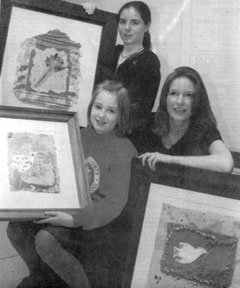
THE sea of floral tributes which flooded Omagh in the immediate aftermath of the August 15 bombing last year have gone on display in the town's library in the form of delicate paper art.
The exhibition, "Petals of Hope Rays of Light", opened on Monday evening, seven months to the date after 29 people died, and hundreds more were severely injured and maimed by the 3001b car bomb which exploded in Market Street.
In addition to framed pieces for each of the families bereaved by the bombing, there are three large pieces of works, measuring eight feet in length and six feet high and in each of them olive leaves, a gift to Omagh, are used.
Olive leaves are an age old symbol of peace, and the particular leaves used were sent to Omagh from Nairobi.
The idea originated in Italy, where children had sent olive leaves to Nairobi as a symbol of love and support, friendship and prayer, after the explosion in the American Embassy there, and were used in a torchlight parade in commemoration of the dead.
A missionary from Nairobi sent the leaves to the Church of Ireland in Omagh as a symbol of solidarity, and by their use in the large pieces they have become a lasting testament to the thousands of people around the world who to shared their prayers with the people of the town.
Seventeen schools in the Omagh district, as well as from Strabane and Buncrana, sent pupils to work on the project in September and October last year among them siblings and close relatives of those who had died in the atrocity.
Displayed alongside the rainbow of paper and petal pictures are an estimated two million messages of sympathy which have been catalogued and turned into Books of Condolence from men, women and children from all four corners of the Globe.
Condolence
Included in the exhibition is the Omagh Book of Condolence, which has five volumes and contains an estimated 35,000 signatures.
Other Books of Condolence have come to the town from all over the world including the UK, USA, Europe, Australia, Switzerland, New Zealand and Canada.
Some 173 books were received from councils in Ireland and the UK, while the people of Co. Cork sent a Book of Condolence eight inches thick, containing around 17,000 signatures and messages.
The exhibition includes flags, scrolls, postcards, pictures and posters as well as Japanese art, and there are around 30,000 E-Mail messages.
Mammoth task
Among those who attended the launch of the exhibition were relatives of those who perished in the blast, or people who became involved in the mammoth task of drying the flowers and creating something positive from the fragile tokens of love and support, which had been left in High Street and Market Street in the weeks after the bombing.
The guest of honour, who also performed the official opening of the exhibition, was Mr. Brian Walker, chairman of the Arts Council for Northern Ireland, who was appointed to the post a fortnight before the market town became headline news at home and abroad.
"To Come down here and see something so positive and beautiful and creative come out of such terrible devastation is very moving and I was greatly honoured to be asked here," he said.
"All I can say is that I am immensely impressed and 1 think it is wonderful what people have been able to do.
Mr Walker went on to pay tribute to Mr. Frank Sweeney, the arts and tourism officer at Omagh District Council, for the work that he had put into the exhibition. "
"It is an amazing piece, of work and I congratulate him. I think the idea of touring the exhibition is a good one. I think it would be very impressive for so many other people of they could see this. I really have been much taken by it," he said.
Meanwhile, Mr. Sweeney, who acted as MC for the launch, said that the project had come about through a telephone call from Miss Carol Kane, an artist, who had asked what was going to happen to the floral tributes which had been left in the town centre by well-wishers.
At that stage, he said, no decision had been taken about what to do with the flowers, and it had been Miss Kane's suggestion to turn them into paper.
"She took these flowers and turned them into something positive and healing," he said.
"This is a significant exhibition in the history of this area, which links together the thousands of people around the world who sent messages and the thousands of people who left or sent flowers."
Mr. Sweeney wept on to thank the staff at the council's works department who collected the flowers daily and spread them out to dry. He also paid tribute to the Western Education and Library Board for the use of the library to stage the exhibition, and the staff and management at Display-It for the framing work done on the floral exhibits.
Mr. Sweeney went on to explain that one of the large pieces of work which was made by primary school age children in the town would make its final home in Buncrana. The other two pieces will be put on display as public pieces,of art - one in Omagh and the other in Madrid.
"This is appropriate because of the young age of the three Buncrana children killed in the bomb. I would like to take the exhibition to Buncrana and display it there, because people there would like to see it too," he said.
"The artwork demonstrates the notion that creativity and positivity was the reaction of people to the destruction of the bomb."
He went on to urge people to "spread the word" that the exhibition had opened and would be on display in the library until April 2.
Miss Kane said that, as an outsider to Omagh, she was struck by the amount of. concern shown through floral tributes given by people from all over the world
"I wondered what would happen to the flowers, so 1 suggested we could use them to make creative pieces of art.
Therapeutic
"In my own work I make handmade paper using flowers. I felt that together, these flowers and this process could become a therapeutic activity for those from Omagh and other affected towns." she said.
Miss Kane went on to pay tribute to those who gave up their free time to become involved in the project, and said: "By getting people together, we produced these pictures as tokens of concern About 125 people, minimum, were involved at some stage or another, including primary school children, young people from post primary schools and volunteers." .
She went on to thank Nobel Laureate, Seamus Heaney, who wrote a verse from his poem, "The Cure at Troy" in the Book of Condolence at Bellaghy Bawn, and who gave permission for the stanza to be used as titles for the three large pieces of floral paper art which are destined for Omagh. Buncrana and Madrid in Spain.
Miss Kane also thanked Mr Sweeney and Miss Jean Brennan, the arts officer for the district, for the support and help they had given during the course of the project.
"1 have found these past few months quite an experience It has been a great blessing to he able to oversee this work take place.
"I have gained tremendous satisfaction watching this paper-making process from the preparation of the flowers, through to the viewing of the work this evening." she said.
The council s head of development, Mr. Vincent Brogan, said that following the atrocity the town immediately became a focus for world attention.
United
"The slaughter on that summer afternoon in our Market Street struck a cord and united the people of Madrid, Buncrana and Omagh in grief. The images that were transmitted all over the work provoked an overwhelming response, a huge outpouring of compassion and love," he said.
Mr. Brogan said expressions of sympathy immediately began to pour into the council offices in Omagh, while many people were moved to compose poems and send other messages of solidarity.
The council opened Books of Condolence throughout the district, and it was learned that similar books were being opened all over Ireland and the rest of the world.
"As the books arrived it became apparent that people had taken the opportunity to express their heartfelt thoughts, hopes and prayers for those who were bereaved and injured. Many of the books were delivered personally and with great reverence," he said.
Mr. Brogan said the number of books received by the town was approaching 800 and within them there was an estimated two million signatures.
"That means two million men, women and children have Omagh in their thoughts - we have not been forgotten," he said.
Mr. Brogan went on to describe the collection as a collective "expression of support and love for all those affected by the bomb".
They are a testimony to the people of Buncrana, Omagh and Madrid. It is our hope that this, exhibition will bring some comfort to the victims and will be a milestone in the healing process," he added.
On behalf of the Omagh Support and Self-Help Group, the group's chairman, Mr. Michael Gallagher, thanked everyone involved in both the flower project and the collation of the Books of Condolence and added that the people in the council and at all levels deserved thanks.
THE sea of floral tributes which flooded Omagh in the immediate aftermath of the August 15 bombing last year have gone on display in the town's library in the form of delicate paper art.
The exhibition, "Petals of Hope Rays of Light", opened on Monday evening, seven months to the date after 29 people died, and hundreds more were severely injured and maimed by the 3001b car bomb which exploded in Market Street.
In addition to framed pieces for each of the families bereaved by the bombing, there are three large pieces of works, measuring eight feet in length and six feet high and in each of them olive leaves, a gift to Omagh, are used.
Olive leaves are an age old symbol of peace, and the particular leaves used were sent to Omagh from Nairobi.
The idea originated in Italy, where children had sent olive leaves to Nairobi as a symbol of love and support, friendship and prayer, after the explosion in the American Embassy there, and were used in a torchlight parade in commemoration of the dead.
A missionary from Nairobi sent the leaves to the Church of Ireland in Omagh as a symbol of solidarity, and by their use in the large pieces they have become a lasting testament to the thousands of people around the world who to shared their prayers with the people of the town.
Seventeen schools in the Omagh district, as well as from Strabane and Buncrana, sent pupils to work on the project in September and October last year among them siblings and close relatives of those who had died in the atrocity.
Displayed alongside the rainbow of paper and petal pictures are an estimated two million messages of sympathy which have been catalogued and turned into Books of Condolence from men, women and children from all four corners of the Globe.
Condolence
Included in the exhibition is the Omagh Book of Condolence, which has five volumes and contains an estimated 35,000 signatures.
Other Books of Condolence have come to the town from all over the world including the UK, USA, Europe, Australia, Switzerland, New Zealand and Canada.
Some 173 books were received from councils in Ireland and the UK, while the people of Co. Cork sent a Book of Condolence eight inches thick, containing around 17,000 signatures and messages.
The exhibition includes flags, scrolls, postcards, pictures and posters as well as Japanese art, and there are around 30,000 E-Mail messages.
Mammoth task
Among those who attended the launch of the exhibition were relatives of those who perished in the blast, or people who became involved in the mammoth task of drying the flowers and creating something positive from the fragile tokens of love and support, which had been left in High Street and Market Street in the weeks after the bombing.
The guest of honour, who also performed the official opening of the exhibition, was Mr. Brian Walker, chairman of the Arts Council for Northern Ireland, who was appointed to the post a fortnight before the market town became headline news at home and abroad.
"To Come down here and see something so positive and beautiful and creative come out of such terrible devastation is very moving and I was greatly honoured to be asked here," he said.
"All I can say is that I am immensely impressed and 1 think it is wonderful what people have been able to do.
Mr Walker went on to pay tribute to Mr. Frank Sweeney, the arts and tourism officer at Omagh District Council, for the work that he had put into the exhibition. "
"It is an amazing piece, of work and I congratulate him. I think the idea of touring the exhibition is a good one. I think it would be very impressive for so many other people of they could see this. I really have been much taken by it," he said.
Meanwhile, Mr. Sweeney, who acted as MC for the launch, said that the project had come about through a telephone call from Miss Carol Kane, an artist, who had asked what was going to happen to the floral tributes which had been left in the town centre by well-wishers.
At that stage, he said, no decision had been taken about what to do with the flowers, and it had been Miss Kane's suggestion to turn them into paper.
"She took these flowers and turned them into something positive and healing," he said.
"This is a significant exhibition in the history of this area, which links together the thousands of people around the world who sent messages and the thousands of people who left or sent flowers."
Mr. Sweeney wept on to thank the staff at the council's works department who collected the flowers daily and spread them out to dry. He also paid tribute to the Western Education and Library Board for the use of the library to stage the exhibition, and the staff and management at Display-It for the framing work done on the floral exhibits.
Mr. Sweeney went on to explain that one of the large pieces of work which was made by primary school age children in the town would make its final home in Buncrana. The other two pieces will be put on display as public pieces,of art - one in Omagh and the other in Madrid.
"This is appropriate because of the young age of the three Buncrana children killed in the bomb. I would like to take the exhibition to Buncrana and display it there, because people there would like to see it too," he said.
"The artwork demonstrates the notion that creativity and positivity was the reaction of people to the destruction of the bomb."
He went on to urge people to "spread the word" that the exhibition had opened and would be on display in the library until April 2.
Miss Kane said that, as an outsider to Omagh, she was struck by the amount of. concern shown through floral tributes given by people from all over the world
"I wondered what would happen to the flowers, so 1 suggested we could use them to make creative pieces of art.
Therapeutic
"In my own work I make handmade paper using flowers. I felt that together, these flowers and this process could become a therapeutic activity for those from Omagh and other affected towns." she said.
Miss Kane went on to pay tribute to those who gave up their free time to become involved in the project, and said: "By getting people together, we produced these pictures as tokens of concern About 125 people, minimum, were involved at some stage or another, including primary school children, young people from post primary schools and volunteers." .
She went on to thank Nobel Laureate, Seamus Heaney, who wrote a verse from his poem, "The Cure at Troy" in the Book of Condolence at Bellaghy Bawn, and who gave permission for the stanza to be used as titles for the three large pieces of floral paper art which are destined for Omagh. Buncrana and Madrid in Spain.
Miss Kane also thanked Mr Sweeney and Miss Jean Brennan, the arts officer for the district, for the support and help they had given during the course of the project.
"1 have found these past few months quite an experience It has been a great blessing to he able to oversee this work take place.
"I have gained tremendous satisfaction watching this paper-making process from the preparation of the flowers, through to the viewing of the work this evening." she said.
The council s head of development, Mr. Vincent Brogan, said that following the atrocity the town immediately became a focus for world attention.
United
"The slaughter on that summer afternoon in our Market Street struck a cord and united the people of Madrid, Buncrana and Omagh in grief. The images that were transmitted all over the work provoked an overwhelming response, a huge outpouring of compassion and love," he said.
Mr. Brogan said expressions of sympathy immediately began to pour into the council offices in Omagh, while many people were moved to compose poems and send other messages of solidarity.
The council opened Books of Condolence throughout the district, and it was learned that similar books were being opened all over Ireland and the rest of the world.
"As the books arrived it became apparent that people had taken the opportunity to express their heartfelt thoughts, hopes and prayers for those who were bereaved and injured. Many of the books were delivered personally and with great reverence," he said.
Mr. Brogan said the number of books received by the town was approaching 800 and within them there was an estimated two million signatures.
"That means two million men, women and children have Omagh in their thoughts - we have not been forgotten," he said.
Mr. Brogan went on to describe the collection as a collective "expression of support and love for all those affected by the bomb".
They are a testimony to the people of Buncrana, Omagh and Madrid. It is our hope that this, exhibition will bring some comfort to the victims and will be a milestone in the healing process," he added.
On behalf of the Omagh Support and Self-Help Group, the group's chairman, Mr. Michael Gallagher, thanked everyone involved in both the flower project and the collation of the Books of Condolence and added that the people in the council and at all levels deserved thanks.
Further Information
Publisher: TYRONE CONSTITUTION
Ref: TC/1326
Published Date: 18-Mar-99
Related Images