SCHOOL CELEBRATES SUCCESSES
School celebrates successes but prizegiving tinged by sadness in bomb aftermath
THE annual prizegiving at Omagh High School on Tuesday night was tinged with sadness and coloured by the events of the August 15 bombing of Market Street in the town, the headmaster, Mr. William Harper, said.
Speaking at the event, Mr. Harper said bomb victims Alan Radford and Lorraine Wilson would have been present at the prizegiving ceremony and he spoke of how the school was still overwhelmed by the loss of its pupils and former pupils who perished in the bombing.
"We are essentially a youthful community in school and I know in moments of personal reflection, years ahead, we will cast our minds back to our friends who were killed," he said.
"In our memories they will always be youthful. My thoughts tonight are with the relatives and friends who have lost loved ones and I would wish to assure them that our grief and our memories will not fade," he said.
Mr. Harper said the school was to act as a focus in the community, and offered sympathy to the relatives of its former pupils, Esther Gibson, Debra-Ann Cartwright, Samantha McFarland, Alan Radford and Lorraine Wilson, as well as of Mrs. Olive Hawkes, Mrs. Ann McCombe and Mrs Veda Short, who were mothers of pupils at the school.
He continued: "The injured pupils and former pupils are, in general, making a reasonable recovery, although in other situations there is a long way to go before anything like normal health can be restored.
"Their optimism, strength of character and lack of self pity in the face of difficulties are an example to us all.
"I would also like to state that, as headmaster, I was proud of our many pupils and former pupils who performed heroically at the scene of the explosion. The school is not self centred and would wish to look outwards and extend our sympathy to other schools and the families of all who died or were injured in the atrocity," Mr. Harper said.
Maximise
The principal said that it was one of the aims of the school that pupils not only maximise their academic potential, but be able to look back on their school days with pleasure and hold happy memories.
He said it was some little consolation that the pupils who were killed seemed, from their records, to have enjoyed their life at Omagh High School.
"Our dead colleagues were all excellent pupils at this school, pupils of whom any parent or school could be very proud. All could have looked forward with confidence to the future," he added.
Mr. Harper went on to acknowledge and extend thanks for the messages and tokens of sympathy the school received, and said it was clear that people of good will everywhere wished that such wanton violence as occurred in Omagh and other towns should stop.
"I join with the hundreds of people who have contacted us in praying that Omagh will engender such mass revulsion of violence that this evil act will play an important part in eliminating violence from political life.
"No one must ever overlook, attempt to marginalise or be dismissive of the suffering experienced in Omagh," Mr. Harper said.
Mr. Harper went on to pay tribute to his staff for the support they had shown.
During his address Mr. Harper also commented on what he saw as the increase in bureaucracy in schools, and said that there was a real danger that the sheer volume of paperwork which continued to descend, linked with the unremitting pace of change, could choke school administration and divert attention from schools' primary function of interacting with and influencing pupils.
"Striking a balance between our administrative and management functions and our leadership role is becoming increasingly difficult," he warned.
Mr. Harper said speedy introductions of programmes did not in itself produce improvements, and added that it was clear it was not only the teaching staff who were adversely affected by increased paperwork.
He went on to pay tribute to the administrative staff at the school, as well as the school nurse and ancillary staff, and those from inside and outside the school, who took time to sit on committees and on the Board of Governors.
Turning to the academic prowess of pupils at the school, he said GCSEs continued to be the main examinations for pupils, and he paid tribute to the highest achievers within the school.
In addition to GCSEs, he said, a variety of other examinations were used to assess the performance of pupils of all abilities, including the Associated Examinations Board, which offered basic skills qualifications in communication and numeracy.
"We entered 107 candidates for communication skills, 90 per cent of whom gained a pass or merit result. In numerical skills, 72 entries were made with 85 per cent gaining a pass or pass with merit grades. Indeed, five of our pupils achieved a 100 per cent score this examination," he said.
Success
Mr. Harper went on to outline the school's success in the Welsh Joint Education Committee certificates, in which all 150 entrants gained pass, merit or distinction grades in all subjects on which they were tested.
"Examinations provided by the Royal Society of Arts Board continue to prove suitable for our pupils and again I am pleased to report another 100 per cent pass rate for the Stage 1 computer literacy and information technology qualification. Forty one pupils were also entered for RSAs initial text processing examination, and 37 of them (90 per cent) gained a distinction grade," he said.
He said the school's high standard was maintained in the English Speaking Board's prevocational examination in oral communication, with 78 per cent of pupils gaining a pass, good pass or merit grades.
"The range of successes in various externally assessed examinations reflects our school's examinations' policy of selecting our external examinations carefully to cater for the needs of all our pupils and to challenge and extend pupils of all abilities," he said.
Mr. Harper added that the school's post-16 GNVQ provision continued to prosper.
In the past year the GNVQ choice was further enhanced with the introduction of business at advanced level, the equivalent to three A levels.
At Key Stage 3, for the first time, the school was assessed in English, mathematics and science, and, he said, he was particularly pleased with the results for mathematics and English.
This year 60.3 per cent of Year 10 pupils achieved level five and above in English, while 19.1 per cent gained level six and above.
In mathematics 36.8 per cent achieved level six, whereas the Northern Ireland average was only 15 per cent, he said.
Pupils achieving level five totalled 75 per cent, where the average was 45 per cent.
Omagh High was one of only 25 secondary schools selected to take part in the CCEA pilot scheme for the 1997-98 Key Stage 3 certificate of competence in Information Technology, and Mr. Harper said it was seen as a permanent assessment tool for information and communications technology by the school.
All of those who took part achieved certificates indicating their level of competence in each strand and an overall level of IT competence, he said.
Turning to special needs, he said that the introduction of the Code of Practice had necessitated the recording of pupil data, which had been transferred to the CLASS system.
"This is a school management computer system which now holds a register of SEN pupils within the school. However, it is essential that these records are used by all staff and that more staff become confident in using the information, so that individual pupils can benefit from our advanced management system."
Mr. Harper said it was felt that Omagh High had been a forerunner in the field of literacy development, having pioneered a successful literacy programme in recent years, and in terms of the National Literacy strategy, he said an example of progress was the creation of a book-tape library for the special needs department.
Support
"Our school is conscious of a network of support, extending from neighbouring and contributory schools, to staff at the Board, to parents and the local community, in our efforts to raise standards and meet the needs of our pupils.
"We see that it is only through all these elements of the network working together that the needs of pupils can be best met and we are pleased to play an influential role in developments in this area," Mr. Harper said.
Turning to pastoral care, he said relationships of all kinds were the bedrock of any school, and the schools personal and social education programme focused on all permutations, as well as on the best ways to achieve co-operation and nullify conflict.
He said young people had the right to be happy, healthy and secure, and the school took very seriously the responsibility it had under the government guidelines on child protection.
"Bullying is a perennial problem in schools and we tackle disruption pro-actively both through our teaching strategies and our disciplinary procedures, with, we hope, reasonable success."
In his address Mr. Harper also spoke on the diminishing school budget. He said that with active management the school had maintained and in many instances enhanced its level of academic pro-vision and technological support.
Trophies and special prizes
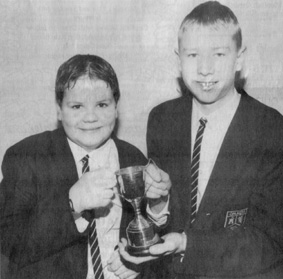
Gamble Cup, for best all-round Year 8 pupil, Peter Kerr and David Tait.
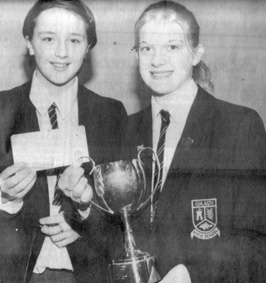
Parents'Association Shield, best all-round Year 9 pupil, Kim Bell.
Parents' Association Shield, best all-round Year 10 pupil, Jessica McFarland.
N1E Trophy, best all-round Year 11 pupil, Martha Irwin.
Eleanor Trafford Award, for most outstanding pupil in junior French, Judith Mulligan.
O. C. Gibson Cup, for public speaking and debating, and Leitch Cup, for school or community service, Lisa Craig.
Preston Cup, for most outstanding pupil, McMillan Shield, for best all-round sports girl, and J. B. Anderson Cup, for best performance in public examinations, girl, Dawn Hemphill.
David Marshall Memorial Cup, for best all-round sports boy, Christopher Reid.
Stephen Gordon Trophy, for oral communication, Nigel Anthony.
Ulster Bank Cup, for GCSE art, Adele Moore.
Desmond and Sons Perpetual Cup, for GCSE business studies, Vicki Caldwell.
ROSPA Plate for GCSE music, Thomas McClure.
McDowell Cup, for best performance in public examinations, boy, Thomas McClure and Neil Mcllwaine.
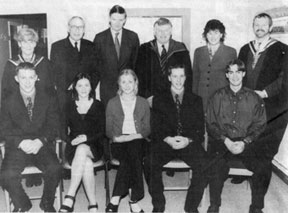
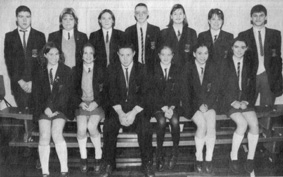
Head Boy Plaque, Fleming McFarland; Head Girl Plaque, Pamela Kenwell.
Other awards
Academic Merit awards:
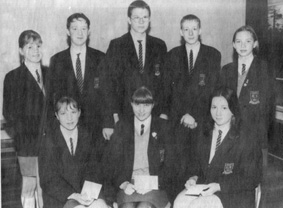
Year 8, Calvin Forbes and Laura Ross; Year 9, Hazel Armstrong and Clive McFarland; Year 10, Lisa Anderson and Matthew Mosgrove; Year 11, Ruth Aiken and Louise Smith.
GCSE subject awards:
Geography and CDT Design and Realisation, Neil Mcllwaine; English, History, Media Studies and Religious Studies, Dawn Hemphill; French, Lorna Moore; Home Economics, Petrina McFarland; Information Systems, Jonathan Clements; Mathematics, Aaron Hempton; Office Studies, Lisa Craig; English Literature, Clare McCormack, and Science, Stephen Anderson.
THE annual prizegiving at Omagh High School on Tuesday night was tinged with sadness and coloured by the events of the August 15 bombing of Market Street in the town, the headmaster, Mr. William Harper, said.
Speaking at the event, Mr. Harper said bomb victims Alan Radford and Lorraine Wilson would have been present at the prizegiving ceremony and he spoke of how the school was still overwhelmed by the loss of its pupils and former pupils who perished in the bombing.
"We are essentially a youthful community in school and I know in moments of personal reflection, years ahead, we will cast our minds back to our friends who were killed," he said.
"In our memories they will always be youthful. My thoughts tonight are with the relatives and friends who have lost loved ones and I would wish to assure them that our grief and our memories will not fade," he said.
Mr. Harper said the school was to act as a focus in the community, and offered sympathy to the relatives of its former pupils, Esther Gibson, Debra-Ann Cartwright, Samantha McFarland, Alan Radford and Lorraine Wilson, as well as of Mrs. Olive Hawkes, Mrs. Ann McCombe and Mrs Veda Short, who were mothers of pupils at the school.
He continued: "The injured pupils and former pupils are, in general, making a reasonable recovery, although in other situations there is a long way to go before anything like normal health can be restored.
"Their optimism, strength of character and lack of self pity in the face of difficulties are an example to us all.
"I would also like to state that, as headmaster, I was proud of our many pupils and former pupils who performed heroically at the scene of the explosion. The school is not self centred and would wish to look outwards and extend our sympathy to other schools and the families of all who died or were injured in the atrocity," Mr. Harper said.
Maximise
The principal said that it was one of the aims of the school that pupils not only maximise their academic potential, but be able to look back on their school days with pleasure and hold happy memories.
He said it was some little consolation that the pupils who were killed seemed, from their records, to have enjoyed their life at Omagh High School.
"Our dead colleagues were all excellent pupils at this school, pupils of whom any parent or school could be very proud. All could have looked forward with confidence to the future," he added.
Mr. Harper went on to acknowledge and extend thanks for the messages and tokens of sympathy the school received, and said it was clear that people of good will everywhere wished that such wanton violence as occurred in Omagh and other towns should stop.
"I join with the hundreds of people who have contacted us in praying that Omagh will engender such mass revulsion of violence that this evil act will play an important part in eliminating violence from political life.
"No one must ever overlook, attempt to marginalise or be dismissive of the suffering experienced in Omagh," Mr. Harper said.
Mr. Harper went on to pay tribute to his staff for the support they had shown.
During his address Mr. Harper also commented on what he saw as the increase in bureaucracy in schools, and said that there was a real danger that the sheer volume of paperwork which continued to descend, linked with the unremitting pace of change, could choke school administration and divert attention from schools' primary function of interacting with and influencing pupils.
"Striking a balance between our administrative and management functions and our leadership role is becoming increasingly difficult," he warned.
Mr. Harper said speedy introductions of programmes did not in itself produce improvements, and added that it was clear it was not only the teaching staff who were adversely affected by increased paperwork.
He went on to pay tribute to the administrative staff at the school, as well as the school nurse and ancillary staff, and those from inside and outside the school, who took time to sit on committees and on the Board of Governors.
Turning to the academic prowess of pupils at the school, he said GCSEs continued to be the main examinations for pupils, and he paid tribute to the highest achievers within the school.
In addition to GCSEs, he said, a variety of other examinations were used to assess the performance of pupils of all abilities, including the Associated Examinations Board, which offered basic skills qualifications in communication and numeracy.
"We entered 107 candidates for communication skills, 90 per cent of whom gained a pass or merit result. In numerical skills, 72 entries were made with 85 per cent gaining a pass or pass with merit grades. Indeed, five of our pupils achieved a 100 per cent score this examination," he said.
Success
Mr. Harper went on to outline the school's success in the Welsh Joint Education Committee certificates, in which all 150 entrants gained pass, merit or distinction grades in all subjects on which they were tested.
"Examinations provided by the Royal Society of Arts Board continue to prove suitable for our pupils and again I am pleased to report another 100 per cent pass rate for the Stage 1 computer literacy and information technology qualification. Forty one pupils were also entered for RSAs initial text processing examination, and 37 of them (90 per cent) gained a distinction grade," he said.
He said the school's high standard was maintained in the English Speaking Board's prevocational examination in oral communication, with 78 per cent of pupils gaining a pass, good pass or merit grades.
"The range of successes in various externally assessed examinations reflects our school's examinations' policy of selecting our external examinations carefully to cater for the needs of all our pupils and to challenge and extend pupils of all abilities," he said.
Mr. Harper added that the school's post-16 GNVQ provision continued to prosper.
In the past year the GNVQ choice was further enhanced with the introduction of business at advanced level, the equivalent to three A levels.
At Key Stage 3, for the first time, the school was assessed in English, mathematics and science, and, he said, he was particularly pleased with the results for mathematics and English.
This year 60.3 per cent of Year 10 pupils achieved level five and above in English, while 19.1 per cent gained level six and above.
In mathematics 36.8 per cent achieved level six, whereas the Northern Ireland average was only 15 per cent, he said.
Pupils achieving level five totalled 75 per cent, where the average was 45 per cent.
Omagh High was one of only 25 secondary schools selected to take part in the CCEA pilot scheme for the 1997-98 Key Stage 3 certificate of competence in Information Technology, and Mr. Harper said it was seen as a permanent assessment tool for information and communications technology by the school.
All of those who took part achieved certificates indicating their level of competence in each strand and an overall level of IT competence, he said.
Turning to special needs, he said that the introduction of the Code of Practice had necessitated the recording of pupil data, which had been transferred to the CLASS system.
"This is a school management computer system which now holds a register of SEN pupils within the school. However, it is essential that these records are used by all staff and that more staff become confident in using the information, so that individual pupils can benefit from our advanced management system."
Mr. Harper said it was felt that Omagh High had been a forerunner in the field of literacy development, having pioneered a successful literacy programme in recent years, and in terms of the National Literacy strategy, he said an example of progress was the creation of a book-tape library for the special needs department.
Support
"Our school is conscious of a network of support, extending from neighbouring and contributory schools, to staff at the Board, to parents and the local community, in our efforts to raise standards and meet the needs of our pupils.
"We see that it is only through all these elements of the network working together that the needs of pupils can be best met and we are pleased to play an influential role in developments in this area," Mr. Harper said.
Turning to pastoral care, he said relationships of all kinds were the bedrock of any school, and the schools personal and social education programme focused on all permutations, as well as on the best ways to achieve co-operation and nullify conflict.
He said young people had the right to be happy, healthy and secure, and the school took very seriously the responsibility it had under the government guidelines on child protection.
"Bullying is a perennial problem in schools and we tackle disruption pro-actively both through our teaching strategies and our disciplinary procedures, with, we hope, reasonable success."
In his address Mr. Harper also spoke on the diminishing school budget. He said that with active management the school had maintained and in many instances enhanced its level of academic pro-vision and technological support.
Trophies and special prizes
Gamble Cup, for best all-round Year 8 pupil, Peter Kerr and David Tait.
Parents'Association Shield, best all-round Year 9 pupil, Kim Bell.
Parents' Association Shield, best all-round Year 10 pupil, Jessica McFarland.
N1E Trophy, best all-round Year 11 pupil, Martha Irwin.
Eleanor Trafford Award, for most outstanding pupil in junior French, Judith Mulligan.
O. C. Gibson Cup, for public speaking and debating, and Leitch Cup, for school or community service, Lisa Craig.
Preston Cup, for most outstanding pupil, McMillan Shield, for best all-round sports girl, and J. B. Anderson Cup, for best performance in public examinations, girl, Dawn Hemphill.
David Marshall Memorial Cup, for best all-round sports boy, Christopher Reid.
Stephen Gordon Trophy, for oral communication, Nigel Anthony.
Ulster Bank Cup, for GCSE art, Adele Moore.
Desmond and Sons Perpetual Cup, for GCSE business studies, Vicki Caldwell.
ROSPA Plate for GCSE music, Thomas McClure.
McDowell Cup, for best performance in public examinations, boy, Thomas McClure and Neil Mcllwaine.
Head Boy Plaque, Fleming McFarland; Head Girl Plaque, Pamela Kenwell.
Other awards
Academic Merit awards:
Year 8, Calvin Forbes and Laura Ross; Year 9, Hazel Armstrong and Clive McFarland; Year 10, Lisa Anderson and Matthew Mosgrove; Year 11, Ruth Aiken and Louise Smith.
GCSE subject awards:
Geography and CDT Design and Realisation, Neil Mcllwaine; English, History, Media Studies and Religious Studies, Dawn Hemphill; French, Lorna Moore; Home Economics, Petrina McFarland; Information Systems, Jonathan Clements; Mathematics, Aaron Hempton; Office Studies, Lisa Craig; English Literature, Clare McCormack, and Science, Stephen Anderson.
Further Information
Publisher: TYRONE CONSTITUTION
Ref: TC/1309
Published Date: 04-Feb-99
Related Images