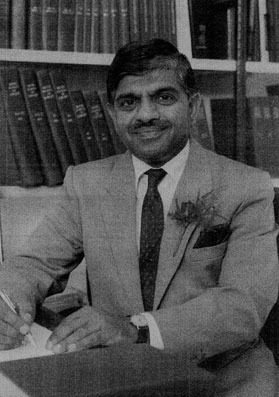
END OF ERA AS SENIOR SURGEON BOWS OUT AT THE COUNTY
End of an era as senior surgeon bows out at the County
by David Killen
AN ERA came to a close at Tyrone County Hospital on Tuesday when one of the area's leading surgeons tidied his desk for the last time after a career that has seen his involvement in some of the most exciting medical breakthroughs of the past 40 years.
And for the past 20 years Mr Dominic Pinto has been part of a dedicated surgical team that has played such a vital role in the life of the Omagh community.
It is a career that has seen him witness the pinnacles of joys and the lowest depths of pain for the many people who have crossed the threshold.
Mr Pinto was born in Goa in India, but was brought up in Kenya. The family tradition was to go into the British Civil Service, but although there
was no history of medicine in the family, the young Dominic Pinto decided that was the career choice for him.
He qualified at the London Medical School in 1962 and worked in London, Cambridge and Ipswich, before starting post-graduate research at The Middlesex Hospital in London. He became a Fellow of the Royal College of Surgeons of England and Edinburgh in 1967.
He researched Deep Vein Thrombosis and presented this research as his thesis to the London University in 1970. DVT, as it is known, has hit the headlines in recent times in relation to its alleged connection with long-haul flights, but Mr Pinto points out that it has long been identified as a problem for patients, who are inactive for lengthy periods of time.
Early in his medical career, Mr Pinto was faced with the decision of either going into general practice or surgery. On the advice of those "who seemed to think I had some ability for it", he decided that surgery would be his choice.
'Mastership of Surgery'
Mr Pinto was granted the Mastership of Surgery from London University in 1970.
He then returned to the Medical Research Unit at Northwick Park and joined the team of Sir Peter Medawar, the Nobel Laureate, working in the field of transplantation biology.
"Those were the early days when methods were being investigated to reduce rejection. While there I was responsible for the treatment of breast cancer and the early implementation of chemotherapy," he said.
Mr Pinto also worked closely with radiologists in the pioneering work in CT scanning and ultrasound. He was appointed an honorary consultant surgeon to Northwick Park Hospital in 19771.
Leaving the Medical Research Centre as a senior scientist, he joined the National Health Service as a consultant surgeon and was appointed to the staff at Tyrone County Hospital in 1980.
He explained that he knew nothing about Omagh before then.
"At that time a lot of the older surgeons recruited during the war were retiring. I knew a professor who had worked here and he said the quality of life in Omagh was great and the people were lovely and that I should come and see it. Everything he said then has proven to be true," said Mr Pinto.
But the County of 20 years ago was a different hospital than today, and was probably a bit behind the standards of the time.
Computerisation
On his arrival Mr. Pinto introduced computerisation in the surgical department, mostly adapted from other available programmes. He helped develop the system to the point where it is now the definitive programme for surgery in the Province.
Because of his interest in computerisation, the Department of Health funded the County as a pilot site for introducing an integrated programme. It is one of seven sites in the UK.
In 1980, the newly arrived Mr Pinto found the accident and emergency department, the showpiece of the hospital, had a lot to be desired. There was no radiologist on site, one came from Altnagelvin once or twice a week, and there was scant, if any, teaching for young doctors.
Mr Pinto started a teaching programme that was to run on a weekly basis for 13 years with local and invited speakers taking part.
He saw, too, that there was a need for health professionals to continue to keep their skills up to date in the years after they entered practise. He developed the idea of a post-graduate centre, and, in a project with the Western Health and Social Services Board, the centre was provided in 1986.
Senior surgeon
Mr Pinto became senior surgeon at the County following the retirement of Mr Cecil Maltby.
With his colleagues he continued the work of developing the County.
Finance was secured for a sterile supply unit, and the physiotherapy department was moved to its present site to ensure the expansion of the radiology department and attract full-time radiologists.
The campaign then began to convince specialists in Belfast that the County could be a viable site for a satellite renal unit. Having won the argument that Omagh was a central site for the west, half of the old paediatric ward was handed over for the new facility, with an improved paediatric ward provided together with a new entrance to the hospital.
This was followed by changes to the surgical wards so that treatment areas were separate for the wards proper. A modern post-operative and intensive care unit was also provided.
Mr Pinto also brought back simple, but effective ideas back to the County from his visits elsewhere. One was to lower corridor ceilings so that engineers could carry out work in a walkway rather than disrupt the work of the hospital. He also designed the endoscopy unit.
Over the past 12 years Mr Pinto has taken on an international commitment in the training of overseas surgeons in the UK. This has led to sponsored surgeons from Bombay and Goa working in the County. They have gone on to other training in Northern Ireland then returned home to pursue their careers.
As well as the physical changes that have taken place in the county over the past 20 years, Mr Pinto says he has seen great changes in medicine in that time and since he started his career.
He was trained as a general surgeon, and that has always been his forte. Surgeons now tend to train in specialities, rather than general surgery, he says.
Technology has driven many of the changes over the past 40 years. As well as computerisation, improved anaesthetics and radiology have changed the way surgeons operate literally.
Nowadays developments such as the CT scanners and other procedures have increased the use of 'non- invasive' surgery.
All this has meant that the old surgical role of hospital has changed.
"Nowadays 60 per cent of my work is day procedures. We can do so much more under local anaesthetics, so that patients can be in an out in a day. Even when we need to bring patients in for operations under a general anaesthetic, they do not stay as long in hospital and there is no need for them to recuperate in the same place they have been operated on," he said.
Frontline hospital
Mr Pinto's time at the County has coincided with a period in which it was a frontline hospital in reacting to terrorist violence.
Everyone, he says, mentions August 1998 when talking about the violence, but there were many other incidents, including the Ballygawley bus-bombing in 1988, as well as many other individual acts of terror.
Mr Pinto said that staff at the County had coped professionally and capably with the many terrorist incidents, just as they had with so many other emergencies, such as car crashes, which also produced tragic outcomes.
While Mr Pinto does not dwell on it, the response by the staff of the County after the Omagh bombing has been much lauded. Many of the injured received initial care that was to help the surgeons at specialised units deal with very significant injuries.
The hospital received a number of awards for the work done by staff, and there was individual recognition for Mr Pinto.
Ten years earlier Mr Pinto was appointed an OBE.
At a time of much talk abut the future of hospital services, Mr Pinto believes that change is inevitable, and necessary.
That change will come not only the shape of physical buildings, but also in the care that patients will receive.
One area of care that has changed, and will continue to change, is in treatment for older people. The population is growing older - 12 per cent is now over the age of 60 - those older people still lead active lives, but when they do become ill will require treatment. In many cases older people often need treatment for more than one problem.
"It is a big issue for us today and will become increasingly important in the years ahead," Mr Pinto said.
He believes there will be a 'matrix' approach to healthcare provision in the future. He believes services will still be provided, though not all necessarily at the same site.
Looking back, Mr Pinto says he has "no regrets" over the direction his career has taken him.
Even after 40 years, he says he finds surgery absorbing and exciting.
"I have never been one to complain. Every patient you see is different and every operation you do is different.
"I still have the same feelings when I go into surgery and I get a great satisfaction when I see someone, who perhaps came in here very ill or badly injured, leaving on their way to recovery," Mr Pinto said.
There were, though, occasions in which there was a less happy outcome, Mr Pinto acknowledges.
In a busy career, Mr Pinto says he enjoyed all aspects.
"I don't think there is anything I liked doing more than anything else. I enjoyed the surgery, but I also enjoyed the research and the teaching," he said.
Asked about his thoughts of leaving the County, Mr Pinto was matter of fact in his reaction.
"I look on it as the end of an era. It happened, it has brought changes for me and hopefully I have helped bring changes, but now it is time to move on," he said.
Moving on will give Mr Pinto more time for many of the activities he has taken up over the years.
He enjoys reading, gardening and travelling, and is a keen member of Omagh Rotary Club. He is also an avid golfer and no doubt will have more time on the greens.
No doubt his duties as Chief Sheriff and Deputy Lieutenant of County Tyrone will also keep him busy from time to time.
Travelling has always been very important to Mr Pinto. Two years ago he returned to Kenya when his brother was ordained at the age of 60.
Tomorrow, Friday, he sets off for a trip to India, where he hopes to meet up with some of the young students he once taught who are now consultants in their own right.
Mr Pinto says he intended to stay in the Omagh area, where his family has grown up. Mr Pinto and his wife, Olga, have three children, Anthony, Fiona and Boris.
His younger son is following in his footsteps and is a second year medical student at Queen's University in Belfast.
by David Killen
AN ERA came to a close at Tyrone County Hospital on Tuesday when one of the area's leading surgeons tidied his desk for the last time after a career that has seen his involvement in some of the most exciting medical breakthroughs of the past 40 years.
And for the past 20 years Mr Dominic Pinto has been part of a dedicated surgical team that has played such a vital role in the life of the Omagh community.
It is a career that has seen him witness the pinnacles of joys and the lowest depths of pain for the many people who have crossed the threshold.
Mr Pinto was born in Goa in India, but was brought up in Kenya. The family tradition was to go into the British Civil Service, but although there
was no history of medicine in the family, the young Dominic Pinto decided that was the career choice for him.
He qualified at the London Medical School in 1962 and worked in London, Cambridge and Ipswich, before starting post-graduate research at The Middlesex Hospital in London. He became a Fellow of the Royal College of Surgeons of England and Edinburgh in 1967.
He researched Deep Vein Thrombosis and presented this research as his thesis to the London University in 1970. DVT, as it is known, has hit the headlines in recent times in relation to its alleged connection with long-haul flights, but Mr Pinto points out that it has long been identified as a problem for patients, who are inactive for lengthy periods of time.
Early in his medical career, Mr Pinto was faced with the decision of either going into general practice or surgery. On the advice of those "who seemed to think I had some ability for it", he decided that surgery would be his choice.
'Mastership of Surgery'
Mr Pinto was granted the Mastership of Surgery from London University in 1970.
He then returned to the Medical Research Unit at Northwick Park and joined the team of Sir Peter Medawar, the Nobel Laureate, working in the field of transplantation biology.
"Those were the early days when methods were being investigated to reduce rejection. While there I was responsible for the treatment of breast cancer and the early implementation of chemotherapy," he said.
Mr Pinto also worked closely with radiologists in the pioneering work in CT scanning and ultrasound. He was appointed an honorary consultant surgeon to Northwick Park Hospital in 19771.
Leaving the Medical Research Centre as a senior scientist, he joined the National Health Service as a consultant surgeon and was appointed to the staff at Tyrone County Hospital in 1980.
He explained that he knew nothing about Omagh before then.
"At that time a lot of the older surgeons recruited during the war were retiring. I knew a professor who had worked here and he said the quality of life in Omagh was great and the people were lovely and that I should come and see it. Everything he said then has proven to be true," said Mr Pinto.
But the County of 20 years ago was a different hospital than today, and was probably a bit behind the standards of the time.
Computerisation
On his arrival Mr. Pinto introduced computerisation in the surgical department, mostly adapted from other available programmes. He helped develop the system to the point where it is now the definitive programme for surgery in the Province.
Because of his interest in computerisation, the Department of Health funded the County as a pilot site for introducing an integrated programme. It is one of seven sites in the UK.
In 1980, the newly arrived Mr Pinto found the accident and emergency department, the showpiece of the hospital, had a lot to be desired. There was no radiologist on site, one came from Altnagelvin once or twice a week, and there was scant, if any, teaching for young doctors.
Mr Pinto started a teaching programme that was to run on a weekly basis for 13 years with local and invited speakers taking part.
He saw, too, that there was a need for health professionals to continue to keep their skills up to date in the years after they entered practise. He developed the idea of a post-graduate centre, and, in a project with the Western Health and Social Services Board, the centre was provided in 1986.
Senior surgeon
Mr Pinto became senior surgeon at the County following the retirement of Mr Cecil Maltby.
With his colleagues he continued the work of developing the County.
Finance was secured for a sterile supply unit, and the physiotherapy department was moved to its present site to ensure the expansion of the radiology department and attract full-time radiologists.
The campaign then began to convince specialists in Belfast that the County could be a viable site for a satellite renal unit. Having won the argument that Omagh was a central site for the west, half of the old paediatric ward was handed over for the new facility, with an improved paediatric ward provided together with a new entrance to the hospital.
This was followed by changes to the surgical wards so that treatment areas were separate for the wards proper. A modern post-operative and intensive care unit was also provided.
Mr Pinto also brought back simple, but effective ideas back to the County from his visits elsewhere. One was to lower corridor ceilings so that engineers could carry out work in a walkway rather than disrupt the work of the hospital. He also designed the endoscopy unit.
Over the past 12 years Mr Pinto has taken on an international commitment in the training of overseas surgeons in the UK. This has led to sponsored surgeons from Bombay and Goa working in the County. They have gone on to other training in Northern Ireland then returned home to pursue their careers.
As well as the physical changes that have taken place in the county over the past 20 years, Mr Pinto says he has seen great changes in medicine in that time and since he started his career.
He was trained as a general surgeon, and that has always been his forte. Surgeons now tend to train in specialities, rather than general surgery, he says.
Technology has driven many of the changes over the past 40 years. As well as computerisation, improved anaesthetics and radiology have changed the way surgeons operate literally.
Nowadays developments such as the CT scanners and other procedures have increased the use of 'non- invasive' surgery.
All this has meant that the old surgical role of hospital has changed.
"Nowadays 60 per cent of my work is day procedures. We can do so much more under local anaesthetics, so that patients can be in an out in a day. Even when we need to bring patients in for operations under a general anaesthetic, they do not stay as long in hospital and there is no need for them to recuperate in the same place they have been operated on," he said.
Frontline hospital
Mr Pinto's time at the County has coincided with a period in which it was a frontline hospital in reacting to terrorist violence.
Everyone, he says, mentions August 1998 when talking about the violence, but there were many other incidents, including the Ballygawley bus-bombing in 1988, as well as many other individual acts of terror.
Mr Pinto said that staff at the County had coped professionally and capably with the many terrorist incidents, just as they had with so many other emergencies, such as car crashes, which also produced tragic outcomes.
While Mr Pinto does not dwell on it, the response by the staff of the County after the Omagh bombing has been much lauded. Many of the injured received initial care that was to help the surgeons at specialised units deal with very significant injuries.
The hospital received a number of awards for the work done by staff, and there was individual recognition for Mr Pinto.
Ten years earlier Mr Pinto was appointed an OBE.
At a time of much talk abut the future of hospital services, Mr Pinto believes that change is inevitable, and necessary.
That change will come not only the shape of physical buildings, but also in the care that patients will receive.
One area of care that has changed, and will continue to change, is in treatment for older people. The population is growing older - 12 per cent is now over the age of 60 - those older people still lead active lives, but when they do become ill will require treatment. In many cases older people often need treatment for more than one problem.
"It is a big issue for us today and will become increasingly important in the years ahead," Mr Pinto said.
He believes there will be a 'matrix' approach to healthcare provision in the future. He believes services will still be provided, though not all necessarily at the same site.
Looking back, Mr Pinto says he has "no regrets" over the direction his career has taken him.
Even after 40 years, he says he finds surgery absorbing and exciting.
"I have never been one to complain. Every patient you see is different and every operation you do is different.
"I still have the same feelings when I go into surgery and I get a great satisfaction when I see someone, who perhaps came in here very ill or badly injured, leaving on their way to recovery," Mr Pinto said.
There were, though, occasions in which there was a less happy outcome, Mr Pinto acknowledges.
In a busy career, Mr Pinto says he enjoyed all aspects.
"I don't think there is anything I liked doing more than anything else. I enjoyed the surgery, but I also enjoyed the research and the teaching," he said.
Asked about his thoughts of leaving the County, Mr Pinto was matter of fact in his reaction.
"I look on it as the end of an era. It happened, it has brought changes for me and hopefully I have helped bring changes, but now it is time to move on," he said.
Moving on will give Mr Pinto more time for many of the activities he has taken up over the years.
He enjoys reading, gardening and travelling, and is a keen member of Omagh Rotary Club. He is also an avid golfer and no doubt will have more time on the greens.
No doubt his duties as Chief Sheriff and Deputy Lieutenant of County Tyrone will also keep him busy from time to time.
Travelling has always been very important to Mr Pinto. Two years ago he returned to Kenya when his brother was ordained at the age of 60.
Tomorrow, Friday, he sets off for a trip to India, where he hopes to meet up with some of the young students he once taught who are now consultants in their own right.
Mr Pinto says he intended to stay in the Omagh area, where his family has grown up. Mr Pinto and his wife, Olga, have three children, Anthony, Fiona and Boris.
His younger son is following in his footsteps and is a second year medical student at Queen's University in Belfast.
Further Information
Publisher: TYRONE CONSTITUTION
Ref: TC/1134
Published Date: 28-Nov-02
Related Images