BOMB SITE MEMORIAL INSTALLED IN OMAGH'S MARKET STREET
Bomb site memorial installed in Omagh's Market Street
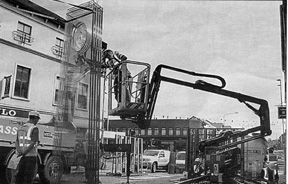
The installation of a glass pillar at the site of the Omagh bomb took place on Sunday, as the development of the 'Garden of Light' memorial nears completion in time for the 10th anniversary of the August 15, 1998, atrocity.
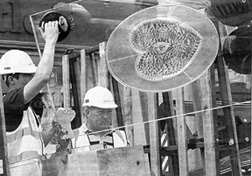
Standing 4.5 metres high, the obelisk is created from sheets of toughened glass laminated together, with a cut crystal heart -made by Tyrone Crystal -suspended inside it.
The complex installation - which began at 4am on Sunday and lasted over 18 hours - saw 21 sheets of glass, bonded together in sets of three sheets, lowered into a specially created foundation framework by crane.
The crystal heart was also made in sections and was inserted into the sheets of glass. The glass was put in place and sealed together, allowing the heart to achieve a three-dimensional effect.
The obelisk, and the completed memorial garden, will be publicly unveiled at 3pm on Friday, August 15, during a ceremony organised by Omagh District Council.
The families of the Omagh bomb victims will hold their service - coordinated by Omagh Support and Self Help Group - on Sunday, August 17, also at 3pm in the memorial garden.
Speaking as final plans were put in place for the memorial's installation, the artist behind the unusual design - Sean Hillen - said: "I will be proud, it's been a very long journey since April last year."
Having worked tirelessly on the six tonne glass sculpture for over a year, before the fruits of his creative endeavours were this week brought to the bomb site, he continued: "Everybody involved has been giving everything to the memorial project, which has got to do with very complex things."
Indeed, the complicated nature of the memorial has raised questions as to its meaning - a point not lost on the designer.
"It's a complex brief, we had to put something on the bomb site, which is a very small site, but to make it grand we had to be creative. I knew about this technology that would refract sunlight. It took a while to come up with the human heart, it's not a religious piece, but it has spiritual elements," Mr Hillen explained.
The design will incorporate 31 refracted mirrors at the site of the bomb memorial garden, which will track the movement of the sun by use of a heliostat - a device which will beam the light across Drumragh Avenue and onto the glass memorial on lower Market Street. The overall shape of the design will replicate a human heart.
The idea of refracted sunlight came from the fact that Omagh reportedly receives less sunlight annually than any other area of the country. Thus, the central message is one of hope that sunlight will shine on the town in the future.
"I had to make it complex so that people in Omagh could get something from it all the time and it also had to respect the families of the victims and everybody who was injured or affected by the bomb," Mr Hillen continued.
"The idea of reflecting light goes all the way back to ancient Egypt and Greek times so I thought it was a common theme and it should be very beautiful. It will be six tonnes of very clear glass, a laboratory glass, and it will be a very strong presence on the site. "I have to pay tribute to Desmond Fitzgerald, the design architect, who has managed the entire team, it's an enormous figure, gigantic almost, and the human heart is particularly prominent as a theme, which I like the idea of. It's been a huge technical challenge, one where everyone involved has given their all to the project."
With the tenth anniversary of the blast looming in just a matter of weeks, the design team is aware of the depth of sadness still in the town, and the role the memorial will play.
"It's not going to be a happy day, but we hope that there will be some resolution and we hope this memorial will play some part in that. We hope that everybody will be satisfied," added Mr Hillen.
The artist acknowledged that after the anniversary remembrance, the memorial will also be judged as a piece of art in a town centre widely changed since August 1998.
"I don't like art that needs to be explained to make a point or that alienates anybody," admitted Mr Hillen. "I would like to think that my art is accessible. I think it's a sign of good art if it's accessible to both art lovers and those who may only have a passing interest. So I do hope ordinary people can relate to the memorial.
"We have had a very strong response from the public, so far, to the design. It's the job of a lifetime.
"For more than a year now, I have given it everything possible, sitting up in the 'wee small hours' mulling over things, so I hope that I have done it justice, not just for myself but for everybody associated."
The technical team, which worked on the garden, was overseen by Desmond Fitzgerald Landscape Architects, who had to overcome the various difficulties of implementing Sean Hillen's design, alongside White Young Green Consulting Engineering, Nolan Ryan Quantity Surveyors and McGrory Contracts.
"The overall project is going fine, it's a difficult and complicated project and there's always something to contend with. It's about as complicated a project as any that has ever been done," said Desmond Fitzgerald.
Speaking ahead of Sunday last's installation, he said: "So far we have been happy with the public response to the project, we haven't had any negative or substantial criticism, we haven't encountered anything untoward. On Sunday we're simply putting it up, there's going to be a hoarding around it to protect it after it sets, so it's not the official unveiling just yet."
"There's two or three significant issues from the design itself," said Mr Fitzgerald. "One that will get all the attention is the heliostat. This is something that people will not necessarily understand. Every kid at one stage in their young life has taken a mirror and flipped it around, that, in simple terms, is what we have done.
"The difficulty of that from a constructional point of view is immense. It's a little like setting up a tricky shot in snooker, where you have to get all the angles, and we had to work it all out on paper beforehand.
"The level of difficulty involved was something that I had never experienced before, technically it was as difficult as they come. In saying that, it also shows the uniqueness of the project and how important it was to get it right.
"People might take it for granted once it is up, but the dedication that has gone into it is very evident. To make a huge monument in glass - there's not many around like it, in fact I'm sure it hasn't been done before - was extremely challenging."
In the garden itself, the designers were tasked with including a large body of text, which also listed the names and origins of the victims, as well as the inclusion of the sentence "To honour and remember 31 people murdered and hundreds injured from three nations by a dissident republican terrorist car bomb," at the behest of the victims' families.
Mr Fitzgerald concluded by stating he hopes the garden of light, as it will be known, will rise above the complications of its design and spread a simple and direct message.
"The garden is something special in itself, we want to make something that will communicate something directly, without being depressing. A lot of work has been done to make it accessible. Again that seems to be working.
"I suppose we have been working well against the clock. It's not like one of these show gardens in Chelsea, it won't be ready and finished on a specific time but it's a garden that will continue to grow and develop," he added.
The glass for the monument was cut by Carey Glass, Co Tipperary, while the crystal heart was created and cut by Tyrone Crystal.
The design of the Omagh Memorial as a whole is highly innovative and uses light as a means of integrating and linking the two sites - the memorial garden and the bomb site.
A statement from Omagh District Council noted that "the central theme and inspiration for the design is that 'light unites us all in that it makes all life possible'. The concept of reflection connects to reactions to, and consequences of, the atrocity."
The garden will be formed by lines of small mirrors positioned on poles around a reflecting pool and backed by a grassy bank planted with silver birches and wild-flowers. A large mirror - a heliostat - tracks the sun and pours a beam of sunlight onto the 31 small mirrors, which is then reflected onto another bank of mirrors at the street corner and on to a crystal heart which appears to float in the pillar of glass at the bomb site.
The heart is to sparkle and glitter as it catches, reflects and distributes the light, "reminding us of the sunlight that shines on us all and makes all life possible."
The narrative for the memorial will be at three locations: a small plaque at the bomb site and a short inscription at the entrance to the Memorial Garden, with the remainder of the substantial narrative carved on granite coping stones on a wall inside the garden.
The narrative was the result of dedicated work by an Independent Facilitation Team, who had over 80 meetings with individuals and groups who had been affected by the Omagh Bomb. Not only does it commemorate those who were killed in the atrocity, but it also includes the context of the event as well as words of hope and healing about the future.
The installation of a glass pillar at the site of the Omagh bomb took place on Sunday, as the development of the 'Garden of Light' memorial nears completion in time for the 10th anniversary of the August 15, 1998, atrocity.
Standing 4.5 metres high, the obelisk is created from sheets of toughened glass laminated together, with a cut crystal heart -made by Tyrone Crystal -suspended inside it.
The complex installation - which began at 4am on Sunday and lasted over 18 hours - saw 21 sheets of glass, bonded together in sets of three sheets, lowered into a specially created foundation framework by crane.
The crystal heart was also made in sections and was inserted into the sheets of glass. The glass was put in place and sealed together, allowing the heart to achieve a three-dimensional effect.
The obelisk, and the completed memorial garden, will be publicly unveiled at 3pm on Friday, August 15, during a ceremony organised by Omagh District Council.
The families of the Omagh bomb victims will hold their service - coordinated by Omagh Support and Self Help Group - on Sunday, August 17, also at 3pm in the memorial garden.
Speaking as final plans were put in place for the memorial's installation, the artist behind the unusual design - Sean Hillen - said: "I will be proud, it's been a very long journey since April last year."
Having worked tirelessly on the six tonne glass sculpture for over a year, before the fruits of his creative endeavours were this week brought to the bomb site, he continued: "Everybody involved has been giving everything to the memorial project, which has got to do with very complex things."
Indeed, the complicated nature of the memorial has raised questions as to its meaning - a point not lost on the designer.
"It's a complex brief, we had to put something on the bomb site, which is a very small site, but to make it grand we had to be creative. I knew about this technology that would refract sunlight. It took a while to come up with the human heart, it's not a religious piece, but it has spiritual elements," Mr Hillen explained.
The design will incorporate 31 refracted mirrors at the site of the bomb memorial garden, which will track the movement of the sun by use of a heliostat - a device which will beam the light across Drumragh Avenue and onto the glass memorial on lower Market Street. The overall shape of the design will replicate a human heart.
The idea of refracted sunlight came from the fact that Omagh reportedly receives less sunlight annually than any other area of the country. Thus, the central message is one of hope that sunlight will shine on the town in the future.
"I had to make it complex so that people in Omagh could get something from it all the time and it also had to respect the families of the victims and everybody who was injured or affected by the bomb," Mr Hillen continued.
"The idea of reflecting light goes all the way back to ancient Egypt and Greek times so I thought it was a common theme and it should be very beautiful. It will be six tonnes of very clear glass, a laboratory glass, and it will be a very strong presence on the site. "I have to pay tribute to Desmond Fitzgerald, the design architect, who has managed the entire team, it's an enormous figure, gigantic almost, and the human heart is particularly prominent as a theme, which I like the idea of. It's been a huge technical challenge, one where everyone involved has given their all to the project."
With the tenth anniversary of the blast looming in just a matter of weeks, the design team is aware of the depth of sadness still in the town, and the role the memorial will play.
"It's not going to be a happy day, but we hope that there will be some resolution and we hope this memorial will play some part in that. We hope that everybody will be satisfied," added Mr Hillen.
The artist acknowledged that after the anniversary remembrance, the memorial will also be judged as a piece of art in a town centre widely changed since August 1998.
"I don't like art that needs to be explained to make a point or that alienates anybody," admitted Mr Hillen. "I would like to think that my art is accessible. I think it's a sign of good art if it's accessible to both art lovers and those who may only have a passing interest. So I do hope ordinary people can relate to the memorial.
"We have had a very strong response from the public, so far, to the design. It's the job of a lifetime.
"For more than a year now, I have given it everything possible, sitting up in the 'wee small hours' mulling over things, so I hope that I have done it justice, not just for myself but for everybody associated."
The technical team, which worked on the garden, was overseen by Desmond Fitzgerald Landscape Architects, who had to overcome the various difficulties of implementing Sean Hillen's design, alongside White Young Green Consulting Engineering, Nolan Ryan Quantity Surveyors and McGrory Contracts.
"The overall project is going fine, it's a difficult and complicated project and there's always something to contend with. It's about as complicated a project as any that has ever been done," said Desmond Fitzgerald.
Speaking ahead of Sunday last's installation, he said: "So far we have been happy with the public response to the project, we haven't had any negative or substantial criticism, we haven't encountered anything untoward. On Sunday we're simply putting it up, there's going to be a hoarding around it to protect it after it sets, so it's not the official unveiling just yet."
"There's two or three significant issues from the design itself," said Mr Fitzgerald. "One that will get all the attention is the heliostat. This is something that people will not necessarily understand. Every kid at one stage in their young life has taken a mirror and flipped it around, that, in simple terms, is what we have done.
"The difficulty of that from a constructional point of view is immense. It's a little like setting up a tricky shot in snooker, where you have to get all the angles, and we had to work it all out on paper beforehand.
"The level of difficulty involved was something that I had never experienced before, technically it was as difficult as they come. In saying that, it also shows the uniqueness of the project and how important it was to get it right.
"People might take it for granted once it is up, but the dedication that has gone into it is very evident. To make a huge monument in glass - there's not many around like it, in fact I'm sure it hasn't been done before - was extremely challenging."
In the garden itself, the designers were tasked with including a large body of text, which also listed the names and origins of the victims, as well as the inclusion of the sentence "To honour and remember 31 people murdered and hundreds injured from three nations by a dissident republican terrorist car bomb," at the behest of the victims' families.
Mr Fitzgerald concluded by stating he hopes the garden of light, as it will be known, will rise above the complications of its design and spread a simple and direct message.
"The garden is something special in itself, we want to make something that will communicate something directly, without being depressing. A lot of work has been done to make it accessible. Again that seems to be working.
"I suppose we have been working well against the clock. It's not like one of these show gardens in Chelsea, it won't be ready and finished on a specific time but it's a garden that will continue to grow and develop," he added.
The glass for the monument was cut by Carey Glass, Co Tipperary, while the crystal heart was created and cut by Tyrone Crystal.
The design of the Omagh Memorial as a whole is highly innovative and uses light as a means of integrating and linking the two sites - the memorial garden and the bomb site.
A statement from Omagh District Council noted that "the central theme and inspiration for the design is that 'light unites us all in that it makes all life possible'. The concept of reflection connects to reactions to, and consequences of, the atrocity."
The garden will be formed by lines of small mirrors positioned on poles around a reflecting pool and backed by a grassy bank planted with silver birches and wild-flowers. A large mirror - a heliostat - tracks the sun and pours a beam of sunlight onto the 31 small mirrors, which is then reflected onto another bank of mirrors at the street corner and on to a crystal heart which appears to float in the pillar of glass at the bomb site.
The heart is to sparkle and glitter as it catches, reflects and distributes the light, "reminding us of the sunlight that shines on us all and makes all life possible."
The narrative for the memorial will be at three locations: a small plaque at the bomb site and a short inscription at the entrance to the Memorial Garden, with the remainder of the substantial narrative carved on granite coping stones on a wall inside the garden.
The narrative was the result of dedicated work by an Independent Facilitation Team, who had over 80 meetings with individuals and groups who had been affected by the Omagh Bomb. Not only does it commemorate those who were killed in the atrocity, but it also includes the context of the event as well as words of hope and healing about the future.
Further Information
Publisher: TYRONE CONSTITUTION
Ref: TC10An/01
Published Date: 31-Jul-08
Related Images