INVESTIGATION IS NOT WITHOUT HOPE, MEETING IS TOLD
Investigation is not without hope, meeting is told
THE Chief Constable has conceded that if he was one of those who had lost a loved one in the Omagh bombing, or had been injured in the blast, he would be as deeply unhappy as some of them are at the revelations in relation to the investigation.
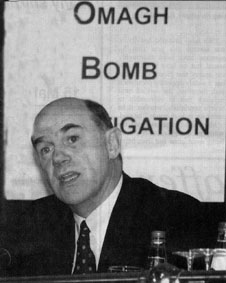
Sir Ronnie Flanagan was speaking at a Press conference, following his meeting with relatives on Thursday last.
He said it was a very important day, primarily for those who were victims of the terrible atrocity perpetrated in Omagh on August 15 1998.
He said: "I was there that day. I travelled to the scene immediately on receipt of news that the bombing had taken place. I saw those brutal scenes, I went on to the hospital. It deeply moved me but nothing I feel can even come close to what those victims of that terrible atrocity had experienced then and continue to experience ever since.
"It is our commitment - all of those in the Police Service of Northern Ireland and colleagues in An Garda Siochana to continue to work on this investigation, to do all that is humanly possible to bring to justice those who committed this terrible crime.
"Today, primarily, was an opportunity to present information about the investigation to those who were victims of that terrible crime and to give them an opportunity to reflect on documentation that we provided. It was not about defending anyone's personal reputation, or defending the reputation of an organisation, it was about giving victims information in which they can, hopefully, begin in a measured way and in a calm and reflective way to make judgments."
He was questioned on the internal RUC McVicker report and what he said to the families about the failure to immediately act on its findings and why McVicker himself failed to take up the position as a senior investigating officer over the Omagh bomb investigation.
Sir Ronnie said: "It was not a case that he failed to take up his position. The senior investigating officer is Detective Superintendent McArthur and he was always in that position. Mr McVicker was appointed as the regional crime adviser for what we call North Region.
"You need to understand what a review is and its purpose. A review is not something that stands absolutely apart from the ongoing investigation but it is an equal part of that ongoing investigation.
"The documentation that I have provided to the Policing Board, to the Secretary of State, to the Ombudsman and indeed to the victims today covers the points that action was taken and continues to be taken in terms of the recommendations in the review of the report conducted by Mr McVicker.
Experienced officer
"Mr McVicker is a very experienced officer and came up with a whole range of recommendations which either have been acted upon, are being acted upon or will be acted upon, they will all be addressed.
"And one of the things I am doing is bringing in an adviser to the current senior investigating officer, a very experienced detective from Merseyside. The remit that detective will have, and whatever team he decides he needs, will include ensuring that all the issues raised are properly and fully addressed.
Unhappy
"I realise from the outset that there will be people, of course, who will be deeply unhappy. If you had gone through what they have gone through, if I had gone through what they had gone through, I would probably remain as deeply unhappy as they do.
"And some of them will have great difficulty in accepting our explanation in terms of the anonymous phone call that was received on August 4, in terms of the validity that should be attached to information given by that person called Kevin Fulton. They have questions about the evacuation procedures.
"They have all those sorts of questions and that's absolutely natural and absolutely understandable, and I guess I would feel the same way as they would in their position. So I never expected that in terms of being able to offer that reassurance that people need that it would happen here today and afternoon. But as the investigation goes on, and I hope to keep in continuous contact with them, I hope that they will come to feel that sense of reassurance.
"The sadness is, of course, that we know who committed this crime, so some of the other suggestions about who should be elevated to firm suspect don't actually fit in to the degree of knowledge we have.
"What we need to do is find the evidence. We are still progressing forensically in that direction but of course we need public support. And there are people out there who know exactly who carried out this atrocity.
"So we need that final piece of the jigsaw to elevate what we now have in terms of knowledge and evidence that will be acceptable before a court. We have success in working in conjunction with the An Garda Siochana but that is a very small consolation to these victims who have suffered and continue to suffer so much.
Shaken
He said he accepted that the events over recent weeks would have shaken the confidence of the relatives. The main purpose of the senior officer appointed from Merseyside was to provide that reassurance and to continually quality reassure the ongoing investigations.
"I am not willing to conclude that we will never get these people. This investigation is not without hope."
Since the Ombudsman's report, there had been further claims that a 'threats book' had gone missing from Omagh police station. The Chief Constable, though, denied that this was a significant, or creditable, claim.
He said: "In terms of the alleged missing threat book, I don't think it ever existed from that year. I have been talking to the Superintendent and the way threats are carried out is that if Special Branch have intelligence that should be presented through a District Commander, or Sub-divisional commander in those days.
"They produce action sheets. Every action sheet for 1998 sequentially numbered from one of 98 to something like 50 of 98 are presented now for examination. In terms of threat books, it is a short written summary and it stays in a communications room for examination by the sergeants as they come on duty. It is available everywhere, it does not stay in the top drawer of any senior officer's desk.
"The current threat book that applies to Omagh came into existence in March 1999, the current District commander thought it might be missing and made suggestions as to where it might be. Suddenly we find a leak in the press that this is somehow suspicious when investigations began this thing mysteriously disappeared.
"The current book dates from March 1999, our own internal review commenced in April 2000. The ombudsman's investigation commenced in August last year, so to suggest that this is missing in suspicious circumstances is absolutely wrong.
"What we have found since looking at that and the district commander having time to reflect is that the system of creating a threat book came into being only after an instruction issued by his Chief Inspector here in Omagh in December 98."
Asked to comment on Mr. Michael Gallagher's initial disappointment, the Chief Constable said: "It makes me feel disappointed and I have to say I probably didn't expect any other outcome.
Reflect
"But I would ask Michael and I would ask other affected victims to reflect on the material we have provided for them. What I was determined to do here today was not to engage in a line by line rebuttal of the Ombudsman's report. What I wanted to do today was to present to those victims enough information and to give them an opportunity to ask questions of me, ask questions of colleagues in An Garda Siochana who were also involved in this investigation, and to ask questions of our forensic experts and that's what they took in very measured and patient terms, the opportunity so to do that."
Asked if he thought it had been "a perfect investigation". Sir Ronnie replied: "Absolutely not. How can anybody say that? Of course there were mistakes made. Of course there were errors, and of course there are things that could have been done better or differently.
"What I can say is that none of those errors and shortcomings have led to any diminution in the prospects of bringing people to justice."
The Chief Constable also commented on the warnings given of terrorist activities, in particular the anonymous phone call on August 4 to Omagh police station.
He said: "What would have prevented the Omagh bombing would have been an accurate warning call in terms of warning officers of going out to evacuate the area.
"They had moved people from where they would have been safe if the reference to the bomb being 200 yards from the courthouse had been accurate. Of course, in the event, what happened was that my officers had moved people from where they would have been safe to where they sadly perished. That is a desperately difficult thing for my officers to contend with."
He said the August 4 call was in relation to supposed activity by the Continuity IRA that two named persons were arranging to have four AK47 assault rifles and two rocket launchers brought by another individual from the Republic to the Omagh area where an attack would take place.
Analysed
"Yes the 15th of August was mentioned, but this was all properly and fully analysed by very experienced Special Branch officers, who knew the first two people named, who knew from their own knowledge they had no connection with subversive organisations."
He said the anonymous caller had promised to call back again, but had never done so. Had that call been anything to do with the bomb, he would have expected the caller to have called again in the intervening period.
He said that if the police, or Gardai, were to go and arrest those named in the anonymous call, they would be behaving unlawfully, because they did not have grounds for reasonable suspicion that they were involved in the attack.
Professional
Asked what he thought would be his future working relationship with Mrs. O'Loan, he said both he and she were professional people, and while there was an issue between them, they could "ring fence" that and get on in an utterly professional way with a relationship that was crucial.
"I have personally always been the strongest advocate of an ombudsman's office with independent investigative capability and I continue to hold that very dear.
"I have drawn up what I think were shortcomings in the way that that investigation was conducted, in the way that it was reported and in the way that it has been handled, and we will address those very real concerns of mine.
He said he was not concerned about individuals in the context of relationships with the Ombudsman's office, but was more concerned with the conduct of the investigation.
The Chief Constable was asked about a suggestion made by one of the relatives that he and Mrs. O'Loan should take part in a televised debate. He said he doubted there would be much value in that.
"It is not that I would in any way shy away from that, but it would be the stuff of the media and I think is is very important that it is not personalised in that way because policing is much more important than any individuals."
He went on: "It is very important not to categorise this as some debate between two individuals or even between two organisations. Yes, there are very real issues, but we can ring fence those issues and see that they are fully and properly addressed, but get on with a working relationship that is so crucial to policing in this part of the world."
He said he had not made any apology to the families over the investigation, but added: "I am certainly deeply sorry that we have not brought to justice those who were responsible for this terrible crime."
And the Chief Constable agreed to a suggestion that, until all those who committed the offence were behind bars, families and relatives would look on the investigation as a failure.
"If I had lost my nearest and dearest and the people [culpable] were still out there, I would look at the investigation as a failure," he said.
THE Chief Constable has conceded that if he was one of those who had lost a loved one in the Omagh bombing, or had been injured in the blast, he would be as deeply unhappy as some of them are at the revelations in relation to the investigation.
Sir Ronnie Flanagan was speaking at a Press conference, following his meeting with relatives on Thursday last.
He said it was a very important day, primarily for those who were victims of the terrible atrocity perpetrated in Omagh on August 15 1998.
He said: "I was there that day. I travelled to the scene immediately on receipt of news that the bombing had taken place. I saw those brutal scenes, I went on to the hospital. It deeply moved me but nothing I feel can even come close to what those victims of that terrible atrocity had experienced then and continue to experience ever since.
"It is our commitment - all of those in the Police Service of Northern Ireland and colleagues in An Garda Siochana to continue to work on this investigation, to do all that is humanly possible to bring to justice those who committed this terrible crime.
"Today, primarily, was an opportunity to present information about the investigation to those who were victims of that terrible crime and to give them an opportunity to reflect on documentation that we provided. It was not about defending anyone's personal reputation, or defending the reputation of an organisation, it was about giving victims information in which they can, hopefully, begin in a measured way and in a calm and reflective way to make judgments."
He was questioned on the internal RUC McVicker report and what he said to the families about the failure to immediately act on its findings and why McVicker himself failed to take up the position as a senior investigating officer over the Omagh bomb investigation.
Sir Ronnie said: "It was not a case that he failed to take up his position. The senior investigating officer is Detective Superintendent McArthur and he was always in that position. Mr McVicker was appointed as the regional crime adviser for what we call North Region.
"You need to understand what a review is and its purpose. A review is not something that stands absolutely apart from the ongoing investigation but it is an equal part of that ongoing investigation.
"The documentation that I have provided to the Policing Board, to the Secretary of State, to the Ombudsman and indeed to the victims today covers the points that action was taken and continues to be taken in terms of the recommendations in the review of the report conducted by Mr McVicker.
Experienced officer
"Mr McVicker is a very experienced officer and came up with a whole range of recommendations which either have been acted upon, are being acted upon or will be acted upon, they will all be addressed.
"And one of the things I am doing is bringing in an adviser to the current senior investigating officer, a very experienced detective from Merseyside. The remit that detective will have, and whatever team he decides he needs, will include ensuring that all the issues raised are properly and fully addressed.
Unhappy
"I realise from the outset that there will be people, of course, who will be deeply unhappy. If you had gone through what they have gone through, if I had gone through what they had gone through, I would probably remain as deeply unhappy as they do.
"And some of them will have great difficulty in accepting our explanation in terms of the anonymous phone call that was received on August 4, in terms of the validity that should be attached to information given by that person called Kevin Fulton. They have questions about the evacuation procedures.
"They have all those sorts of questions and that's absolutely natural and absolutely understandable, and I guess I would feel the same way as they would in their position. So I never expected that in terms of being able to offer that reassurance that people need that it would happen here today and afternoon. But as the investigation goes on, and I hope to keep in continuous contact with them, I hope that they will come to feel that sense of reassurance.
"The sadness is, of course, that we know who committed this crime, so some of the other suggestions about who should be elevated to firm suspect don't actually fit in to the degree of knowledge we have.
"What we need to do is find the evidence. We are still progressing forensically in that direction but of course we need public support. And there are people out there who know exactly who carried out this atrocity.
"So we need that final piece of the jigsaw to elevate what we now have in terms of knowledge and evidence that will be acceptable before a court. We have success in working in conjunction with the An Garda Siochana but that is a very small consolation to these victims who have suffered and continue to suffer so much.
Shaken
He said he accepted that the events over recent weeks would have shaken the confidence of the relatives. The main purpose of the senior officer appointed from Merseyside was to provide that reassurance and to continually quality reassure the ongoing investigations.
"I am not willing to conclude that we will never get these people. This investigation is not without hope."
Since the Ombudsman's report, there had been further claims that a 'threats book' had gone missing from Omagh police station. The Chief Constable, though, denied that this was a significant, or creditable, claim.
He said: "In terms of the alleged missing threat book, I don't think it ever existed from that year. I have been talking to the Superintendent and the way threats are carried out is that if Special Branch have intelligence that should be presented through a District Commander, or Sub-divisional commander in those days.
"They produce action sheets. Every action sheet for 1998 sequentially numbered from one of 98 to something like 50 of 98 are presented now for examination. In terms of threat books, it is a short written summary and it stays in a communications room for examination by the sergeants as they come on duty. It is available everywhere, it does not stay in the top drawer of any senior officer's desk.
"The current threat book that applies to Omagh came into existence in March 1999, the current District commander thought it might be missing and made suggestions as to where it might be. Suddenly we find a leak in the press that this is somehow suspicious when investigations began this thing mysteriously disappeared.
"The current book dates from March 1999, our own internal review commenced in April 2000. The ombudsman's investigation commenced in August last year, so to suggest that this is missing in suspicious circumstances is absolutely wrong.
"What we have found since looking at that and the district commander having time to reflect is that the system of creating a threat book came into being only after an instruction issued by his Chief Inspector here in Omagh in December 98."
Asked to comment on Mr. Michael Gallagher's initial disappointment, the Chief Constable said: "It makes me feel disappointed and I have to say I probably didn't expect any other outcome.
Reflect
"But I would ask Michael and I would ask other affected victims to reflect on the material we have provided for them. What I was determined to do here today was not to engage in a line by line rebuttal of the Ombudsman's report. What I wanted to do today was to present to those victims enough information and to give them an opportunity to ask questions of me, ask questions of colleagues in An Garda Siochana who were also involved in this investigation, and to ask questions of our forensic experts and that's what they took in very measured and patient terms, the opportunity so to do that."
Asked if he thought it had been "a perfect investigation". Sir Ronnie replied: "Absolutely not. How can anybody say that? Of course there were mistakes made. Of course there were errors, and of course there are things that could have been done better or differently.
"What I can say is that none of those errors and shortcomings have led to any diminution in the prospects of bringing people to justice."
The Chief Constable also commented on the warnings given of terrorist activities, in particular the anonymous phone call on August 4 to Omagh police station.
He said: "What would have prevented the Omagh bombing would have been an accurate warning call in terms of warning officers of going out to evacuate the area.
"They had moved people from where they would have been safe if the reference to the bomb being 200 yards from the courthouse had been accurate. Of course, in the event, what happened was that my officers had moved people from where they would have been safe to where they sadly perished. That is a desperately difficult thing for my officers to contend with."
He said the August 4 call was in relation to supposed activity by the Continuity IRA that two named persons were arranging to have four AK47 assault rifles and two rocket launchers brought by another individual from the Republic to the Omagh area where an attack would take place.
Analysed
"Yes the 15th of August was mentioned, but this was all properly and fully analysed by very experienced Special Branch officers, who knew the first two people named, who knew from their own knowledge they had no connection with subversive organisations."
He said the anonymous caller had promised to call back again, but had never done so. Had that call been anything to do with the bomb, he would have expected the caller to have called again in the intervening period.
He said that if the police, or Gardai, were to go and arrest those named in the anonymous call, they would be behaving unlawfully, because they did not have grounds for reasonable suspicion that they were involved in the attack.
Professional
Asked what he thought would be his future working relationship with Mrs. O'Loan, he said both he and she were professional people, and while there was an issue between them, they could "ring fence" that and get on in an utterly professional way with a relationship that was crucial.
"I have personally always been the strongest advocate of an ombudsman's office with independent investigative capability and I continue to hold that very dear.
"I have drawn up what I think were shortcomings in the way that that investigation was conducted, in the way that it was reported and in the way that it has been handled, and we will address those very real concerns of mine.
He said he was not concerned about individuals in the context of relationships with the Ombudsman's office, but was more concerned with the conduct of the investigation.
The Chief Constable was asked about a suggestion made by one of the relatives that he and Mrs. O'Loan should take part in a televised debate. He said he doubted there would be much value in that.
"It is not that I would in any way shy away from that, but it would be the stuff of the media and I think is is very important that it is not personalised in that way because policing is much more important than any individuals."
He went on: "It is very important not to categorise this as some debate between two individuals or even between two organisations. Yes, there are very real issues, but we can ring fence those issues and see that they are fully and properly addressed, but get on with a working relationship that is so crucial to policing in this part of the world."
He said he had not made any apology to the families over the investigation, but added: "I am certainly deeply sorry that we have not brought to justice those who were responsible for this terrible crime."
And the Chief Constable agreed to a suggestion that, until all those who committed the offence were behind bars, families and relatives would look on the investigation as a failure.
"If I had lost my nearest and dearest and the people [culpable] were still out there, I would look at the investigation as a failure," he said.
Further Information
Publisher: TYRONE CONSTITUTION
Ref: TC/1004
Published Date: 31-Jan-02
Related Images