YEAR OF HOPE OVERSHADOWED BY MASSACRE
LOOKING BACK ON YEAR OF HOPE
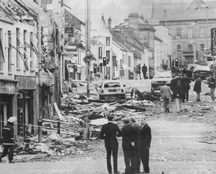
WHILE 1998 opened as a year of hope, developing into one of promise with the signing of the Good Friday Agreement, in Tyrone it will be most remembered for the terrible atrocity meted out to the people of the Omagh area by those who planned and planted the August 15 bomb.
It was an atrocity which stunned the world, and its painful effects reached out into virtually every corner of the county.
As the year opened, political parties were engaged in talks to try and find a new way forward in Northern Ireland, and Easter brought the promise of something better with the signing of the Agreement.
Everyone knew the journey to a lasting peace would not be an easy one, but no one could have anticipated the Omagh bomb of August, which claimed the lives of 29 people and two unborn babies.
In the past it was known as a quiet town, where one month ran into another without much of note occurring. But, as the months progressed, the black clouds overhead continued to gather, and bad news rained down.
It was a 12-month period when the town made the headline news both nationally and internationally in connection with a series of violent deaths, job losses and tragedy.
The various crises within the agricultural industry, too, cast a gloom over the Omagh district. Farmers were hit from all sides, with the BSE crisis, outbreaks of foul pest decimating the lives of poultry-farmers, and the pressure brought about within farming circles by the trouble within the pig industry.
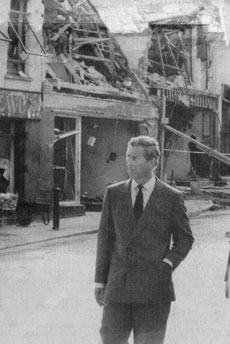
But the Market Street bomb on August 15, for all its terrible damage not only to human life, but to businesses and jobs, also showed the world another side of the people of Northern Ireland - a side so rarely seen by those outside whose only images of the Province are those edited and shown on television.
While millions were horrified by the damage and destruction caused by the 300lb car bomb, they were equally deeply touched by the dignity, courage and loving care shown to each other by the local populace.
This manifested itself in almost unbelievable ways, with bouquets of flowers and messages of sympathy sent to the town from all corners of the globe.
There were visits by some of the most powerful people in the Western World, including the US President, Bill Clinton and his wife, the First Lady, Hilary.
Politicians and figureheads from Northern and Southern Ireland, England, Spain and France converged on the town to show solidarity with the everyday folk whose lives revolved around Market Street and High Street.
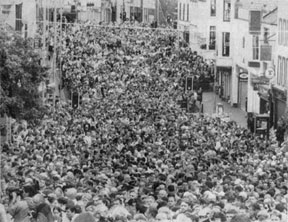
There were unforgettable scenes of anguish and unity as thousands of people flocked to Omagh one week to the day after the bombing, for an outdoor memorial service, while others have worked quietly and tirelessly behind the scenes to help those bereaved and injured come to terms with the scale of what had happened.
Through all of this, the quiet dignity of those who suffered injury or loss has been a shining light to all.
AUGUST
Omagh was thrust onto the international stage for all the wrong reasons on August 15, following an act of terrorism which killed 29 men, women and children, and robbed unborn twins of their right to life. Hundreds more were injured.
The world looked on helpless as flickering images of the scenes of devastation in the small town were beamed around the globe, capturing headlines in all five continents.
Among the victims were well-known and loved townsfolk, people "from areas outlying Omagh, three young friends from Buncrana and a young boy and his supervisor from Spain.
Despite visits from Royalty, the promise of a visit from the American President and his wife, and some of the biggest names in politics stopping off to offer support, which lifted spirits if only for a while, August ended in silent grief for Omagh. The bombing was labelled the worst single terrorist atrocity in the history of Northern Ireland's 'Troubles'.
SEPTEMBER
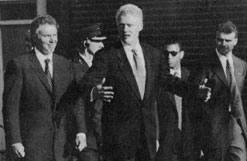
OMAGH was in a state of total shutdown on September 3, as a subdued US President, Bill Clinton and the First Lady Hillary flew in to share in the grief and pain of the bereaved and injured.
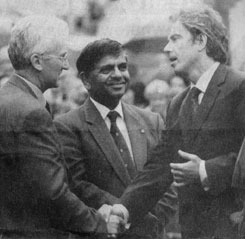
It was the biggest security operation ever witnessed in the town's history, and President Clinton, Hillary and the Prime Minister, Tony Blair and his wife, Cherie, spent over an hour talking to relatives of those killed, and the injured, before venturing into the town to unveil a plaque and lay f|loral tributes to the dead.
Omagh was not on the President's itinerary for his one-day visit to Northern Ireland, but a week before he touched down in Belfast, the White House announced he could be coming to the town to express his sympathy to the community.
The Omagh bombing claimed its 29th victim, Mr. Sean McGrath, at the start of September, three weeks after the blast. Tributes poured in as the 61-year-old baker, described as "a friend to all", was laid to rest in the graveyard at St. Mary's Church, Killyclogher.
Meanwhile, the vital role played by Tyrone County Hospital in helping those injured in the August bomb atrocity was highlighted by local representatives during a debate in the Northern Ireland Assembly.
The month came to a close with news that 12 people were being questioned on both sides of the border in relation to the bombing.
Six were being questioned by Gardai in the Republic, while a further six were under questioning by the RUC at Gough Barracks, Armagh. All were later released without charge.
OCTOBER
THERE was a ray of hope at the start of October for victims of the Omagh bomb, with the announcement that the newly set up Omagh Memorial Fund was expected to top £5 million, and between 450 and 700 people would get priority payouts.
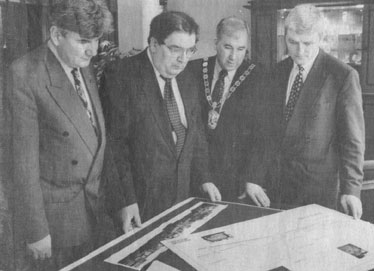
October ended with news of a £7 million plan to create a shopping mall in Omagh on the site of the Royal Arms Hotel and the Mews area.
The state-of-the-art development was heralded as a positive step towards rebuilding the town after the devastation caused by the Market Street bomb in August.
That week it was also revealed that the reconstruction and redevelopment of the lower Market Street area was to benefit from a £900,000 grant from the Heritage Lottery Fund.
NOVEMBER
The chilly month of November blew in with the news that relatives of those who died in the Omagh bombing had pledged to continue their fight to force the 32-County Sovereignty Committee member, Mr. Francis Mackey, to resign from the district council.
At the monthly meeting, a motion calling on the councillor to resign his seat was proposed by Labour councillor, Mr. Johnny McLaughlin, but it was amended by Sinn Fein, and finally passed with most of the council members abstaining from the vote. Mr. Mackey refused to resign.
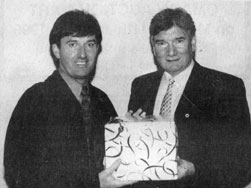
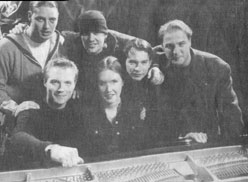
Meanwhile, chart-topping Irish band. Boyzone, took time out from their hectic schedule to make a secret visit to St. Joseph's Hall, Omagh, where they gave a special Christmas gift to Claire Gallagher, who was blinded in the Omagh bomb.
Television personality, Noel Edmunds, was there to film the event for his annual Christmas show, 'Noel's Christmas Presents', which was broadcast on BBC-1 on Christmas Day.
And around 10.000 people crammed into High Street on the last Thursday of the month to witness the annual switch-on of the town's festive lighting by singing star, Daniel O'Donnell. The star-studded event included contributions from folk singers. Dolores and Sean Keane, Pio McCann, and a hilarious performance from the Chevys.
DECEMBER
Meantime, Mr. Jim Sharkey, who was injured in the Omagh bomb, found himself on the front page of the 'Tyrone Constitution' when he witnessed a robbery in a small town outside Toronto. He was in Canada as a guest of the Tyrone-Donegal Partnership.
At the end of the month, and year, there was brighter news, with the announcement that Omagh had received a message of hope in the form of a £2.3 million funding boost to assist with the provision of care in the aftermath of the August bombing.
The good news was brought to Omagh by the Health and Education Minister, Mr. John McFall, during a visit to the town.
Further Information
Related Images