CORONER HEARS HOW BOMB VICTIMS WERE REDUCED TO LITTLE MORE THAN BUTCHERS MEAT
Coroner hears how bomb victims were reduced to little more than butcher's meat
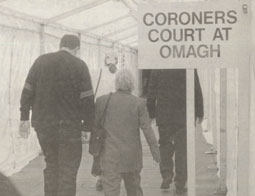
LYNDA GILBY at the Omagh inquest
ON Thursday, the second day of the Omagh Inquest, the Prayer for the Day began: "You Are the God, O Lord, who know a father's grief".
And it included the words: "Hold us, father, in your pity when memory aches ... Allow us to live this day with grace and truth."
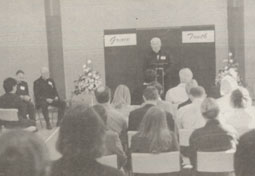
It is a short and simple service that takes place every morning at 10.30, in a hastily-converted basketball court, at Omagh Leisure Centre.
Four clergy from differing denominations officiate from an unadorned makeshift altar backed by two, blue screens. One has the word Grace written on it, the other Truth. At the back of the room sits a table and on it are flowers, a lighted candle and a copy of the book Lost Lives, detailing the history of every human life lost since the beginning of the Troubles.
The book lies open at random, to signify that those affected by the horror that happened at Omagh do not look merely inwards, but reach out to victims of other tragedies. The daily service, organised by Omagh Churches Forum, forms part of the cradle of care that Omagh has cast around the victims and their families, as they face the lengthy ordeal of this inquest.
After the service the families greet each other, filing out to the strains of the Negro spiritual Steal Away, played from a music centre.
In court, the proceedings are a strange, strange mixture of tedium, interest and, at times, an awed hush as the shock of certain evidence registers.
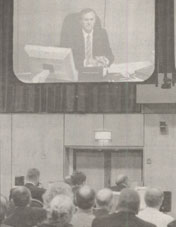
Proceedings go slowly. Maps of the town are studied in the most minute of details. Two large screens above the Coroner's head face the onlookers. The camera focuses on whoever is speaking and when it homes in on lawyers, with their backs to the audience, the faces of the families, seated in the front rows, are also on screen.
In the long silences, where maps amended and displayed on screen, all that can be heard is the whispering swish of the air conditioning.
Top English QC, Michael Mansfield, representing one of the families, is closely questioning the RUC man who took the bomb call in Coleraine and logged it on the computer.
Mansfield is soft-pedalling compared to the previous day when complaints were made about his interrogation technique. Even so, a lawyer representing some of the other families gets to his feet to express his client's concern that the policeman should be questioned in this manner without legal representation. By 12.30pm, the most jarring moment has been when a mapper describes how he was instructed by police to mark certain items on the map of the bomb scene.
"And what are those?". asked the Coroner, "pieces of flesh" he replied.
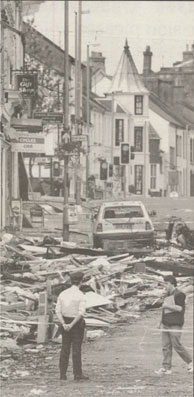
We are now, though, about to see, in their entirety, three amateur videos filmed in the immediate aftermath of the explosion.
Most of the families leave to either watch the footage, relayed to the private room set aside for them, or to avoid it altogether.
The films are devastating. In the first, amid the noise, the confusion and hysteria, a voice can be heard crying urgently: "Put your hand on it. Put pressure on it" - presumably to stop the bleeding. In the other two, appalling injuries can be seen quite clearly.
One trembles for the families who have elected to view this horror. How on earth must they be feeling?
Pretty grim. After a lunch-break, extended to allow them time to recover themselves, rows of seats reserved for them in court are noticeably empty. And heaven help them, this is only the beginning, and far from the worst of the ordeal ahead of them.
As the weeks wear on, if the 29 deaths are examined with the sort of forensic thoroughness displayed so far, they will be subjected to the most minute and agonisingly detail of how people they loved were reduced, in some cases, to lumps of butcher's meat.
If you were bereaved, in the manner of the relatives of the Omagh victims are bereaved, how could you possibly make the decision whether or not to witness such evidence?
The desire to know would be overwhelming, but the posing of that knowledge could well haunt you to your own grave.
There is no doubt that every care possible is taken in court to consider the feelings of the families. But.the question still arises, what is this all for? Unlike in England, the inquest can reach no verdict. And it could, of course, be performed in a much more quiet and perfunctory manner.
As one of the bereaved, who decided not to attend the inquest was quoted as saying last week: "I already know what killed my wife".
The people of Omagh and its environs, who are not directly involved in the tragedy, do not appear to be attending the inquest.
In court, seats are laid out with scrupulous equity - 96 for the families, 96 for the public, the same for the Press.
In the public section, only clergy and others forming part of the support services, occupy the most uncomfortable folding seats in Christendom.
But, from the caring ethos that permeates the leisure centre at Omagh, the comfort and support of the community surrounding it is almost palpable.
LYNDA GILBY at the Omagh inquest
ON Thursday, the second day of the Omagh Inquest, the Prayer for the Day began: "You Are the God, O Lord, who know a father's grief".
And it included the words: "Hold us, father, in your pity when memory aches ... Allow us to live this day with grace and truth."
It is a short and simple service that takes place every morning at 10.30, in a hastily-converted basketball court, at Omagh Leisure Centre.
Four clergy from differing denominations officiate from an unadorned makeshift altar backed by two, blue screens. One has the word Grace written on it, the other Truth. At the back of the room sits a table and on it are flowers, a lighted candle and a copy of the book Lost Lives, detailing the history of every human life lost since the beginning of the Troubles.
The book lies open at random, to signify that those affected by the horror that happened at Omagh do not look merely inwards, but reach out to victims of other tragedies. The daily service, organised by Omagh Churches Forum, forms part of the cradle of care that Omagh has cast around the victims and their families, as they face the lengthy ordeal of this inquest.
After the service the families greet each other, filing out to the strains of the Negro spiritual Steal Away, played from a music centre.
In court, the proceedings are a strange, strange mixture of tedium, interest and, at times, an awed hush as the shock of certain evidence registers.
Proceedings go slowly. Maps of the town are studied in the most minute of details. Two large screens above the Coroner's head face the onlookers. The camera focuses on whoever is speaking and when it homes in on lawyers, with their backs to the audience, the faces of the families, seated in the front rows, are also on screen.
In the long silences, where maps amended and displayed on screen, all that can be heard is the whispering swish of the air conditioning.
Top English QC, Michael Mansfield, representing one of the families, is closely questioning the RUC man who took the bomb call in Coleraine and logged it on the computer.
Mansfield is soft-pedalling compared to the previous day when complaints were made about his interrogation technique. Even so, a lawyer representing some of the other families gets to his feet to express his client's concern that the policeman should be questioned in this manner without legal representation. By 12.30pm, the most jarring moment has been when a mapper describes how he was instructed by police to mark certain items on the map of the bomb scene.
"And what are those?". asked the Coroner, "pieces of flesh" he replied.
We are now, though, about to see, in their entirety, three amateur videos filmed in the immediate aftermath of the explosion.
Most of the families leave to either watch the footage, relayed to the private room set aside for them, or to avoid it altogether.
The films are devastating. In the first, amid the noise, the confusion and hysteria, a voice can be heard crying urgently: "Put your hand on it. Put pressure on it" - presumably to stop the bleeding. In the other two, appalling injuries can be seen quite clearly.
One trembles for the families who have elected to view this horror. How on earth must they be feeling?
Pretty grim. After a lunch-break, extended to allow them time to recover themselves, rows of seats reserved for them in court are noticeably empty. And heaven help them, this is only the beginning, and far from the worst of the ordeal ahead of them.
As the weeks wear on, if the 29 deaths are examined with the sort of forensic thoroughness displayed so far, they will be subjected to the most minute and agonisingly detail of how people they loved were reduced, in some cases, to lumps of butcher's meat.
If you were bereaved, in the manner of the relatives of the Omagh victims are bereaved, how could you possibly make the decision whether or not to witness such evidence?
The desire to know would be overwhelming, but the posing of that knowledge could well haunt you to your own grave.
There is no doubt that every care possible is taken in court to consider the feelings of the families. But.the question still arises, what is this all for? Unlike in England, the inquest can reach no verdict. And it could, of course, be performed in a much more quiet and perfunctory manner.
As one of the bereaved, who decided not to attend the inquest was quoted as saying last week: "I already know what killed my wife".
The people of Omagh and its environs, who are not directly involved in the tragedy, do not appear to be attending the inquest.
In court, seats are laid out with scrupulous equity - 96 for the families, 96 for the public, the same for the Press.
In the public section, only clergy and others forming part of the support services, occupy the most uncomfortable folding seats in Christendom.
But, from the caring ethos that permeates the leisure centre at Omagh, the comfort and support of the community surrounding it is almost palpable.
Further Information
Publisher: SUNDAY LIFE
Ref: SL/084
Published Date: 10-Sep-00
Related Images