ART SHEDS LIGHT ON ULSTER'S PAST
Art sheds light on Ulster's past
BY PHIL CROSSEY Arts Correspondent
phil.crossey@newsletter.co.uk
TIME has done little to dull the pain of the Omagh bombing, or its impact on modern Northern Ireland.
In August 1998 a Real IRA car bomb killed 29 people - including a pregnant woman carrying twins - and injured hundreds more.
It became the worst single terrorist atrocity on Northern Irish soil.
The incident was particularly tragic, even by the standards of Ulster's violent past, one event in the hundreds which made up the Troubles during which thousands were killed and tens of thousands were injured.
The question of how Ulster should address this legacy is a fairly recent one.
A landmark Arts Council conference next week will look at art and conflict, and the idea of linking our harrowing past with a creative future.
Among the speakers will be Sean Hillen, the artist behind the Omagh memorial.
The Newry man was chosen to create the groundbreaking work of art which now stands in the Co Tyrone town.
His proposal, entitled Garden of Light, was selected in 2007, and work has been ongoing on the ambitious project since then.
Against the backdrop of such human suffering, the mention of art might seem a shade belittling - "the average person doesn't get up in the morning and begin worrying about art," Sean said.
But he added that it has a role to play in how we represent and deal with our history.
"If you want to have an effect on people's lives you have to be out there in public," Sean said.
His work is the first major artistic memorial of the Troubles and, as the Omagh bomb court case this week illustrated, it is based around a live issue.
"The Omagh situation is very messy," Sean said, "it is disputed and still unresolved.
"And I agree with the victims' groups that there should be an independent inquiry."
The ongoing nature of the aftermath of Omagh, the size and scale of the tragedy and the importance of the pioneering work were all considerations for the piece.
"The weight of responsibility has made it a difficult job to do, work has been very slow," Sean said.
"It was and still is" a huge responsibility," he said, "it was a huge challenge - the artist in me couldn't resist that - but ultimately I wanted to contribute something real."
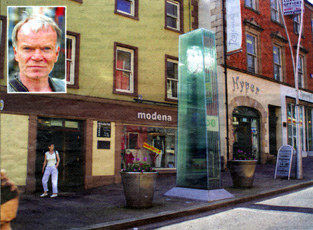
Co-designed with landscape architect Desmond Fitzgerald, the memorial is based around 31 small mirrors situated in the memorial garden in Omagh which focus light onto a heart-shaped mirror in a glass monolith 300 metres away, on the site of the blast.
"It was an unusual requirement to connect the two points," Sean said.
But his idea of directing sunlight was simple yet effective and evocative - and the result is a work charged with symbolism that is based not on tragedy but humanity.
"It has taken over my life for the past two years," Sean said.
Intellectual and creative notions aside, there were plenty of practical concerns about the work - "the reflected light couldn't be too bright, because health and safety regulations meant you couldn't dazzle people," Sean said - and it had to comply with structural regulations.
But Garden of Light now stands as a physical, and cultural, landmark. Sean will be speaking at the Arts and Conflict conference, which also features South African Justice Albie Sachs and writer/broadcaster Fergal Keane.
"Art and conflict have a very complicated relationship," Sean said. "On the one hand, living in Northern Ireland was a gift for an artist, on the other it was a poison chalice, but I grew up in the middle of the Troubles and felt a need to document it." Now based in Dublin, Sean's early work centred around photographs of the Troubles, which developed into collage and montage pieces. While they used images of the violence, his work was never intended to be a lecture - "I don't need to tell people about history," Sean said - or make a political point.
"You don't want to be a cheerleader, or producing propaganda," he said. "We live in an electronic world full of campaigning and various representations and there is very little truth in it - the artist is beholden to nothing but the truth."
The Arts and Conflict conference Is organised by the Arts Council and takes place In the Grand Opera House, Belfast, next Wednesday, June 17. For more Information log on to www.artscouncll-nl.org or contact Marlyn Beck on 9038 5228.
BY PHIL CROSSEY Arts Correspondent
phil.crossey@newsletter.co.uk
TIME has done little to dull the pain of the Omagh bombing, or its impact on modern Northern Ireland.
In August 1998 a Real IRA car bomb killed 29 people - including a pregnant woman carrying twins - and injured hundreds more.
It became the worst single terrorist atrocity on Northern Irish soil.
The incident was particularly tragic, even by the standards of Ulster's violent past, one event in the hundreds which made up the Troubles during which thousands were killed and tens of thousands were injured.
The question of how Ulster should address this legacy is a fairly recent one.
A landmark Arts Council conference next week will look at art and conflict, and the idea of linking our harrowing past with a creative future.
Among the speakers will be Sean Hillen, the artist behind the Omagh memorial.
The Newry man was chosen to create the groundbreaking work of art which now stands in the Co Tyrone town.
His proposal, entitled Garden of Light, was selected in 2007, and work has been ongoing on the ambitious project since then.
Against the backdrop of such human suffering, the mention of art might seem a shade belittling - "the average person doesn't get up in the morning and begin worrying about art," Sean said.
But he added that it has a role to play in how we represent and deal with our history.
"If you want to have an effect on people's lives you have to be out there in public," Sean said.
His work is the first major artistic memorial of the Troubles and, as the Omagh bomb court case this week illustrated, it is based around a live issue.
"The Omagh situation is very messy," Sean said, "it is disputed and still unresolved.
"And I agree with the victims' groups that there should be an independent inquiry."
The ongoing nature of the aftermath of Omagh, the size and scale of the tragedy and the importance of the pioneering work were all considerations for the piece.
"The weight of responsibility has made it a difficult job to do, work has been very slow," Sean said.
"It was and still is" a huge responsibility," he said, "it was a huge challenge - the artist in me couldn't resist that - but ultimately I wanted to contribute something real."
Co-designed with landscape architect Desmond Fitzgerald, the memorial is based around 31 small mirrors situated in the memorial garden in Omagh which focus light onto a heart-shaped mirror in a glass monolith 300 metres away, on the site of the blast.
"It was an unusual requirement to connect the two points," Sean said.
But his idea of directing sunlight was simple yet effective and evocative - and the result is a work charged with symbolism that is based not on tragedy but humanity.
"It has taken over my life for the past two years," Sean said.
Intellectual and creative notions aside, there were plenty of practical concerns about the work - "the reflected light couldn't be too bright, because health and safety regulations meant you couldn't dazzle people," Sean said - and it had to comply with structural regulations.
But Garden of Light now stands as a physical, and cultural, landmark. Sean will be speaking at the Arts and Conflict conference, which also features South African Justice Albie Sachs and writer/broadcaster Fergal Keane.
"Art and conflict have a very complicated relationship," Sean said. "On the one hand, living in Northern Ireland was a gift for an artist, on the other it was a poison chalice, but I grew up in the middle of the Troubles and felt a need to document it." Now based in Dublin, Sean's early work centred around photographs of the Troubles, which developed into collage and montage pieces. While they used images of the violence, his work was never intended to be a lecture - "I don't need to tell people about history," Sean said - or make a political point.
"You don't want to be a cheerleader, or producing propaganda," he said. "We live in an electronic world full of campaigning and various representations and there is very little truth in it - the artist is beholden to nothing but the truth."
The Arts and Conflict conference Is organised by the Arts Council and takes place In the Grand Opera House, Belfast, next Wednesday, June 17. For more Information log on to www.artscouncll-nl.org or contact Marlyn Beck on 9038 5228.
Further Information
Publisher: NEWS LETTER
Ref: NL/799
Published Date: 13-Jun-09
Related Images