CATCH THE OMAGH KILLERS'
Catch the Omagh killers'
Board backs PSNI on Hoey trial and calls for public support
BY STEPHEN DEMPSTER and PHILIP BRADFIELD
newsdesk@newsletter. co. uk
THE Policing Board has backed the PSNI over the collapse of the Omagh bomb trial and is demanding that the public focus is put back onto pursuit of the Real IRA murderers.
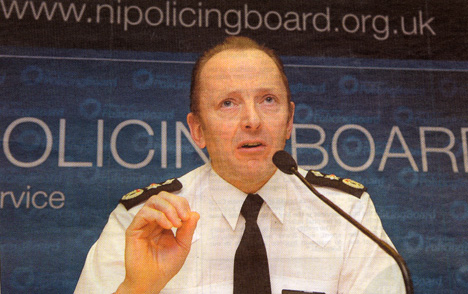
Although Chief Constable Sir Hugh Orde faced three hours of questioning last night regarding the trial judge's damning view of the integrity of two investigating officers, the Policing Board later fell in behind Sir Hugh and is now determined to put the focus back on the criminal investigation.
Policing Board member Jeffrey Donaldson said: "The board is determined that it will not support a witchhunt of the PSNI and that its number one priority is to deliver justice for the Omagh families.
"While Sir Hugh Orde made it clear he did not believe we currently have enough evidence to bring another prosecution, it was also made clear to us that we still do have real evidence, leads and suspects.
"That is why we are recommending an independent review of the investigation to see how we can best restart the criminal investigation and press for fresh prosecutions."
He said the Police Ombudsman's investigation into the two police officers began some months ago and is nearly complete.
"She never asked for the officers to be suspended from duty and to do so at this late stage would certainly prejudice their right to a presumption of innocence," he added.
Board chairman Professor Sir Desmond Rea noted the Chief Constable's view that the viability of further prosecution depended on new witnesses.
"There are people in the community who have information and as a board we would also join with the Chief Constable in urging anyone with any information or fresh evidence to bring this to the police," he said.
During the grilling last night, Sir Hugh was challenged as to why he had not suspended the two officers who admitted - in court -tampering with statements.
But the PSNI boss said he would not act until a Police Ombudsman's inquiry into the pairs' actions was complete.
Sir Hugh also defended his force and especially Det Chief Superintendent Norman Baxter, who headed the failed investigation, where suspect Sean Hoey was acquitted.
Mr Baxter and the PSNI, Sir Hugh said, "were doing our best with what we had", as far as evidence was concerned.
Appearing to distance himself and the second Omagh investigation from fault, he made it clear that the PSNI had been fighting a losing battle in achieving justice for Omagh because of the poor handling of the case in its infancy - in the days of Sir Ronnie Flanagan and what was then the RUC.
He said: "We have been very clear from the word go that we were dealing with exhibits [of evidence] that were not good.
"The judge's [Justice Weir in summing up at the Hoey trial] comments - and I am assuming you have read the judgment - were very damning on how exhibits were handled in 1998.
"Norman Baxter was doing his best with second-hand goods.
"In my judgment he did his very best with what he had.
"We took it to the prosecution service and they agreed [to go to trial].
"We took it to a preliminary hearing in front of a magistrate which lasted a week and the scientific evidence was tested by that magistrate and the defence and prosecution.
"The learned magistrate felt there was a case to answer; it went to the Crown Court; the learned judge felt there was a case to answer and dismissed applications by the defence team to throw the case out.
"Now, the basic principle of the system which we have is very simple: we have to satisfy to a very high standard - beyond reasonable doubt - that someone is guilty.
"We failed to convince the judge of that point.
"The prosecution failed - I understand that; I can live with that; that's part of policing."
Mr Justice Weir told the trial that two officers on the case were guilty of a "deliberate and calculated deception" in "beefing up" their statements regarding how carefully they collected forensic evidence.
The evidence was later used for low copy DNA testing.
Expert testimony in the trial questioned the reliability of the technique and a national review into it is now under way.
Board backs PSNI on Hoey trial and calls for public support
BY STEPHEN DEMPSTER and PHILIP BRADFIELD
newsdesk@newsletter. co. uk
THE Policing Board has backed the PSNI over the collapse of the Omagh bomb trial and is demanding that the public focus is put back onto pursuit of the Real IRA murderers.
Although Chief Constable Sir Hugh Orde faced three hours of questioning last night regarding the trial judge's damning view of the integrity of two investigating officers, the Policing Board later fell in behind Sir Hugh and is now determined to put the focus back on the criminal investigation.
Policing Board member Jeffrey Donaldson said: "The board is determined that it will not support a witchhunt of the PSNI and that its number one priority is to deliver justice for the Omagh families.
"While Sir Hugh Orde made it clear he did not believe we currently have enough evidence to bring another prosecution, it was also made clear to us that we still do have real evidence, leads and suspects.
"That is why we are recommending an independent review of the investigation to see how we can best restart the criminal investigation and press for fresh prosecutions."
He said the Police Ombudsman's investigation into the two police officers began some months ago and is nearly complete.
"She never asked for the officers to be suspended from duty and to do so at this late stage would certainly prejudice their right to a presumption of innocence," he added.
Board chairman Professor Sir Desmond Rea noted the Chief Constable's view that the viability of further prosecution depended on new witnesses.
"There are people in the community who have information and as a board we would also join with the Chief Constable in urging anyone with any information or fresh evidence to bring this to the police," he said.
During the grilling last night, Sir Hugh was challenged as to why he had not suspended the two officers who admitted - in court -tampering with statements.
But the PSNI boss said he would not act until a Police Ombudsman's inquiry into the pairs' actions was complete.
Sir Hugh also defended his force and especially Det Chief Superintendent Norman Baxter, who headed the failed investigation, where suspect Sean Hoey was acquitted.
Mr Baxter and the PSNI, Sir Hugh said, "were doing our best with what we had", as far as evidence was concerned.
Appearing to distance himself and the second Omagh investigation from fault, he made it clear that the PSNI had been fighting a losing battle in achieving justice for Omagh because of the poor handling of the case in its infancy - in the days of Sir Ronnie Flanagan and what was then the RUC.
He said: "We have been very clear from the word go that we were dealing with exhibits [of evidence] that were not good.
"The judge's [Justice Weir in summing up at the Hoey trial] comments - and I am assuming you have read the judgment - were very damning on how exhibits were handled in 1998.
"Norman Baxter was doing his best with second-hand goods.
"In my judgment he did his very best with what he had.
"We took it to the prosecution service and they agreed [to go to trial].
"We took it to a preliminary hearing in front of a magistrate which lasted a week and the scientific evidence was tested by that magistrate and the defence and prosecution.
"The learned magistrate felt there was a case to answer; it went to the Crown Court; the learned judge felt there was a case to answer and dismissed applications by the defence team to throw the case out.
"Now, the basic principle of the system which we have is very simple: we have to satisfy to a very high standard - beyond reasonable doubt - that someone is guilty.
"We failed to convince the judge of that point.
"The prosecution failed - I understand that; I can live with that; that's part of policing."
Mr Justice Weir told the trial that two officers on the case were guilty of a "deliberate and calculated deception" in "beefing up" their statements regarding how carefully they collected forensic evidence.
The evidence was later used for low copy DNA testing.
Expert testimony in the trial questioned the reliability of the technique and a national review into it is now under way.
Further Information
Publisher: NEWS LETTER
Ref: NL/716
Published Date: 04-Jan-08
Related Images