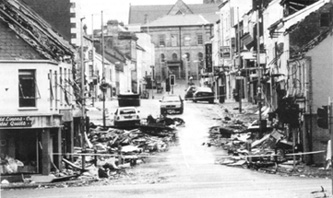
AUGUST 15TH 1998
AUGUST I 5TH 1998
Fr. Kevin Mullan in conversation with Bernard Cotter Editor of Intercom Magazine
I was preparing for Saturday evening Mass when I heard the bomb go off. There was this bang you would not mistake. There's an army camp just across from my house, so I checked there first. They said, "It's not here, it's downtown, but the police have everything under control". They thought the bomb was at the Courthouse where it was supposed to be.
I drove on into town, not expecting anything. I happened to park around the corner from where everything was happening. It was a terrible scene, dreadful. Everybody was screaming.
After a while I realised there were people dead. Most of the bodies were covered - the shop assistants had torn down curtains to put over them. Ambulances were arriving, and taxis were there offering to take people wherever they needed to go. The young people from the shops were helping everyone.
I was also on hospital duty that Saturday. My pager wouldn't work (all the phones were knocked out by the blast) and I was desperate to find out if there were priests at the hospital to help. I decided I'd better stay on the street, but I heard afterwards that priests from all the parishes around had gone in to help out.
All I did there on Market Street was pray as much as I could. I hadn't a notion who I was praying with at times, but it seemed to mean a lot to people, just the fact that I was there, with them. People said afterwards: "the priest was there and he prayed with us and with the dead".
Finally, when the street began to be cleared of bodies, I came home. There was a baptism arranged for six o'clock. It was a very strange experience, to be blessing new life, with nearly 30 people dead downtown. We went through it very quickly and quietly.
At the evening Mass, I had to abandon the set texts. Nobody was in the mood for anything but a Mass of the dead. We read the story of the widow's son at Naim for the Gospel. When I read about his body being carried out for burial, I could see in my mind all the bodies in the street being carried out of the town. The church was full of people, they came flooding in from all around. In fact a lot of people who attend infrequently came back to church that evening.
After Mass I discovered that an incident centre had been set up in the town's leisure complex and all the information would be channelled through it. It was a long night there. The names from the hospitals were being fed back there and families could check to see if their missing person was on the list. As the night wore on, it was clear that some people had not been accounted for.
Every family was assigned a police person and social worker, and a clergy person if they wanted one. I liaised with two families, one from my own parish, another from out the country. The families were told that the missing could yet be found, or could be in hospital, or might indeed be dead. The centre staff took details of who were missing and what they were wearing, which they matched up with what they had found.
I spent the whole night there. After Sunday morning Mass in the parish, I came back to the incident centre for the rest of that day. By evening, people from the media were arriving. The BBC were looking for somebody to do Thought for the Day next morning on Radio Four. Because they wanted a local, I was asked to do it. There was just an hour and a quarter to write it. So I had to find a place to be quiet in the middle of everything and just scream out for inspiration, I didn't get to bed afterwards till three.
Next morning I had to be up at a quarter past five for a Sky TV interview and to read the Thought for the Day, live. The whole day was just interviews, interviews, interviews. The media were at times demanding, but I made this work part of my ministry. After all, they were able to tell the world how wrong this was, to show the lovely people who had been hurt.
The media were great in that sense; they spread the news for us. The story was so vast, they brought it all together. The reporters were very sympathetic people who were moved by the dignified response of people.
We were conscious the whole time that this wasn't an accident. It wasn't a plane crash or a train going off the rails. It was something planned. Someone did this for a reason.
I found that hard to cope with. Why did it have to happen here? Why did it happen to so many good people? I wanted to find the people who did this and sit them down and tell them what had happened and hear what they had to say about it. It was important that they know how much grief they had caused.
The media helped us do that too. We were grateful to them. That's why the reporters were included in the memorial service at the end of the week.
One of the prayers was offered for 'those who told our story'.
The Monday after the bombing, bodies were being released and we started getting ready for funerals. That night, all the clergy of the different dominations in the town and the surrounding villages had a meeting in the leisure centre. We coordinated the funerals so that people could go to as many as they wanted to.
We also heard there that the four church leaders wanted us to organise a service in Omagh the following Saturday. We discussed the general guidelines, then delegated the work to a small group. I was on that group.
We met three nights that week - late and long! We asked ourselves, "what hope can we give to the town"? The service was finally put together on the Friday morning. Then all the clergy met again on Friday night to go through it. The press officer for the Church of Ireland and Fr. Martin Clarke were involved too; they were very helpful.
The reaction to what we called a service of 'prayerful remembrance' was very good. At least it got people back into the town, and got them talking again. The week had been such a silent time.
That Saturday, a wedding had been arranged for the Church of Ireland which couldn't easily be changed. The couple went ahead, but the day influenced their wedding. They said special prayers for all the victims at the church, and then had a minute's silence at the reception. And they were very quiet driving out of the town.
All that week, the families affected were great. I got more from the families of the dead than I could ever give them. They were so dignified. The Tuesday and Wednesday night before the funerals, the whole of Omagh and the surrounding district was just one long pilgrimage, people going through the night from wake to wake.
I was in tears watching it, going from one house to the next. Then, late on in the night, some of the bereaved families themselves started to visit other bereaved homes. The solidarity and comfort they gave one another was absolutely amazing.
On the Thursday morning, there were funerals crisscrossing each other at the top of the town, where there are four churches of different denominations. The sight of hearse crossing hearse was unbelievable.
For the funeral in my own church on Wednesday morning, the Church of Ireland minister said he was going to come along, and the Presbyterian minister and his wife too. They ended up sitting in the sanctuary with the bishop - there was nowhere else to sit! Each shared a few words of sympathy at the end, and said to me "be sure to come to our funerals and say a few words there too". This would never have happened before. Barriers fell down everywhere.
Once the memorial service on the Saturday was over, my focus shifted to the injured. I went from Belfast to Enniskillen to Altnagelvin to the hospital here, and to the homes. The week of the funerals, I hadn't been able to visit them at all, though I know some of the ministers left Omagh at six in the morning some days to visit the injured and then get back for funerals. I wasn't able to do that.
The Clinton visit came very soon after that. Our parish hall was used as a gathering place for the bereaved and injured the morning of the visit. It was the first time all the people who were in the street the day of the bomb were together again. It was very moving to see them talking to each other. They were all making a first step back into life. I felt proud that we were able to facilitate them.
I stood at the back of the leisure centre during the president's visit. He stayed as long as the people wanted. Anyone in the hall could talk to him - he didn't mind who went up to him. The families said they found it good that someone powerful was taking notice of them. At the end I got a moment with him myself.
Being together was the best thing: Clinton was the catalyst for that, but we helped each other. As well as clapping Clinton, we were clapping ourselves. It was as if we were saying: "we've got this far, let's encourage each other to go on".
Right through the time after the bomb, the support system in the town worked very well. It was unobtrusive but very strong. Every need was catered for.
I suppose every town has its own structured divisions. But ours all crumbled during that week. I think we've moved beyond some of the old divisions.
There was an amazing outpouring of good after the bomb. It was as if the wave of destruction of the bomb was immediately followed by a wave of goodness and kindness and prayer. Now it's a matter of holding on to that togetherness'.
Fr. Kevin Mullan in conversation with Bernard Cotter Editor of Intercom Magazine
I was preparing for Saturday evening Mass when I heard the bomb go off. There was this bang you would not mistake. There's an army camp just across from my house, so I checked there first. They said, "It's not here, it's downtown, but the police have everything under control". They thought the bomb was at the Courthouse where it was supposed to be.
I drove on into town, not expecting anything. I happened to park around the corner from where everything was happening. It was a terrible scene, dreadful. Everybody was screaming.
After a while I realised there were people dead. Most of the bodies were covered - the shop assistants had torn down curtains to put over them. Ambulances were arriving, and taxis were there offering to take people wherever they needed to go. The young people from the shops were helping everyone.
I was also on hospital duty that Saturday. My pager wouldn't work (all the phones were knocked out by the blast) and I was desperate to find out if there were priests at the hospital to help. I decided I'd better stay on the street, but I heard afterwards that priests from all the parishes around had gone in to help out.
All I did there on Market Street was pray as much as I could. I hadn't a notion who I was praying with at times, but it seemed to mean a lot to people, just the fact that I was there, with them. People said afterwards: "the priest was there and he prayed with us and with the dead".
Finally, when the street began to be cleared of bodies, I came home. There was a baptism arranged for six o'clock. It was a very strange experience, to be blessing new life, with nearly 30 people dead downtown. We went through it very quickly and quietly.
At the evening Mass, I had to abandon the set texts. Nobody was in the mood for anything but a Mass of the dead. We read the story of the widow's son at Naim for the Gospel. When I read about his body being carried out for burial, I could see in my mind all the bodies in the street being carried out of the town. The church was full of people, they came flooding in from all around. In fact a lot of people who attend infrequently came back to church that evening.
After Mass I discovered that an incident centre had been set up in the town's leisure complex and all the information would be channelled through it. It was a long night there. The names from the hospitals were being fed back there and families could check to see if their missing person was on the list. As the night wore on, it was clear that some people had not been accounted for.
Every family was assigned a police person and social worker, and a clergy person if they wanted one. I liaised with two families, one from my own parish, another from out the country. The families were told that the missing could yet be found, or could be in hospital, or might indeed be dead. The centre staff took details of who were missing and what they were wearing, which they matched up with what they had found.
I spent the whole night there. After Sunday morning Mass in the parish, I came back to the incident centre for the rest of that day. By evening, people from the media were arriving. The BBC were looking for somebody to do Thought for the Day next morning on Radio Four. Because they wanted a local, I was asked to do it. There was just an hour and a quarter to write it. So I had to find a place to be quiet in the middle of everything and just scream out for inspiration, I didn't get to bed afterwards till three.
Next morning I had to be up at a quarter past five for a Sky TV interview and to read the Thought for the Day, live. The whole day was just interviews, interviews, interviews. The media were at times demanding, but I made this work part of my ministry. After all, they were able to tell the world how wrong this was, to show the lovely people who had been hurt.
The media were great in that sense; they spread the news for us. The story was so vast, they brought it all together. The reporters were very sympathetic people who were moved by the dignified response of people.
We were conscious the whole time that this wasn't an accident. It wasn't a plane crash or a train going off the rails. It was something planned. Someone did this for a reason.
I found that hard to cope with. Why did it have to happen here? Why did it happen to so many good people? I wanted to find the people who did this and sit them down and tell them what had happened and hear what they had to say about it. It was important that they know how much grief they had caused.
The media helped us do that too. We were grateful to them. That's why the reporters were included in the memorial service at the end of the week.
One of the prayers was offered for 'those who told our story'.
The Monday after the bombing, bodies were being released and we started getting ready for funerals. That night, all the clergy of the different dominations in the town and the surrounding villages had a meeting in the leisure centre. We coordinated the funerals so that people could go to as many as they wanted to.
We also heard there that the four church leaders wanted us to organise a service in Omagh the following Saturday. We discussed the general guidelines, then delegated the work to a small group. I was on that group.
We met three nights that week - late and long! We asked ourselves, "what hope can we give to the town"? The service was finally put together on the Friday morning. Then all the clergy met again on Friday night to go through it. The press officer for the Church of Ireland and Fr. Martin Clarke were involved too; they were very helpful.
The reaction to what we called a service of 'prayerful remembrance' was very good. At least it got people back into the town, and got them talking again. The week had been such a silent time.
That Saturday, a wedding had been arranged for the Church of Ireland which couldn't easily be changed. The couple went ahead, but the day influenced their wedding. They said special prayers for all the victims at the church, and then had a minute's silence at the reception. And they were very quiet driving out of the town.
All that week, the families affected were great. I got more from the families of the dead than I could ever give them. They were so dignified. The Tuesday and Wednesday night before the funerals, the whole of Omagh and the surrounding district was just one long pilgrimage, people going through the night from wake to wake.
I was in tears watching it, going from one house to the next. Then, late on in the night, some of the bereaved families themselves started to visit other bereaved homes. The solidarity and comfort they gave one another was absolutely amazing.
On the Thursday morning, there were funerals crisscrossing each other at the top of the town, where there are four churches of different denominations. The sight of hearse crossing hearse was unbelievable.
For the funeral in my own church on Wednesday morning, the Church of Ireland minister said he was going to come along, and the Presbyterian minister and his wife too. They ended up sitting in the sanctuary with the bishop - there was nowhere else to sit! Each shared a few words of sympathy at the end, and said to me "be sure to come to our funerals and say a few words there too". This would never have happened before. Barriers fell down everywhere.
Once the memorial service on the Saturday was over, my focus shifted to the injured. I went from Belfast to Enniskillen to Altnagelvin to the hospital here, and to the homes. The week of the funerals, I hadn't been able to visit them at all, though I know some of the ministers left Omagh at six in the morning some days to visit the injured and then get back for funerals. I wasn't able to do that.
The Clinton visit came very soon after that. Our parish hall was used as a gathering place for the bereaved and injured the morning of the visit. It was the first time all the people who were in the street the day of the bomb were together again. It was very moving to see them talking to each other. They were all making a first step back into life. I felt proud that we were able to facilitate them.
I stood at the back of the leisure centre during the president's visit. He stayed as long as the people wanted. Anyone in the hall could talk to him - he didn't mind who went up to him. The families said they found it good that someone powerful was taking notice of them. At the end I got a moment with him myself.
Being together was the best thing: Clinton was the catalyst for that, but we helped each other. As well as clapping Clinton, we were clapping ourselves. It was as if we were saying: "we've got this far, let's encourage each other to go on".
Right through the time after the bomb, the support system in the town worked very well. It was unobtrusive but very strong. Every need was catered for.
I suppose every town has its own structured divisions. But ours all crumbled during that week. I think we've moved beyond some of the old divisions.
There was an amazing outpouring of good after the bomb. It was as if the wave of destruction of the bomb was immediately followed by a wave of goodness and kindness and prayer. Now it's a matter of holding on to that togetherness'.
Further Information
Publisher: CAPPAGH
Ref: MAG/006
Published Date: 1998
Related Images