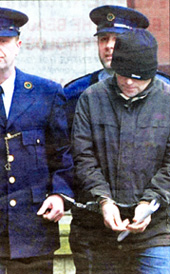
REAL IRA MEMBER ATTEMPTS TO QUASH HEARING IN NORTH
Real IRA member attempts to quash hearing in north
A TOP dissident republican wanted over an alleged arms-smuggling plot yesterday launched a High Court bid to be released from custody in Northern Ireland.
Liam Campbell, one of the men held to be responsible for the Omagh bombing, is seeking an order that he is being held unlawfully at Maghaberry Prison.
His lawyers combined their request for a Writ of Habeas Corpus with an attempt to quash a decision to have extradition proceedings against him heard in Belfast rather than continue in Dublin.
The 46-year-old, from Upper Faughart, Dundalk, Co Louth, is wanted in Lithuania over a suspected operation to acquire and ship guns, ammunition and explosives from the eastern European state to Ireland.
Last month Campbell and three other men were found liable for the Omagh atrocity following a landmark civil action brought by relatives of some of the 29 people killed in the August 1998 blast.
A judge declared there was cogent evidence that he was a member of the Real IRA's army council.
Campbell was arrested in south Armagh in May after crossing the border to take his wife to work.
Earlier this month Belfast Recorder Tom Burgess ruled that extradition proceedings should take place in Northern Ireland because Lithuania wanted the case to be heard in Britain.
But seeking leave to apply for a judicial review, Cambell's barrister Edward Fitzgerald QC yesterday argued that Judge Burgess had got it wrong.
"By initiating these proceedings here and continuing them there was an interference with the due process that had already been initiated in the south," Mr Fitzgerald said.
He also told a two-judge Divisional Court panel: "On any test it goes to a typical Habeas Corpus point - unlawfully detained because this is an arbitrary process.
"Alternatively we submit this is a classic judicial review case.
"We say that the learned recorder misdirected himself in a number of ways."
Gerry Simpson QC, for the Lithuanian government, cautioned against any suggestion of scheming in the case.
Mr Simpson pointed out how an arrest warrant in the Republic was withdrawn after the decision was reached to proceed in Northern Ireland.
"All of that was why the recorder came to the decision he did, that there wasn't any bad faith or any whiff of manipulation by the Lithuanian authorities," he said.
After hearing both sides Lord Justice Higgins and Mr Justice McCloskey reserved judgment in the application.
A TOP dissident republican wanted over an alleged arms-smuggling plot yesterday launched a High Court bid to be released from custody in Northern Ireland.
Liam Campbell, one of the men held to be responsible for the Omagh bombing, is seeking an order that he is being held unlawfully at Maghaberry Prison.
His lawyers combined their request for a Writ of Habeas Corpus with an attempt to quash a decision to have extradition proceedings against him heard in Belfast rather than continue in Dublin.
The 46-year-old, from Upper Faughart, Dundalk, Co Louth, is wanted in Lithuania over a suspected operation to acquire and ship guns, ammunition and explosives from the eastern European state to Ireland.
Last month Campbell and three other men were found liable for the Omagh atrocity following a landmark civil action brought by relatives of some of the 29 people killed in the August 1998 blast.
A judge declared there was cogent evidence that he was a member of the Real IRA's army council.
Campbell was arrested in south Armagh in May after crossing the border to take his wife to work.
Earlier this month Belfast Recorder Tom Burgess ruled that extradition proceedings should take place in Northern Ireland because Lithuania wanted the case to be heard in Britain.
But seeking leave to apply for a judicial review, Cambell's barrister Edward Fitzgerald QC yesterday argued that Judge Burgess had got it wrong.
"By initiating these proceedings here and continuing them there was an interference with the due process that had already been initiated in the south," Mr Fitzgerald said.
He also told a two-judge Divisional Court panel: "On any test it goes to a typical Habeas Corpus point - unlawfully detained because this is an arbitrary process.
"Alternatively we submit this is a classic judicial review case.
"We say that the learned recorder misdirected himself in a number of ways."
Gerry Simpson QC, for the Lithuanian government, cautioned against any suggestion of scheming in the case.
Mr Simpson pointed out how an arrest warrant in the Republic was withdrawn after the decision was reached to proceed in Northern Ireland.
"All of that was why the recorder came to the decision he did, that there wasn't any bad faith or any whiff of manipulation by the Lithuanian authorities," he said.
After hearing both sides Lord Justice Higgins and Mr Justice McCloskey reserved judgment in the application.
Further Information
Publisher: THE IRISH NEWS
Ref: IN/1010
Published Date: 28-Jul-09
Related Images