FAMILIES CASE SET OUT IN POWERFUL ORATION
Families' case set out in powerful oration
As the Omagh relatives gamble all their hopes for justice on a civil action which represents their endgame, Bimpe Fatogun watched a day where hope battled grief.
"Switch off mobile phones. I don't want any interruptions."
Mr Justice Declan Morgan was determined to start proceedings as he meant to go on - insisting that even silent mode was unacceptable and "no recording devices" could be used in his courtroom.
But on the opening day of the "unprecedented civil action", it was mobile phones and recording devices that took centre stage.
Arrangements have been made to allow Michael McKevitt to watch proceedings from Portlaoise prison where he is serving a 20-year prison sentence.
The first day, made up as it was of opening statements, was a taste of what is to come over the next eight weeks.
There was an eloquence of legal counsel before the court, with four bewigged eminents representing six families who lost loved ones in the 1998 atrocity.
This was more than matched by the defence, with no fewer than four senior counsel arguing on behalf of the five respondents.
And while, so far, they appear to be singing from the same hymn sheet, each seemed yesterday to feel the need to perform their own solo before the judge.
Scarcely had Lord Daniel Brennan, heading the victims' case, begun his opening remarks than no fewer than three of his opposing counsel interrupted with objections.
The problem, it emerged, was with his choice of the word "terrorist" to describe the defendants.
Dublin barrister Michael Higgins SC protested that the term was "pejorative" and might be interpreted as a factual description of his client, convicted Real IRA leader Michael McKevitt.
This was tartly rebuffed by Lord Brennan, who defended his approach on a point of law and further remarked that, as a former chairman of the bar of England and Wales, he bridled at being "lectured" on how he chose to frame his opening remarks.
His oration was extremely powerful.
Borrowing from the 1916 Proclamation of Independence which he said condemned "any dishonour brought about by cowardice and inhumanity", Lord Brennan said "it is our case that these defendants were responsible for cowardice and inhumanity".
Delivered in a slow and measured manner, the softly spoken Englishman outlined the simple yet devastating details of the families' case.
It was divided into chapters, a fateful tale of Preparation, The Effects, Responsibility, The Aftermath and The Telephone Matrix - the latter examining in detail the mobile phone communications between the alleged bombers.
He showed a picture taken moments before the fatal explosion of a car parked on the busy shopping street in the Co Tyrone town.
In it one of the group of Spanish children who had been studying English in Co Donegal, and had been taken on a coach trip to Omagh was pictured smiling aloft the shoulders of an adult helper.
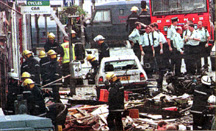
Both were just yards from the maroon Vauxhall Astra car which minutes later would be transformed into a fireball of destruction.
At this point a number of the relatives became overcome with emotion.
Victor Barker, a Surrey solicitor whose 12-year-old son James died that day, wiped a tear from his eye, as did Michael Gallagher who lost his 21-year-old son Aiden.
Stanley McCombe, widowed from wife Ann in the explosion, bowed his head.
The naked torment, a companion all have grown accustomed to over the past 10 years, was clear on their faces.
However, so was another emotion - hope.
As the Omagh relatives gamble all their hopes for justice on a civil action which represents their endgame, Bimpe Fatogun watched a day where hope battled grief.
"Switch off mobile phones. I don't want any interruptions."
Mr Justice Declan Morgan was determined to start proceedings as he meant to go on - insisting that even silent mode was unacceptable and "no recording devices" could be used in his courtroom.
But on the opening day of the "unprecedented civil action", it was mobile phones and recording devices that took centre stage.
Arrangements have been made to allow Michael McKevitt to watch proceedings from Portlaoise prison where he is serving a 20-year prison sentence.
The first day, made up as it was of opening statements, was a taste of what is to come over the next eight weeks.
There was an eloquence of legal counsel before the court, with four bewigged eminents representing six families who lost loved ones in the 1998 atrocity.
This was more than matched by the defence, with no fewer than four senior counsel arguing on behalf of the five respondents.
And while, so far, they appear to be singing from the same hymn sheet, each seemed yesterday to feel the need to perform their own solo before the judge.
Scarcely had Lord Daniel Brennan, heading the victims' case, begun his opening remarks than no fewer than three of his opposing counsel interrupted with objections.
The problem, it emerged, was with his choice of the word "terrorist" to describe the defendants.
Dublin barrister Michael Higgins SC protested that the term was "pejorative" and might be interpreted as a factual description of his client, convicted Real IRA leader Michael McKevitt.
This was tartly rebuffed by Lord Brennan, who defended his approach on a point of law and further remarked that, as a former chairman of the bar of England and Wales, he bridled at being "lectured" on how he chose to frame his opening remarks.
His oration was extremely powerful.
Borrowing from the 1916 Proclamation of Independence which he said condemned "any dishonour brought about by cowardice and inhumanity", Lord Brennan said "it is our case that these defendants were responsible for cowardice and inhumanity".
Delivered in a slow and measured manner, the softly spoken Englishman outlined the simple yet devastating details of the families' case.
It was divided into chapters, a fateful tale of Preparation, The Effects, Responsibility, The Aftermath and The Telephone Matrix - the latter examining in detail the mobile phone communications between the alleged bombers.
He showed a picture taken moments before the fatal explosion of a car parked on the busy shopping street in the Co Tyrone town.
In it one of the group of Spanish children who had been studying English in Co Donegal, and had been taken on a coach trip to Omagh was pictured smiling aloft the shoulders of an adult helper.
Both were just yards from the maroon Vauxhall Astra car which minutes later would be transformed into a fireball of destruction.
At this point a number of the relatives became overcome with emotion.
Victor Barker, a Surrey solicitor whose 12-year-old son James died that day, wiped a tear from his eye, as did Michael Gallagher who lost his 21-year-old son Aiden.
Stanley McCombe, widowed from wife Ann in the explosion, bowed his head.
The naked torment, a companion all have grown accustomed to over the past 10 years, was clear on their faces.
However, so was another emotion - hope.
Further Information
Publisher: THE IRISH NEWS
Ref: IN/0912
Published Date: 08-Apr-08
Related Images