NINE-YEARS ON AND STILL NO CLOSER TO THE TRUTH
Nine-years on and still no closer to the truth
By Barry McCaffrey
POLICE had rushed to push shoppers and tourists away from Omagh Court House following three telephone calls warning that a bomb had been planted in the area.
On a busy Saturday afternoon at the height of summer the Co Tyrone town had been packed with people.
Dozens of families, including a coach party from Buncrana in Co Donegal were there for a cross-community carnival that had been due to take place in the town later in the day.
Mothers were there to find uniforms for their children who were due to return to school a fortnight later.
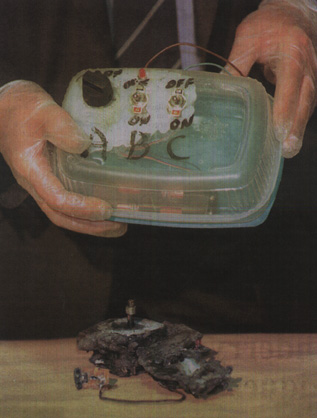
No-one knew that the crowds were actually being pushed towards the 5001b bomb, which had been hidden in a maroon Vauxhall Astra parked in the town's Market Street.
At 3.10pm the device, made up of Semtex, fertiliser and fuel oil, exploded without warning, wiping out everything in its path within seconds.
The tight confines of the street and the abnormal numbers packed into the tiny area meant the force of the explosion was multiplied.
Twenty-one people died where they fell while eight others died in the following days.
The dead included five girls and four boys - including 18-month-old and 20-month-old baby girls and unborn twins.
Fourteen women and six men were killed.
More than 250 others were injured, many of them seriously.
In the days after the bomb heat-seeking equipment was brought in to check wrecked buildings for any other bodies.
The names of the dead read like a microcosm of those killed during the Troubles. No religion or community was left untouched.
The dead included Catholics, Protestants, republicans, unionists, young and old.
Among those killed were father and son Brian and Frederick White.
Grandmother Mary Grimes, her daughter Avril Monaghan and 18 month-old grandchild Maura were all killed.
It also included Spanish schoolboy Fernando Blasco and his teacher Rocio Ramos who had been on a bus trip from Buncrana in Co Donegal.
The scene at Omagh Hospital was compared to a scene from a Second World War battlefield with blood running down the steps of the entrance.
Off-duty hospital staff rushed back to work to help the injured.
Helicopters were used to fly the most seriously injured victims to other hospitals across the north as emergency services in the Co Tyrone town struggled to cope.
A British army camp at Lisanelly had to be opened as a temporary morgue.
Tony Blair, Bertie Ahern, Hilary and Bill Clinton, President Mary McAleese and Prince Charles all visited Omagh in the days after the bomb.
At the time Mr Ahern refused to rule out internment against dissident republicans.
The day after the atrocity the Real IRA admitted responsibility and said it was ordering an immediate halt to "military operations".
In the summer of 2000 an internal RUC review of the Omagh bomb investigation found that Special Branch had failed to act on two prior warnings that the Co Tyrone town was to be attacked.
The review, which was kept secret for more than a year, found that "many evidential opportunities" had been missed, including an anonymous telephone tip-off 11 days before the bomb.
Despite claims that no stone would be left untouched in the hunt for the bombers it emerged that the car used in the attack had been allowed to rust in a car park, endangering potential forensic evidence.
The review found that the two leading detectives on the Omagh team were not able to work on it full time and that the number of detectives working on the murder inquiry had been significantly reduced after just two months.
In August 2001 Police Ombudsman Nuala O'Loan launched an investigation into claims that the RUC had received an anonymous phone call 11 days before the attack, warning that named dissidents planned to attack police officers in Omagh.
The caller had identified four suspects and given the date of the attack on Omagh during a 10-minute phone call to police.
Three days before the attack informer Kevin Fulton had warned police that named dissidents were planning some form of attack.
Shortly before the attack Fulton warned his handlers again.
Mrs O'Loan described Special Branch's failure to act on the information as a "serious breakdown in communication".
Special Branch was found to have only handed over a fifth of relevant material to the Omagh inquiry.
Special Branch and the chief constable were found to have been reluctant to allow ombudsman investigators access to their material, including failing to inform investigators of the existence of a computer system where intelligence, vital to the investigation, was held.
The chief constable point-blank refused Mrs O'Loan's recommendation that an officer should be brought in from outside Northern Ireland to head the Omagh bomb investigation.
Nuala O'Loan found that the judgment and leadership of the then chief constable Sir Ronnie Flanagan had been "seriously flawed" and that as a result the chances of convicting the Omagh bombers had been "significantly reduced".
"The victims, their families, the people of Omagh and officers of the RUC were let down by defective leadership, poor judgment and a lack of urgency," she said.
In January 2002 Co Louth builder Colm Murphy was jailed for 14 years by a Dublin Court for conspiracy to cause the Omagh bomb by allowing his mobile phones to be used by the bombers.
However, in January 2005 Murphy's convictions was overturned on appeal after two gardai were found to have perjured themselves during the trial. No date has been set for his retrial.
In July 2002 the Omagh families began a civil action against five dissident republicans, including Colm Murphy, who they allege were responsible for the Real IRA atrocity.
The civil action was supported by celebrities including Bob Geldof and Barry McGuigan.
In August 2003 leading dissident republican Michael McKevitt was sentenced to 20 years in prison in the Republic after being convicted on charges of directing terrorism.
The charge had been brought into law in the Republic as a result of the Omagh bomb.
In August 2003 the British government announced it was giving 5800,000 to the Omagh families' civil action. The entire action is estimated to cost £2 million.
In September 2003 south Armagh electrician Sean Hoey appeared in court charged in connection with a series of Real IRA attacks, including the Omagh bomb.
He is a nephew of Colm Murphy.
In February 2005 Dundalk man Anthony Donegan (34) appeared in court charged with providing the car used in the Omagh bomb.
The charges against Donegan were dropped four months later.
After nine years and two lengthy court cases the Omagh families are still no closer to justice.
Further Information
Related Images