THE DISSIDENT THREAT IS STILL HIGH
The dissident threat 'is still high'
By Brian Campbell
THE most serious republican threat to security forces in Northern Ireland emanates from dissidents and not the Provisional IRA, a British army spokesman has confirmed.
In the republican stronghold of south Armagh, tensions over the continued army presence - despite the IRA ceasefire - are higher than ever.
However, both the army and security minister Jane Kennedy maintain that the high level of troops, bases and helicopters in Armagh, are essential due to the threat posed by dissident republicans.
In his recent speech in Belfast, Prime Minister Tony Blair signalled that an end to the Provisionals would accelerate British demilitarisation.
An army spokesman said it considered two elements in assessing the level of threat posed by paramilitary groups: their capability and their intent.
"The capability of the Provisional IRA is high. They are politically astute and they continue to develop improvised weapons and have vast knowledge after 30 years.
"Their intent, however, is deemed to be low for various reasons, including the signals we've received regarding decommissioning," he said.
"Dissidents, on the other hand, have a high level of intent. It's difficult to assess them when it comes to capability, but it is certainly significant and the CIRA and RIRA seem to be growing.
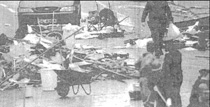
"RIRA, after all, is widely held responsible for carrying out the Omagh bombing, one of the worst atrocities of the Troubles, and dissident activity has barely decreased in the last few years."
While Mr Blair linked demilitarisation to an act from the Provisional IRA, Sinn Fein said his stance was contradictory because the military installations were apparently in place to tackle dissidents.
Newry and Armagh Sinn Fein assembly member Conor Murphy said: "The stock response by the British government is that the presence is due to the level of threat, but Tony Blair's speech revealed the real reasons. It was made clear that demilitarisation would occur overnight if the circumstances were right. He has contradicted himself and people are seeing through him now.
"He indicated that the British government will not move on this unless they can use it to some advantage in their point of view in the peace process."
A string of attacks this year have been linked to dissidents. In September, two suspected Real IRA members were arrested after two booby-trap car-bombs were discovered by police outside Newry. The Real IRA was also linked to a massive fuel-laundering operation uncovered on the Armagh border last week.
The Continuity IRA admitted planting incendiary devices in Belfast this year and an explosion close to Viscount Brookeborough's estate in Fermanagh in July.
The army spokesman said demilitarisation had been taking place since the IRA ceasefire in 1994, with 43 per cent of military bases closed across the north and border patrol bases demolished.
But he said south Armagh was different.
"The police are still unable to go about their duties without military support. For a proportion of the population, smuggling and other illegal activities such as electricity tapping, refusal to pay TV licences, fraud, counterfeiting and fuel laundering are endemic.
"In south Armagh, the terrorist threat is still too high to permit security forces to move by road. As soon as the threat allows, fewer soldiers and police will be flown between locations."
SDLP assembly member John Fee said the IRA had demonstrated "to all intents and purposes" that its ceasefire was 100 per cent intact.
"The type of significant reciprocation we all expected from the British government is long overdue," he said.
"Talk of a dissident threat is a mantra that people are hiding behind and the real matter of demilitarisation is not being dealt with."
Ulster Unionist assembly member Danny Kennedy said Mr Blair had under-estimating the threat coming from dissidents by hinting at full normalisation.
"The government has always discounted the threat posed by dissidents, but it was dissidents who carried out the Omagh bombing. It would consequently be foolish in the extreme... to take such groups lightly," he said.
By Brian Campbell
THE most serious republican threat to security forces in Northern Ireland emanates from dissidents and not the Provisional IRA, a British army spokesman has confirmed.
In the republican stronghold of south Armagh, tensions over the continued army presence - despite the IRA ceasefire - are higher than ever.
However, both the army and security minister Jane Kennedy maintain that the high level of troops, bases and helicopters in Armagh, are essential due to the threat posed by dissident republicans.
In his recent speech in Belfast, Prime Minister Tony Blair signalled that an end to the Provisionals would accelerate British demilitarisation.
An army spokesman said it considered two elements in assessing the level of threat posed by paramilitary groups: their capability and their intent.
"The capability of the Provisional IRA is high. They are politically astute and they continue to develop improvised weapons and have vast knowledge after 30 years.
"Their intent, however, is deemed to be low for various reasons, including the signals we've received regarding decommissioning," he said.
"Dissidents, on the other hand, have a high level of intent. It's difficult to assess them when it comes to capability, but it is certainly significant and the CIRA and RIRA seem to be growing.
"RIRA, after all, is widely held responsible for carrying out the Omagh bombing, one of the worst atrocities of the Troubles, and dissident activity has barely decreased in the last few years."
While Mr Blair linked demilitarisation to an act from the Provisional IRA, Sinn Fein said his stance was contradictory because the military installations were apparently in place to tackle dissidents.
Newry and Armagh Sinn Fein assembly member Conor Murphy said: "The stock response by the British government is that the presence is due to the level of threat, but Tony Blair's speech revealed the real reasons. It was made clear that demilitarisation would occur overnight if the circumstances were right. He has contradicted himself and people are seeing through him now.
"He indicated that the British government will not move on this unless they can use it to some advantage in their point of view in the peace process."
A string of attacks this year have been linked to dissidents. In September, two suspected Real IRA members were arrested after two booby-trap car-bombs were discovered by police outside Newry. The Real IRA was also linked to a massive fuel-laundering operation uncovered on the Armagh border last week.
The Continuity IRA admitted planting incendiary devices in Belfast this year and an explosion close to Viscount Brookeborough's estate in Fermanagh in July.
The army spokesman said demilitarisation had been taking place since the IRA ceasefire in 1994, with 43 per cent of military bases closed across the north and border patrol bases demolished.
But he said south Armagh was different.
"The police are still unable to go about their duties without military support. For a proportion of the population, smuggling and other illegal activities such as electricity tapping, refusal to pay TV licences, fraud, counterfeiting and fuel laundering are endemic.
"In south Armagh, the terrorist threat is still too high to permit security forces to move by road. As soon as the threat allows, fewer soldiers and police will be flown between locations."
SDLP assembly member John Fee said the IRA had demonstrated "to all intents and purposes" that its ceasefire was 100 per cent intact.
"The type of significant reciprocation we all expected from the British government is long overdue," he said.
"Talk of a dissident threat is a mantra that people are hiding behind and the real matter of demilitarisation is not being dealt with."
Ulster Unionist assembly member Danny Kennedy said Mr Blair had under-estimating the threat coming from dissidents by hinting at full normalisation.
"The government has always discounted the threat posed by dissidents, but it was dissidents who carried out the Omagh bombing. It would consequently be foolish in the extreme... to take such groups lightly," he said.
Further Information
Publisher: THE IRISH NEWS
Ref: IN/0584
Published Date: 06-Nov-02
Related Images