MAKING THE DREAM OF BREAD AND BUTTER POLITICS COME TRUE
Making the dream of bread and butter politics come true
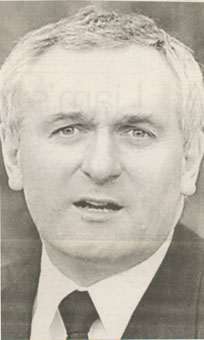
As the fledgling Northern Ireland assembly reconvenes today, Taoiseach Bert Ahern ... in an exclusive interview with our Dublin correspondent Micheal O'Toole ... talks of his devotion to the cause of peace in Ireland and of his faith that the people of Northern Ireland and their leaders will make the Good Friday agreement work...
Few leaders can have devoted as much of their entire time in office to a place technically outside their jurisdiction as Bertie Ahern has in the last 15 months.
Since he became taoiseach in June 1997 Mr Ahern has placed Northern Ireland high among his priorities; and now, with the assembly reconvening today, there is no sign of him relaxing that vice-like grip on policy on the north.
But despite the successes in the peace process, Mr Ahern would rather push on than sit back and bask in glory.
He says: "Every day I block out several hours where I just concentrate on (Northern Ireland).
"I keep on thinking about what is in front.
"Every week I look at where we are in the agreement by reading all the reports we get back so I'm aware of what's happening on the human rights end, the equality end, the sentence review group, the prisoners.
"All the time I keep myself briefed on where we are. Because of that the people here know that I am keeping very closely to it, so that helps to motivate."
And it's the assembly that is on his mind at the minute and the hope that, after 30 years, politics in Northern Ireland could develop a sense of normality.
"A lot of what is happening now is working through the formal structures and procedures, clearing standing orders, setting up the committee system and all of the mechanisms that are needed to run a successful assembly.
"In a wider sense, it is important that the parties use this period to learn to cooperate and work together.
"My big hope is that this session between now and February will be used to build up -as any parliamentary system would - that basis for the cut and thrust of every day politics."
By that the taoiseach means "the normal things that affect people".
"I go out to the streets every day and the things I am asked about - employment, the health service, education - that's the same if it is in Dublin, Belfast, Timbucktoo or HonKong and I think that is what we have to work to get."
But, before that can happen, there's an issue peculiar to Northern Ireland politics that has to be resolved - decommissioning.
First minister David Trimble is adamant that the IRA has to make some movement on decommissioning before he will sit in an executive with Sinn Fein; Gerry Adams insists that decommissioning was not a precondition laid down by the Good Friday agreement: How can these two positions be reconciled?
Mr Ahern also insists decommissioning is not a precondition - but is confident that the problem will be resolved.
The agreement must be implemented in all its aspects as mandated by the people of Ireland," he insists.
"At the same time I think we should be careful not to impose new preconditions or to focus on one aspect or another exclusively -that would be a mistake.
"We want to see the shadow executive established as soon as possible: we also of course want to see the earliest possible progress on decommissioning.
"Remember decommissioning, giving it no more emphasis, is a part of the agreement."
But already, Mr Ahern sees grounds for optimism - the appointment of Martin McGuinness to liaise with the decommissioning body, Gerry Adams's statement that violence should be "over, done with and gone", the meeting of most of the political leaders are in the north.
He says "The best way to resolve difficult issues - is to build trust through direct contact and I am glad this has happened.
"If we take the overall agreement, and be committed to implement all its aspects - not try to put timescales or fudge - let's take it as it is ... if we do that and try to build trust and confidence in the system and if we have direct contact between the parties then they will see that our positions have to all move to try to find the compromises necessary to carry everybody forward"
But will there be actual, physical decommissioning?
'There is in the agreement the strong commitment by all of the parties to the total disarmament of all paramilitary organisations.
"I am confident that decommissioning will happen in the context of the implementation of the agreement as a whole."
But the agreement says decommissioning within two years - is that schedule still on track?
"I think that we are" is the taoiseach's confident response.
He cautions, however, against concentrating on one part of the agreement.
He says: if we keep right across, we are on target: we are working our way through it and I think it (decommissioning) will happen."
Mr Ahern is also confident that the IRA's war is over for good.
He says: "I note that the number of punishment beatings is down dramatically. I would like to see them eliminated, but I do think we are making considerable progress.
"I am confident that the IRA ceasefire is definite ... and that the use of violence by them is over, done with and gone, as we hope it is on all sides."
The atrocity in Omagh, he says, was a watershed which persuaded the public and paramilitaries alike that violence was futile.
The taoiseach says: "Omagh must be the last violent incident of that kind.
"Omagh confirmed in many people's minds the Tightness of the decision by most groups that the armed struggle was over.
"The overall tragedy, the horror of it, the individual cases that came out...I think that has had a huge effect on the psyche of not only the law-abiding community but also on those people who have been passively supporting them or who believe there was some value in it.
"Whatever arguments people with warped minds could have made, this time those arguments didn't stand up to any examination ... even to their own examination, never mind the wider public.
"The INLA had made up their mind because of the Good Friday agreement, but others have made it on the back of Omagh."
One of the consequences of the Omagh atrocity was a set of tough new security measures for the Republic.
The taoiseach insists the legislation will be used in the hunt for the Omagh bombers; but concedes in the wake of the Real IRA ceasefire, there will be no wholesale swoops on suspects members.
Mr Ahern says: "The purpose of the legislation was to help prevent any further Omaghs or any other atrocities by organisations which try to carry on the armed struggle.
"And also to assist in tracking down the Omagh bombers, or Moira, Banbridge or any of the other more recent bombs.
"We would far rather have the situation where the legislation did not prove necessary.
"We will continue to use the legislation wherever it is necessary to bring to justice those people who were involved in the atrocities.
"It will not be used in terms of rounding up people who have declared a ceasefire."
Mr Ahern confirmed there had been intermediaries between his government and the Real IRA and INLA.
He said: "We did during the course of the year try to convince people in the INLA and the 32 County Sovereignty Committee and others that violence was the wrong way forward.
"There have been intermediaries with all people involved in violence and they are the usual people - religious and community leaders.
"We are very grateful for their efforts because it is not an area in which we would have a great involvement.
"But the real reason for the (Real IRA) ceasefire was twofold: the reaction of public opinion and the draconian legislation."
There is, however, no sign of a ceasefire from the only paramilitary group on the island not to have ended its campaign - the Continuity IRA
"That worries me," admits Mr Ahern. "We have to continue to press that organisation and those politically associated with them to state their position.
"Our aim is to try and force and convince or convince and force - whichever way it has to be - people engaged in the armed struggle to stop."
Mr Ahern also vowed that the Republic would continue its prisoner release's programme in the north - despite the lingering memory of that famous dance with Ian Paisley after the Drumcree stand-off in 1995.
He says: "I have a good personal working relationship with David Trimble.
"David Trimble is providing tough, but constructive, leadership.
"He has shown considerable courage and leadership in what have been very difficult political circumstances.
"I am confident that he has the capacity ... to lead a pluralist parliament for a pluralist people.
"Seamus Mallon and David Trimble are providing joint leadership of a high calibre, we are very happy to work with both of them.".
The taoiseach is quick to heap praise on SDLP leader John Hume.
"When the history books are written, I am sure the name of John Hume will take pride of place."
Mr Ahern also believes that the anti-agreement unionist camp has weakened as confidence in the deal grows.
He said: "I expect this is going to continue.
"I am confident that over time large numbers of the no camp will come to see that the agreement is protecting and guaranteeing the basic rights and the interests of unionists.
"We never negotiated the agreement to try to damage unionism, what we tried to do was negotiate an agreement that was balanced.
"It has the capacity to make Northern Ireland a better place for all its people and those who oppose it offer at this stage no valid alternative."
He now wants to "bed down" the cross-border bodies central to the agreement rather than dwelling on the "longer horizon".
"Of course there is no limit to their potential.
"And any change and development in the institution has to be agreed by both sides, endorsed by the assembly and the Oireachtas.
"I am confident the institutions will grow and I will work hard, as a nationalist, to see that growth.
That's what I believe in, but we have to be realistic and work to achieve the worthwhile, practical benefits."
Apart from the decommissioning imbroglio, there is another fly in the ointment of Northern Ireland's future: Drumcree.
The street violence there and the strain the nationalist residents are suffering as a result of the impasse worry the taoiseach. He is eager for the situation to be resolved as soon as possible.
He says: "The government have been concerned about the situation in Portadown for some considerable time.
"There is an ongoing problem there - which was brought home to people by last week's street troubles - which has been putting the nationalist population under severe strain for a very long time.
"We have been actively involved in efforts to resolve the Drumcree situation and we will continue to do that during the winter.
"I strongly believe that this is an issue which should be dealt with during the winter when we have time for dialogue and consultation.
"We still believe that the parades' issue can be resolved by dialogue in the context of the consideration of the wider social and economic issues, including the question of sectarianism.
"That will ultimately be achieved by direct dialogue.'
As the fledgling Northern Ireland assembly reconvenes today, Taoiseach Bert Ahern ... in an exclusive interview with our Dublin correspondent Micheal O'Toole ... talks of his devotion to the cause of peace in Ireland and of his faith that the people of Northern Ireland and their leaders will make the Good Friday agreement work...
Few leaders can have devoted as much of their entire time in office to a place technically outside their jurisdiction as Bertie Ahern has in the last 15 months.
Since he became taoiseach in June 1997 Mr Ahern has placed Northern Ireland high among his priorities; and now, with the assembly reconvening today, there is no sign of him relaxing that vice-like grip on policy on the north.
But despite the successes in the peace process, Mr Ahern would rather push on than sit back and bask in glory.
He says: "Every day I block out several hours where I just concentrate on (Northern Ireland).
"I keep on thinking about what is in front.
"Every week I look at where we are in the agreement by reading all the reports we get back so I'm aware of what's happening on the human rights end, the equality end, the sentence review group, the prisoners.
"All the time I keep myself briefed on where we are. Because of that the people here know that I am keeping very closely to it, so that helps to motivate."
And it's the assembly that is on his mind at the minute and the hope that, after 30 years, politics in Northern Ireland could develop a sense of normality.
"A lot of what is happening now is working through the formal structures and procedures, clearing standing orders, setting up the committee system and all of the mechanisms that are needed to run a successful assembly.
"In a wider sense, it is important that the parties use this period to learn to cooperate and work together.
"My big hope is that this session between now and February will be used to build up -as any parliamentary system would - that basis for the cut and thrust of every day politics."
By that the taoiseach means "the normal things that affect people".
"I go out to the streets every day and the things I am asked about - employment, the health service, education - that's the same if it is in Dublin, Belfast, Timbucktoo or HonKong and I think that is what we have to work to get."
But, before that can happen, there's an issue peculiar to Northern Ireland politics that has to be resolved - decommissioning.
First minister David Trimble is adamant that the IRA has to make some movement on decommissioning before he will sit in an executive with Sinn Fein; Gerry Adams insists that decommissioning was not a precondition laid down by the Good Friday agreement: How can these two positions be reconciled?
Mr Ahern also insists decommissioning is not a precondition - but is confident that the problem will be resolved.
The agreement must be implemented in all its aspects as mandated by the people of Ireland," he insists.
"At the same time I think we should be careful not to impose new preconditions or to focus on one aspect or another exclusively -that would be a mistake.
"We want to see the shadow executive established as soon as possible: we also of course want to see the earliest possible progress on decommissioning.
"Remember decommissioning, giving it no more emphasis, is a part of the agreement."
But already, Mr Ahern sees grounds for optimism - the appointment of Martin McGuinness to liaise with the decommissioning body, Gerry Adams's statement that violence should be "over, done with and gone", the meeting of most of the political leaders are in the north.
He says "The best way to resolve difficult issues - is to build trust through direct contact and I am glad this has happened.
"If we take the overall agreement, and be committed to implement all its aspects - not try to put timescales or fudge - let's take it as it is ... if we do that and try to build trust and confidence in the system and if we have direct contact between the parties then they will see that our positions have to all move to try to find the compromises necessary to carry everybody forward"
But will there be actual, physical decommissioning?
'There is in the agreement the strong commitment by all of the parties to the total disarmament of all paramilitary organisations.
"I am confident that decommissioning will happen in the context of the implementation of the agreement as a whole."
But the agreement says decommissioning within two years - is that schedule still on track?
"I think that we are" is the taoiseach's confident response.
He cautions, however, against concentrating on one part of the agreement.
He says: if we keep right across, we are on target: we are working our way through it and I think it (decommissioning) will happen."
Mr Ahern is also confident that the IRA's war is over for good.
He says: "I note that the number of punishment beatings is down dramatically. I would like to see them eliminated, but I do think we are making considerable progress.
"I am confident that the IRA ceasefire is definite ... and that the use of violence by them is over, done with and gone, as we hope it is on all sides."
The atrocity in Omagh, he says, was a watershed which persuaded the public and paramilitaries alike that violence was futile.
The taoiseach says: "Omagh must be the last violent incident of that kind.
"Omagh confirmed in many people's minds the Tightness of the decision by most groups that the armed struggle was over.
"The overall tragedy, the horror of it, the individual cases that came out...I think that has had a huge effect on the psyche of not only the law-abiding community but also on those people who have been passively supporting them or who believe there was some value in it.
"Whatever arguments people with warped minds could have made, this time those arguments didn't stand up to any examination ... even to their own examination, never mind the wider public.
"The INLA had made up their mind because of the Good Friday agreement, but others have made it on the back of Omagh."
One of the consequences of the Omagh atrocity was a set of tough new security measures for the Republic.
The taoiseach insists the legislation will be used in the hunt for the Omagh bombers; but concedes in the wake of the Real IRA ceasefire, there will be no wholesale swoops on suspects members.
Mr Ahern says: "The purpose of the legislation was to help prevent any further Omaghs or any other atrocities by organisations which try to carry on the armed struggle.
"And also to assist in tracking down the Omagh bombers, or Moira, Banbridge or any of the other more recent bombs.
"We would far rather have the situation where the legislation did not prove necessary.
"We will continue to use the legislation wherever it is necessary to bring to justice those people who were involved in the atrocities.
"It will not be used in terms of rounding up people who have declared a ceasefire."
Mr Ahern confirmed there had been intermediaries between his government and the Real IRA and INLA.
He said: "We did during the course of the year try to convince people in the INLA and the 32 County Sovereignty Committee and others that violence was the wrong way forward.
"There have been intermediaries with all people involved in violence and they are the usual people - religious and community leaders.
"We are very grateful for their efforts because it is not an area in which we would have a great involvement.
"But the real reason for the (Real IRA) ceasefire was twofold: the reaction of public opinion and the draconian legislation."
There is, however, no sign of a ceasefire from the only paramilitary group on the island not to have ended its campaign - the Continuity IRA
"That worries me," admits Mr Ahern. "We have to continue to press that organisation and those politically associated with them to state their position.
"Our aim is to try and force and convince or convince and force - whichever way it has to be - people engaged in the armed struggle to stop."
Mr Ahern also vowed that the Republic would continue its prisoner release's programme in the north - despite the lingering memory of that famous dance with Ian Paisley after the Drumcree stand-off in 1995.
He says: "I have a good personal working relationship with David Trimble.
"David Trimble is providing tough, but constructive, leadership.
"He has shown considerable courage and leadership in what have been very difficult political circumstances.
"I am confident that he has the capacity ... to lead a pluralist parliament for a pluralist people.
"Seamus Mallon and David Trimble are providing joint leadership of a high calibre, we are very happy to work with both of them.".
The taoiseach is quick to heap praise on SDLP leader John Hume.
"When the history books are written, I am sure the name of John Hume will take pride of place."
Mr Ahern also believes that the anti-agreement unionist camp has weakened as confidence in the deal grows.
He said: "I expect this is going to continue.
"I am confident that over time large numbers of the no camp will come to see that the agreement is protecting and guaranteeing the basic rights and the interests of unionists.
"We never negotiated the agreement to try to damage unionism, what we tried to do was negotiate an agreement that was balanced.
"It has the capacity to make Northern Ireland a better place for all its people and those who oppose it offer at this stage no valid alternative."
He now wants to "bed down" the cross-border bodies central to the agreement rather than dwelling on the "longer horizon".
"Of course there is no limit to their potential.
"And any change and development in the institution has to be agreed by both sides, endorsed by the assembly and the Oireachtas.
"I am confident the institutions will grow and I will work hard, as a nationalist, to see that growth.
That's what I believe in, but we have to be realistic and work to achieve the worthwhile, practical benefits."
Apart from the decommissioning imbroglio, there is another fly in the ointment of Northern Ireland's future: Drumcree.
The street violence there and the strain the nationalist residents are suffering as a result of the impasse worry the taoiseach. He is eager for the situation to be resolved as soon as possible.
He says: "The government have been concerned about the situation in Portadown for some considerable time.
"There is an ongoing problem there - which was brought home to people by last week's street troubles - which has been putting the nationalist population under severe strain for a very long time.
"We have been actively involved in efforts to resolve the Drumcree situation and we will continue to do that during the winter.
"I strongly believe that this is an issue which should be dealt with during the winter when we have time for dialogue and consultation.
"We still believe that the parades' issue can be resolved by dialogue in the context of the consideration of the wider social and economic issues, including the question of sectarianism.
"That will ultimately be achieved by direct dialogue.'
Further Information
Publisher: THE IRISH NEWS
Ref: IN/0229
Published Date: 14-Sep-98
Related Images