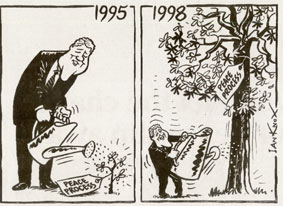
TIME FOR PEACE IN INIS FAIL
Time for peace on Inis Fail
The IRISH NEWS
Pro fide et patria
PRESIDENT Clinton yesterday set out "the benchmarks" by which the Good Friday agreement will be judged.
They represent a challenge to all those parties which are represented in the Northern Ireland assembly - not just those groups with links to paramilitary organisations.
All political parties - not just republicans and loyalists - have the capacity to make this agreement work, or to destroy it.
Much of the focus has been on the need for the decommissioning of paramilitary arms.
But of greater danger to the agreement in the short term is the refusal of political leaders to reach out to one another and to fully recognise the legitimacy of their opponents' mandates.
The most immediate hurdle facing the peace process is the Ulster Unionist Party's refusal to deal on a fair basis with Sinn Fein, and its refusal to accept that republicans have won the right at the ballot box to seats in the new executive.
David Trimble's ungenerous speech at the Waterfront demonstrated clearly that he too has work to do if he is to reach the Clinton benchmark.
It is worth repeating here the tests Mr Clinton set for the political parties:
-to decommission weapons of war that are obsolete in a Northern Ireland at peace
-to move forward with a formation of an executive council
-to adapt the RUC so that it has the confidence, respect and support of all the people
-to end street justice, because defining crime, applying punishment, and enforcing the law, must be left to the peoples' elected representatives, the courts and the police
-to pursue early release for prisoners whose organisations have truly abandoned violence
-to help released prisoners find a productive, constructive place in society
-to build a more just society where human rights are birth rights and where every citizen receives equal protection and equal treatment under the law.
That is a significant agenda for the months and years ahead. There is little question that the British and Irish governments, the nationalist parties, including deputy first minister Seamus Mallon, the loyalist parties, and the Women's Coalition are up to the challenge. The jury is still out on the UUP. Mr Trimble uttered some fine words yesterday about his commitment to building the new society prefigured in the agreement.
But he too has to show by his actions that those words are not just hollow rhetoric. Mr Trimble's decision to stick with the talks, to sign the agreement, to accept the office of first minister are all encouraging signs. But he has yet to convince people that he is entirely behind the agreement, and prepared to implement all its provisions with enthusiasm.
In contrast, Seamus Mallon gave the performance of his life. His address was inclusive and forward looking. Crucially it was a positive statement of faith in the capacity of the people of Ireland to transcend the violence of this past 30 years.
He was right to talk of the Good Friday agreement as "a beacon of hope for this generation".
And he was right too to thank the president for helping to "free us from a violent and bitter past and to set forth on the awesome, yet exciting road on our new journey of hope".
His words chimed perfectly with Tony Blair's affirmation of the president's role in Ireland's history. There have been many peacemakers in this process, and Mr Clinton has been among the first division.
Perhaps one of the most potent passages in the president's speech was his call to the people of Ireland to do everything within their power to preserve the peace we now enjoy, and to nurture it.
"It may not come again in our lifetime," he said. That was a chilling warning. It demonstrated the risks we all face, but it also showed how far we had travelled in a very short time.
That, of course, is cold comfort to the people of Omagh. They have paid the price for peace in the most monstrous way.
While the peace rally in Armagh and the events in Belfast were important in themselves. They paled beside the simple act of remembrance in Omagh, and the president's gesture of support to the men, women and children in the town who have suffered so much.
At the end of the day, all those of us who were mere bystanders during Omagh's day of agony, have an obligation to ensure the peace process works.
That would be the finest monument to the 28 who died and the hundreds who were injured in Northern Ireland's darkest day. Out of the trauma must spring hope. The president put that so well when he spoke of the Inis Fail, Island of destiny.
"Today Americans see you at Inis Fail and your destiny is peace. America is with you. The entire world is with you. May God be with you and give you strength for the good work ahead."
Few could dissent from that sentiment.
The IRISH NEWS
Pro fide et patria
PRESIDENT Clinton yesterday set out "the benchmarks" by which the Good Friday agreement will be judged.
They represent a challenge to all those parties which are represented in the Northern Ireland assembly - not just those groups with links to paramilitary organisations.
All political parties - not just republicans and loyalists - have the capacity to make this agreement work, or to destroy it.
Much of the focus has been on the need for the decommissioning of paramilitary arms.
But of greater danger to the agreement in the short term is the refusal of political leaders to reach out to one another and to fully recognise the legitimacy of their opponents' mandates.
The most immediate hurdle facing the peace process is the Ulster Unionist Party's refusal to deal on a fair basis with Sinn Fein, and its refusal to accept that republicans have won the right at the ballot box to seats in the new executive.
David Trimble's ungenerous speech at the Waterfront demonstrated clearly that he too has work to do if he is to reach the Clinton benchmark.
It is worth repeating here the tests Mr Clinton set for the political parties:
-to decommission weapons of war that are obsolete in a Northern Ireland at peace
-to move forward with a formation of an executive council
-to adapt the RUC so that it has the confidence, respect and support of all the people
-to end street justice, because defining crime, applying punishment, and enforcing the law, must be left to the peoples' elected representatives, the courts and the police
-to pursue early release for prisoners whose organisations have truly abandoned violence
-to help released prisoners find a productive, constructive place in society
-to build a more just society where human rights are birth rights and where every citizen receives equal protection and equal treatment under the law.
That is a significant agenda for the months and years ahead. There is little question that the British and Irish governments, the nationalist parties, including deputy first minister Seamus Mallon, the loyalist parties, and the Women's Coalition are up to the challenge. The jury is still out on the UUP. Mr Trimble uttered some fine words yesterday about his commitment to building the new society prefigured in the agreement.
But he too has to show by his actions that those words are not just hollow rhetoric. Mr Trimble's decision to stick with the talks, to sign the agreement, to accept the office of first minister are all encouraging signs. But he has yet to convince people that he is entirely behind the agreement, and prepared to implement all its provisions with enthusiasm.
In contrast, Seamus Mallon gave the performance of his life. His address was inclusive and forward looking. Crucially it was a positive statement of faith in the capacity of the people of Ireland to transcend the violence of this past 30 years.
He was right to talk of the Good Friday agreement as "a beacon of hope for this generation".
And he was right too to thank the president for helping to "free us from a violent and bitter past and to set forth on the awesome, yet exciting road on our new journey of hope".
His words chimed perfectly with Tony Blair's affirmation of the president's role in Ireland's history. There have been many peacemakers in this process, and Mr Clinton has been among the first division.
Perhaps one of the most potent passages in the president's speech was his call to the people of Ireland to do everything within their power to preserve the peace we now enjoy, and to nurture it.
"It may not come again in our lifetime," he said. That was a chilling warning. It demonstrated the risks we all face, but it also showed how far we had travelled in a very short time.
That, of course, is cold comfort to the people of Omagh. They have paid the price for peace in the most monstrous way.
While the peace rally in Armagh and the events in Belfast were important in themselves. They paled beside the simple act of remembrance in Omagh, and the president's gesture of support to the men, women and children in the town who have suffered so much.
At the end of the day, all those of us who were mere bystanders during Omagh's day of agony, have an obligation to ensure the peace process works.
That would be the finest monument to the 28 who died and the hundreds who were injured in Northern Ireland's darkest day. Out of the trauma must spring hope. The president put that so well when he spoke of the Inis Fail, Island of destiny.
"Today Americans see you at Inis Fail and your destiny is peace. America is with you. The entire world is with you. May God be with you and give you strength for the good work ahead."
Few could dissent from that sentiment.
Further Information
Publisher: THE IRISH NEWS
Ref: IN/0228
Published Date: 04-Sep-98
Related Images