WATCHING HISTORY BEING MADE
Watching history be made
By ROY FOSTER
Gerry Adams's statement that violence must 'be over done with and gone', coupled with the nomination of Martin McGuinness to represent Sinn Fein (and, presumably, their friends) in the decommissioning process, announces that Irish politics have yet again gone into fast-forward mode.
If this is republicanism, it is not republicanism as we have recently know it: despite all the warnings to John Hume about riding on the backs of tigers, constitutional nationalism looks like absorbing most of the 'advanced movement'. This seems to have happened before in Irish history.
In the 1880s, for instance, Parnell tamed old Fenians and Land War firebrands into the parliamentary Home Rule Party. In the 1920s ex-Sinn Feiners emerged as the top-hatted respectable of Cumann na Cae-dheal, bearing an uncomfortably close resemblance to the Redmondites they had originally displaced in the revolution of the previous decade. From the 1930s de Valera's Fianna Fail similarly turned its back on its violent roots and adopted the language of peaceful persuasion (and 'draconian' anti-terrorist measures). So it goes.
But of course in each case an irreducible rump was left, who repudiated their newly moderate ex-comrades; 'the phoenix flame' was guarded by a handful of people, and - by their own fundamentalist lights -time would usually reward them. How different are things now, in the four years since the first IRA ceasefire?
In the euphoria of September 1994, some Sinn Feiners used unguarded language, which implied that the six-county unit was an accepted reality, but this was rapidly papered over by Gerry Adam's inimitable doublespeak; and manipulation of words and formulae have continued ingeniously through all the twists and turns since then.
Indeed, an irresistible if apocryphal story asserts that the whole peace process was based on a mishearing or misreading; a defiant fax had been sent from IRA headquarters to the Northern Ireland Office declaring that 'the conflict is now overt' but the paper was torn off at the margin, obliterating the last letter.
Over or overt? Following the statements of the last months, it has sometimes been hard to tell. This too has its historical precedents; de Valera was one of the great manipulators of words in order to square circles and accommodate incompatible interests, never more so than when the newly Hedged parliamentarians of Fianna Fail took the Dail oath in 1927, declaring it to be merely 'a form of words',
His successors have often followed him in statements that contrive to embrace constitutional commitments and republican fellow-travelling all at once. Mr Adam's Houdini-like contortions over endorsing 'the struggle' while reversing hard into democratic politics are in a long tradition. But his statement on September 1 was as near the unequivocal repudiation as he is likely to get; unlike the threatening bravado of de Valera's address to the 'legions of the rearguard' telling them to lay down their arms in 1923, it seemed to sound a note of separation from the whole sorry record of violence.
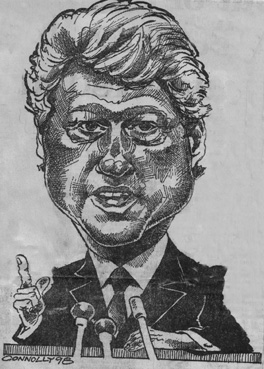
Realpolitik was there too, with the impending Clinton visit and the need for the President to bring back a foreign policy success to his disillusioned supporters at home. Monica Lewinsky may turn out to be a figure in Irish history too.
But much more profoundly, since Omagh the universally vituperative denunciations of the terrorist tradition in republicanism left Mr Adams no room for manoeuvre. Wednesday's Dail debate on the new and unprecedented security legislation was historic in more ways than one; never has that 'phoenix flame' been more passionately repudiated. Words like 'crazed', 'deluded', 'fascist', 'vampire', were piled up upon each other: incomprehension was being expressed, not just at the simple horror of Omagh but at the flat-earth denial of political reality subscribed to by its perpetrators. It may indeed be the fact that Messrs Adams and McGuinness were themselves flat-earthers until very recently, as Brendan McGahon tactlessly pointed out. But with Tuesday's statement they had come nearer the real world than before, and there is no going back. Another decisive change form previous scenarios concerns international input. From the 1920s to the 1960s, Irish political problems were generally left to find Irish solutions - North and South. The Free State was left to put its own house in order, with only occasional threats of interference from Great Britain: even under de Valera's more confrontational leadership in the 1930s, British policy remained cautious. Regarding Northern Ireland's administration by its local satraps, this continued until the balloon went up at the end of the 1960s: the evidence of diaries kept by cabinet ministers like Dick Crossman present a sobering reminder of ignorance and complacency until a very late stage, and form 1969 until the mid-eighties the record of constructive British involvement has been erratic to say the least. But the Blair-Mowlam initiative has been kept at consistently high profile, responding fast to each unfolding crisis, backed up by constant prime ministerial intervention as well as a Secretary prepared to go the risky distance. (Nor, in the preceding era, should the consistently committed involvement of John Major be forgotten, though it was necessarily more trammelled and less upfront). Even more strikingly different form previous historical junctures is the input of America. After World War I, when republicans tried to interest President Wilson and his advisors in the Irish claims to self-government, the seed fell upon stony ground. In ensuing decades, American interest in Ireland was left to traditional pro-republican groups and occasional senators or congressmen who made it a special-interest issue: a syndrome not greatly changed by the Kennedy ascendancy. The initiative from presidential level did not come until Clinton, and it has been kept - for one reason or another - at the centre of White House strategy.
This kind of support and the sense that history is being made, has enabled Adams and McGuinness to bring an astonishingly large numerical proportion of the republican movement with them - so far. It has also helped to conceal the fact that what Sinn Fein now endorses is so far from flat-earth United Ireland republicanism as to be its negation.
THE REAL test is coming, with McGuinness's secondment to the decommissioning tribunal, following Adams's statement nearly saying the war is over. But it should not be forgotten that this pronouncement followed a statement form the IRA emphatically refusing to go so far, and stubbornly declaring that decommissioning was not an issue. The pessimistic reading of last week's events would be that Adams, pushed even further towards the centre by the pre-Clinton momentum, no longer speaks for the IRA; and the assumption that he is implicitly doing so has been, up to this, his strongest card. He and his colleagues may have left old-style republican know-nothingism to history. But does this mean that it has atrophied; and if not, where will it go now. However, even if elements in the IRA are immovable on decommissioning arms or recognising the inevitable, the horrific example of Omagh has apparently reduced their number. The Provisionals' recent threat to the 'Real IRA' of retaliatory measures unless they disband in a fortnight may indicate that Mr Adams still has clout with the Army Council. And decommissioning suggests another way in which the current situation is different from anything that has gone before; there is now a timetable of procedures, put carefully in place and against all the odds - largely adhered to by the principals in the drama. Previously, history has shown that in Anglo-Irish relations, reliance has too often been on ad hoc (and even tit-for-tat) measures.
Thus with the treatment of Partition in the 1921 Treaty negotiations simply conjured up the ensuing and pointless - Boundary Commission: thus the declaration of a Republic in 1948 called forth the ill-considered riposte of the1949 Ireland Act affirming NTs unchanging status. As time goes by, the Good Friday Agreement - hailed for its flexibility- is more and more clearly seen to have a momentum built in as well. It has been a bumpy ride, but elections have happened; the assembly; has convened; the formation of a Northern Ireland government edges ever closer.
This is the kind of long-term and incremental process which has not been put in place before. Omagh has forced the pace further. It seems unlikely that either Trimble or Adams is a devotee of the work of Kurt Weill, especially as interpreted by Lotte Lenya, but since the beginning of the month I keep remembering his September Song.
'It's a long long time from
May to December{tab}
But the days grow short as{tab}
we reach September{tab}
And I haven't got time
For a waiting game ...
Nor have the politicians of Northern Ireland. Despite the bewildering and often horrific events of the last months, the 'peace process' rolls on towards the organisation of a devolved government, underpinned by the message of those summer referenda. No irreconcilable fringe-republican statement can deny the historic fact that enabled the process to begin, and lies behind Gerry Adam's statement on Tuesday; main-line republicanism's admission that their theological belief in the non-existence of Northern Ireland and the irrelevance of a million unionists, must at last be itself consigned to history.
By ROY FOSTER
Gerry Adams's statement that violence must 'be over done with and gone', coupled with the nomination of Martin McGuinness to represent Sinn Fein (and, presumably, their friends) in the decommissioning process, announces that Irish politics have yet again gone into fast-forward mode.
If this is republicanism, it is not republicanism as we have recently know it: despite all the warnings to John Hume about riding on the backs of tigers, constitutional nationalism looks like absorbing most of the 'advanced movement'. This seems to have happened before in Irish history.
In the 1880s, for instance, Parnell tamed old Fenians and Land War firebrands into the parliamentary Home Rule Party. In the 1920s ex-Sinn Feiners emerged as the top-hatted respectable of Cumann na Cae-dheal, bearing an uncomfortably close resemblance to the Redmondites they had originally displaced in the revolution of the previous decade. From the 1930s de Valera's Fianna Fail similarly turned its back on its violent roots and adopted the language of peaceful persuasion (and 'draconian' anti-terrorist measures). So it goes.
But of course in each case an irreducible rump was left, who repudiated their newly moderate ex-comrades; 'the phoenix flame' was guarded by a handful of people, and - by their own fundamentalist lights -time would usually reward them. How different are things now, in the four years since the first IRA ceasefire?
In the euphoria of September 1994, some Sinn Feiners used unguarded language, which implied that the six-county unit was an accepted reality, but this was rapidly papered over by Gerry Adam's inimitable doublespeak; and manipulation of words and formulae have continued ingeniously through all the twists and turns since then.
Indeed, an irresistible if apocryphal story asserts that the whole peace process was based on a mishearing or misreading; a defiant fax had been sent from IRA headquarters to the Northern Ireland Office declaring that 'the conflict is now overt' but the paper was torn off at the margin, obliterating the last letter.
Over or overt? Following the statements of the last months, it has sometimes been hard to tell. This too has its historical precedents; de Valera was one of the great manipulators of words in order to square circles and accommodate incompatible interests, never more so than when the newly Hedged parliamentarians of Fianna Fail took the Dail oath in 1927, declaring it to be merely 'a form of words',
His successors have often followed him in statements that contrive to embrace constitutional commitments and republican fellow-travelling all at once. Mr Adam's Houdini-like contortions over endorsing 'the struggle' while reversing hard into democratic politics are in a long tradition. But his statement on September 1 was as near the unequivocal repudiation as he is likely to get; unlike the threatening bravado of de Valera's address to the 'legions of the rearguard' telling them to lay down their arms in 1923, it seemed to sound a note of separation from the whole sorry record of violence.
Realpolitik was there too, with the impending Clinton visit and the need for the President to bring back a foreign policy success to his disillusioned supporters at home. Monica Lewinsky may turn out to be a figure in Irish history too.
But much more profoundly, since Omagh the universally vituperative denunciations of the terrorist tradition in republicanism left Mr Adams no room for manoeuvre. Wednesday's Dail debate on the new and unprecedented security legislation was historic in more ways than one; never has that 'phoenix flame' been more passionately repudiated. Words like 'crazed', 'deluded', 'fascist', 'vampire', were piled up upon each other: incomprehension was being expressed, not just at the simple horror of Omagh but at the flat-earth denial of political reality subscribed to by its perpetrators. It may indeed be the fact that Messrs Adams and McGuinness were themselves flat-earthers until very recently, as Brendan McGahon tactlessly pointed out. But with Tuesday's statement they had come nearer the real world than before, and there is no going back. Another decisive change form previous scenarios concerns international input. From the 1920s to the 1960s, Irish political problems were generally left to find Irish solutions - North and South. The Free State was left to put its own house in order, with only occasional threats of interference from Great Britain: even under de Valera's more confrontational leadership in the 1930s, British policy remained cautious. Regarding Northern Ireland's administration by its local satraps, this continued until the balloon went up at the end of the 1960s: the evidence of diaries kept by cabinet ministers like Dick Crossman present a sobering reminder of ignorance and complacency until a very late stage, and form 1969 until the mid-eighties the record of constructive British involvement has been erratic to say the least. But the Blair-Mowlam initiative has been kept at consistently high profile, responding fast to each unfolding crisis, backed up by constant prime ministerial intervention as well as a Secretary prepared to go the risky distance. (Nor, in the preceding era, should the consistently committed involvement of John Major be forgotten, though it was necessarily more trammelled and less upfront). Even more strikingly different form previous historical junctures is the input of America. After World War I, when republicans tried to interest President Wilson and his advisors in the Irish claims to self-government, the seed fell upon stony ground. In ensuing decades, American interest in Ireland was left to traditional pro-republican groups and occasional senators or congressmen who made it a special-interest issue: a syndrome not greatly changed by the Kennedy ascendancy. The initiative from presidential level did not come until Clinton, and it has been kept - for one reason or another - at the centre of White House strategy.
This kind of support and the sense that history is being made, has enabled Adams and McGuinness to bring an astonishingly large numerical proportion of the republican movement with them - so far. It has also helped to conceal the fact that what Sinn Fein now endorses is so far from flat-earth United Ireland republicanism as to be its negation.
THE REAL test is coming, with McGuinness's secondment to the decommissioning tribunal, following Adams's statement nearly saying the war is over. But it should not be forgotten that this pronouncement followed a statement form the IRA emphatically refusing to go so far, and stubbornly declaring that decommissioning was not an issue. The pessimistic reading of last week's events would be that Adams, pushed even further towards the centre by the pre-Clinton momentum, no longer speaks for the IRA; and the assumption that he is implicitly doing so has been, up to this, his strongest card. He and his colleagues may have left old-style republican know-nothingism to history. But does this mean that it has atrophied; and if not, where will it go now. However, even if elements in the IRA are immovable on decommissioning arms or recognising the inevitable, the horrific example of Omagh has apparently reduced their number. The Provisionals' recent threat to the 'Real IRA' of retaliatory measures unless they disband in a fortnight may indicate that Mr Adams still has clout with the Army Council. And decommissioning suggests another way in which the current situation is different from anything that has gone before; there is now a timetable of procedures, put carefully in place and against all the odds - largely adhered to by the principals in the drama. Previously, history has shown that in Anglo-Irish relations, reliance has too often been on ad hoc (and even tit-for-tat) measures.
Thus with the treatment of Partition in the 1921 Treaty negotiations simply conjured up the ensuing and pointless - Boundary Commission: thus the declaration of a Republic in 1948 called forth the ill-considered riposte of the1949 Ireland Act affirming NTs unchanging status. As time goes by, the Good Friday Agreement - hailed for its flexibility- is more and more clearly seen to have a momentum built in as well. It has been a bumpy ride, but elections have happened; the assembly; has convened; the formation of a Northern Ireland government edges ever closer.
This is the kind of long-term and incremental process which has not been put in place before. Omagh has forced the pace further. It seems unlikely that either Trimble or Adams is a devotee of the work of Kurt Weill, especially as interpreted by Lotte Lenya, but since the beginning of the month I keep remembering his September Song.
'It's a long long time from
May to December{tab}
But the days grow short as{tab}
we reach September{tab}
And I haven't got time
For a waiting game ...
Nor have the politicians of Northern Ireland. Despite the bewildering and often horrific events of the last months, the 'peace process' rolls on towards the organisation of a devolved government, underpinned by the message of those summer referenda. No irreconcilable fringe-republican statement can deny the historic fact that enabled the process to begin, and lies behind Gerry Adam's statement on Tuesday; main-line republicanism's admission that their theological belief in the non-existence of Northern Ireland and the irrelevance of a million unionists, must at last be itself consigned to history.
Further Information
Publisher: IRISH INDEPENDENT
Ref: II/231
Published Date: 04-Sep-98
Related Images