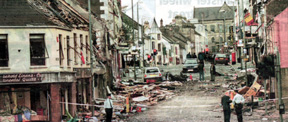
HOW GREEN SHOOTS OF HOPE HAVE RISEN FROM THE RUBBLE OF OMAGH
How green shoots of hope have risen from the rubble of Omagh
MARTINA DEVLIN
Comment
Sometimes it takes a seismic tremor to send a wake-up call shrilling through a community. We have just experienced one here with the banking collapse, causing us to reconsider our acquisition-driven law of the jungle.
The Omagh bomb was another such convulsion. Decades of fossilised thinking was swept away in outrage at the desecration which occurred in my home town.
And some seeds were planted there. We saw one of those seeds blossom this week, when relatives of the dead who teamed up to press for justice won a landmark civil case against the bombers.
Courage, faith and persistence were eventually rewarded on this bright day, in the course of a gloomy journey for those bereaved families - a journey which they still have some distance to travel.
But I want to talk about a number of other seeds flowering now in Omagh, with which people may be less familiar. These green shoots were never as dramatic as the civil suit but are important, too, in their way.
We form perceptions of places based on striking events associated with them. Yet these happenings, while they judder through a community, wounding it and causing consternation, do not sum it up. There was always more to the Tyrone market town than a massive explosion which ricocheted around the world. But the bomb is what settled into the public consciousness.
This was understandable in many ways. Before August 1998, it was not a well-known town; people usually thought I was saying Armagh instead of Omagh when I described where I came from. Presumably the bomb will be the first association people make with the town for at least another generation - even if they are thankfully less quick now to say "isn't that where ... ?" when the name crops up.
Yet what pleases me most, in the aftermath, is how Omagh has declined to be defined by this single event, electrifying though it was. The bomb was something done to Omagh, not by Omagh.
The community has emerged on the far side of this act of barbarity with a vibrant artistic, literary and music scene. These are among the interfaces where all sides come together in friendship and cooperation.
Last week, I attended the launch of an exhibition for four talented Irish artists, one of them local woman Samantha Ellis-Fox, at the beautiful, light-filled McKenna Gallery in Omagh. The wellspring of good wishes in the room was striking - there was a palpable sense of warmth and buoyancy.
People are keen for the gallery, and for the artistic community it endorses, to succeed. They rightly regard the former as an amenity for the area and the latter as an enhancement to it. Standing there, surrounded on all sides by artworks which challenged, intrigued and gave pleasure, I was struck by how agreeable it was to be in artistic company - compared with the financial sphere with which we have all become acquainted in recent times.
Those engaged in the artistic fields need to earn a living, of course, but their values are less likely to be profit-driven. The process of working is deemed as worthwhile as the end result. And to some, the act of creation has more intrinsic merit than the arbitrary price tag attached to the work. After being bludgeoned by the scale of senior bankers' bonuses and their performance-driven culture, and lately by the planned �4bn cash injection into Anglo Irish Bank, this artistic approach seems a saner ethos.
The owner of a music shop situated beside the gallery spoke to me about the cross-community music projects with which he is involved. It was satisfying evidence of progress, although I look forward to a time when these ventures are so commonplace there is no need to flag them as cross-community. I have no doubt such a day will come.
Also present at the exhibition were representatives from Omagh's new Strule Arts Centre, and others connected with the Benedict Kiely Literary Festival held in the town every September. Various strands of the artistic community were knitting together to support one another. This year, the festival organisers are delighted that RTE's 'Sunday Miscellany" will broadcast live from the venue, as a tribute to Benedict Kiely who had a long association with the radio show.
All was positive news, and the optimism engendered was worth its weight in gold. As for the Omagh relatives involved in the court case - they must also feel a sense of achievement at finally making progress in their quest for some form of justice, imperfect though it may be. I expect there are many days when even that goal is scant consolation for what they have lost. On Sunday, I sat for a few minutes in the memorial garden to the bomb victims - a serene place where I often pause and gather my thoughts. And I noticed Godfrey Wilson there. He was father to 15-year-old Lorraine Wilson, killed on that hot Summer's day, and was among the group which took the civil action.
How could I not feel a twinge of regret - and guilt - that my moment of silent reflection, soon set aside, translated into something bleaker and impossible to forget for him?
But human nature, where it has the choice, struggles against focusing on such dark episodes in time. And so I made myself remember the music shop owner and his cross-community band and choir.
Omagh has more than one story to tell. The legacy of the bomb is not the only one.
MARTINA DEVLIN
Comment
Sometimes it takes a seismic tremor to send a wake-up call shrilling through a community. We have just experienced one here with the banking collapse, causing us to reconsider our acquisition-driven law of the jungle.
The Omagh bomb was another such convulsion. Decades of fossilised thinking was swept away in outrage at the desecration which occurred in my home town.
And some seeds were planted there. We saw one of those seeds blossom this week, when relatives of the dead who teamed up to press for justice won a landmark civil case against the bombers.
Courage, faith and persistence were eventually rewarded on this bright day, in the course of a gloomy journey for those bereaved families - a journey which they still have some distance to travel.
But I want to talk about a number of other seeds flowering now in Omagh, with which people may be less familiar. These green shoots were never as dramatic as the civil suit but are important, too, in their way.
We form perceptions of places based on striking events associated with them. Yet these happenings, while they judder through a community, wounding it and causing consternation, do not sum it up. There was always more to the Tyrone market town than a massive explosion which ricocheted around the world. But the bomb is what settled into the public consciousness.
This was understandable in many ways. Before August 1998, it was not a well-known town; people usually thought I was saying Armagh instead of Omagh when I described where I came from. Presumably the bomb will be the first association people make with the town for at least another generation - even if they are thankfully less quick now to say "isn't that where ... ?" when the name crops up.
Yet what pleases me most, in the aftermath, is how Omagh has declined to be defined by this single event, electrifying though it was. The bomb was something done to Omagh, not by Omagh.
The community has emerged on the far side of this act of barbarity with a vibrant artistic, literary and music scene. These are among the interfaces where all sides come together in friendship and cooperation.
Last week, I attended the launch of an exhibition for four talented Irish artists, one of them local woman Samantha Ellis-Fox, at the beautiful, light-filled McKenna Gallery in Omagh. The wellspring of good wishes in the room was striking - there was a palpable sense of warmth and buoyancy.
People are keen for the gallery, and for the artistic community it endorses, to succeed. They rightly regard the former as an amenity for the area and the latter as an enhancement to it. Standing there, surrounded on all sides by artworks which challenged, intrigued and gave pleasure, I was struck by how agreeable it was to be in artistic company - compared with the financial sphere with which we have all become acquainted in recent times.
Those engaged in the artistic fields need to earn a living, of course, but their values are less likely to be profit-driven. The process of working is deemed as worthwhile as the end result. And to some, the act of creation has more intrinsic merit than the arbitrary price tag attached to the work. After being bludgeoned by the scale of senior bankers' bonuses and their performance-driven culture, and lately by the planned �4bn cash injection into Anglo Irish Bank, this artistic approach seems a saner ethos.
The owner of a music shop situated beside the gallery spoke to me about the cross-community music projects with which he is involved. It was satisfying evidence of progress, although I look forward to a time when these ventures are so commonplace there is no need to flag them as cross-community. I have no doubt such a day will come.
Also present at the exhibition were representatives from Omagh's new Strule Arts Centre, and others connected with the Benedict Kiely Literary Festival held in the town every September. Various strands of the artistic community were knitting together to support one another. This year, the festival organisers are delighted that RTE's 'Sunday Miscellany" will broadcast live from the venue, as a tribute to Benedict Kiely who had a long association with the radio show.
All was positive news, and the optimism engendered was worth its weight in gold. As for the Omagh relatives involved in the court case - they must also feel a sense of achievement at finally making progress in their quest for some form of justice, imperfect though it may be. I expect there are many days when even that goal is scant consolation for what they have lost. On Sunday, I sat for a few minutes in the memorial garden to the bomb victims - a serene place where I often pause and gather my thoughts. And I noticed Godfrey Wilson there. He was father to 15-year-old Lorraine Wilson, killed on that hot Summer's day, and was among the group which took the civil action.
How could I not feel a twinge of regret - and guilt - that my moment of silent reflection, soon set aside, translated into something bleaker and impossible to forget for him?
But human nature, where it has the choice, struggles against focusing on such dark episodes in time. And so I made myself remember the music shop owner and his cross-community band and choir.
Omagh has more than one story to tell. The legacy of the bomb is not the only one.
Further Information
Publisher: BELFAST TELEGRAPH
Ref: BT/1167
Published Date: 12-Jun-09
Related Images