HOW OMAGH CAN BE EXAMPLE TO THE WORLD
How Omagh can be example to the world
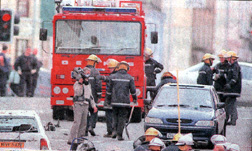
Plunged into despair by the bomb, but the people of the town did not let it ruin community relations.
By David McKittrick
In Omagh town Mick Grimes's granddaughters, Aoibheann and Eilisha, performed an exuberant Irish reel, bouncing and bobbing with effortless teenage energy, full of vitality. Full of life.
The hundreds packed into the town's library applauded, acclaiming both the talent of the teenagers and the extraordinary resilience of 83-year-old Mick, who has gone through more grief than a human being should have to endure.
Their dancing and other cheerful moments provided a poignant counterpoint to those parts of the evening that dwelt on the tragedy in Mick's life.
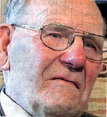
A farmer with a literary bent, he has just published a book looking back on a life which was a happy one until, 10 years ago, members of the Real IRA placed a car bomb in Omagh which blasted his family apart. It killed his wife Mary and it killed their daughter Avril and her unborn twins, and it killed her 18-month-old daughter Maura. At the funeral the priest asked mourners to pray for Avril 'as she takes her little angel with her to heaven'.
Yet incredibly, even in the face of such almost unbearable loss, Mick is not a bitter man. One of his poems commends good relations:
Neighbours working side by side, Laugh together enjoying life, Without the slightest sign of strife.
And equally incredibly, Omagh itself, where 29 people were killed and hundreds injured, is not a bitter place. Although many from the town, and even more from its surrounding countryside, were killed, injured or bereaved, it has not allowed itself to be brutalised.
So the dissident republicans did not ruin community relations, and nor did they wreck the peace process as they had hoped. Despite the shock, or perhaps because of it, those involved in the process redoubled their efforts, eventually delivering today's peace. There is a unity of shared grief: both Catholics and Protestants died so the pain and the loss was collective. As the Rev Robert Herron, local Presbyterian minister described it: the response was very much a human response, not so much a sectarian one."
Catholic parish priest Monsignor Joe Donnelly agreed: "Omagh was always distinctive in that there was very little rank sectarianism here. There was always a coming together of the people and it refused to be divided by what happened."
And rather than keep their distance, Omagh's Protestant and Catholic churches have combined to promote a unique project. Monsignor Donnelly and the Rev Herron jointly head up a campaign to bring local schools together.
The churches want to bring together up to half a dozen existing schools, Catholic and Protestant, secondary and primary, to a large, vacant site close to the centre of the I town. While the schools I would remain separate entities, they would become part of an 'educational village', sharing the land and the facilities. Pupils would mix socially and in many activities. A Unionist minister in the Northern Ireland executive has called it 'a magnificent opportunity' and Sinn Fein described it as 'an inspirational beacon to the world in respect of conflict transformation'.
The fact that the vacant site is a former army barracks, Lisanelly, adds to the symbolism of the project. Until a few years ago it was a heavily fortified base, but now the soldiers have gone, rendered redundant by the peace process.
There is an added symbolism in Lisanelly being used for a shared future, and one which is not lost on the bereaved. In the fraught, terrible hours after the bombing, a temporary mortuary was set up there, soldiers providing curtains, flowers and comfortable chairs for those involved in the dreadful wait for news.
The death toll was so high that some families actually had to queue in a line before they could make a formal identification of the dead. Some of them are still haunted by the ordeal.
Lisanelly was where some had their last glimpses of their loved ones, sometimes seeing sights which have never left them. "She had a face full of shrapnel," a father said of his teenage daughter. Another parent would later say: "That's what I see every night, that makeshift mortuary."
It seems almost beyond belief that Northern Ireland's most deeply wounded town should be actively working towards a future together, and thinking of coexistence rather than separation. Yet many talk of the town's strong sense of hope.
The organisation the world knows best is the Omagh Support and Self Help Group, which represents some victim families and which maintains a vocal public campaign. Its speciality is the use of legal action. It has brought a civil action seeking millions in damages from five alleged Real IRA figures. It further seeks a full-scale public inquiry into the bombing.
Unfortunately the group has recently become involved in disagreements on exactly how to mark the 10th anniversary of the attack. This means there are two separate commemoration ceremonies: most in Omagh regard this as a thousand pities.
It is not completely surprising that the underlying keynote in Omagh is one of conciliation rather than rage and hatred, for within days of the bomb there were signs that the town would not let its hurt turn into acrimony.
At one of the funerals a Catholic bishop told townspeople: "If it could become a model for the type of Northern Ireland we want to build, something good will have come of this. In the midst of your trauma you have given a great example." Remarkably his words were applauded by the congregation, many of whom were attending multiple funerals.
Since then sorrow has gone hand in hand with determined efforts by the community and by individuals to move on. A girl who lost a leg will shortly be married; another amputee has become a teacher. Another teenager was so badly injured that she begged her father to help her die: today she is an occupational therapist and the mother of two sons.
A young woman who lost her eyesight works as a counsellor for the Royal National Institute for the Blind. "I've tried to make the most of my life," she explained. "Everybody has their way of coping, and my way of coping is to get on with it."
The town has seen much redevelopment since the bomb and there are few obvious physical reminders of the bomb. But no one forgets.
Wesley Atchison, editor of the Tyrone Constitution newspaper, said: "There has rarely been a week when there hasn't been something in our paper relating in some way to the bomb. So it's very much an ongoing atrocity.
"It's not going to disappear in this generation. But above all we have very resilient people - amazingly resilient. I think that's the most important thing that I can say."
Resilience is one of the words they use about Mick Grimes: "Dignity was always associated with him," according to a local councillor.
A Protestant neighbour praised the Catholic Grimes family for the rural reticence with which it has coped with its terrible losses: "They were hit the hardest and they have dealt with it admirably in the privacy of the farmhouse kitchen," he said.
Mick and his wife Mary had 12 children together. Mary was 66 on the day she died: she went into Omagh with her daughter Avril and her little grand-daughter. Avril's last words to Mick as they drove off from their farmyard were "We are away now, bye."
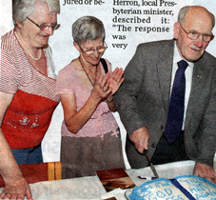
Mick has said little publicly over the last decade: at the launch of his book his voice trembled as he reached the last lines of one of his poems. He almost broke down but he made it through. The applause was thunderous, and at the end of the sad but uplifting occasion people mingled saying, "Lovely night, lovely night."
The quiet country poet who has had to endure so much grief has - in common with many in Omagh - succeeded in reaching what another Irish poet, Seamus Heaney, described as "the far side of revenge." He called his book "Till we meet again" and writes in it:
'Although they have gone we know 'twas God's will; They are still very near and do love us still. Though our hearts are still breaking, we must try to smile: They are waiting to greet us at the end of the mile."
Plunged into despair by the bomb, but the people of the town did not let it ruin community relations.
By David McKittrick
In Omagh town Mick Grimes's granddaughters, Aoibheann and Eilisha, performed an exuberant Irish reel, bouncing and bobbing with effortless teenage energy, full of vitality. Full of life.
The hundreds packed into the town's library applauded, acclaiming both the talent of the teenagers and the extraordinary resilience of 83-year-old Mick, who has gone through more grief than a human being should have to endure.
Their dancing and other cheerful moments provided a poignant counterpoint to those parts of the evening that dwelt on the tragedy in Mick's life.
A farmer with a literary bent, he has just published a book looking back on a life which was a happy one until, 10 years ago, members of the Real IRA placed a car bomb in Omagh which blasted his family apart. It killed his wife Mary and it killed their daughter Avril and her unborn twins, and it killed her 18-month-old daughter Maura. At the funeral the priest asked mourners to pray for Avril 'as she takes her little angel with her to heaven'.
Yet incredibly, even in the face of such almost unbearable loss, Mick is not a bitter man. One of his poems commends good relations:
Neighbours working side by side, Laugh together enjoying life, Without the slightest sign of strife.
And equally incredibly, Omagh itself, where 29 people were killed and hundreds injured, is not a bitter place. Although many from the town, and even more from its surrounding countryside, were killed, injured or bereaved, it has not allowed itself to be brutalised.
So the dissident republicans did not ruin community relations, and nor did they wreck the peace process as they had hoped. Despite the shock, or perhaps because of it, those involved in the process redoubled their efforts, eventually delivering today's peace. There is a unity of shared grief: both Catholics and Protestants died so the pain and the loss was collective. As the Rev Robert Herron, local Presbyterian minister described it: the response was very much a human response, not so much a sectarian one."
Catholic parish priest Monsignor Joe Donnelly agreed: "Omagh was always distinctive in that there was very little rank sectarianism here. There was always a coming together of the people and it refused to be divided by what happened."
And rather than keep their distance, Omagh's Protestant and Catholic churches have combined to promote a unique project. Monsignor Donnelly and the Rev Herron jointly head up a campaign to bring local schools together.
The churches want to bring together up to half a dozen existing schools, Catholic and Protestant, secondary and primary, to a large, vacant site close to the centre of the I town. While the schools I would remain separate entities, they would become part of an 'educational village', sharing the land and the facilities. Pupils would mix socially and in many activities. A Unionist minister in the Northern Ireland executive has called it 'a magnificent opportunity' and Sinn Fein described it as 'an inspirational beacon to the world in respect of conflict transformation'.
The fact that the vacant site is a former army barracks, Lisanelly, adds to the symbolism of the project. Until a few years ago it was a heavily fortified base, but now the soldiers have gone, rendered redundant by the peace process.
There is an added symbolism in Lisanelly being used for a shared future, and one which is not lost on the bereaved. In the fraught, terrible hours after the bombing, a temporary mortuary was set up there, soldiers providing curtains, flowers and comfortable chairs for those involved in the dreadful wait for news.
The death toll was so high that some families actually had to queue in a line before they could make a formal identification of the dead. Some of them are still haunted by the ordeal.
Lisanelly was where some had their last glimpses of their loved ones, sometimes seeing sights which have never left them. "She had a face full of shrapnel," a father said of his teenage daughter. Another parent would later say: "That's what I see every night, that makeshift mortuary."
It seems almost beyond belief that Northern Ireland's most deeply wounded town should be actively working towards a future together, and thinking of coexistence rather than separation. Yet many talk of the town's strong sense of hope.
The organisation the world knows best is the Omagh Support and Self Help Group, which represents some victim families and which maintains a vocal public campaign. Its speciality is the use of legal action. It has brought a civil action seeking millions in damages from five alleged Real IRA figures. It further seeks a full-scale public inquiry into the bombing.
Unfortunately the group has recently become involved in disagreements on exactly how to mark the 10th anniversary of the attack. This means there are two separate commemoration ceremonies: most in Omagh regard this as a thousand pities.
It is not completely surprising that the underlying keynote in Omagh is one of conciliation rather than rage and hatred, for within days of the bomb there were signs that the town would not let its hurt turn into acrimony.
At one of the funerals a Catholic bishop told townspeople: "If it could become a model for the type of Northern Ireland we want to build, something good will have come of this. In the midst of your trauma you have given a great example." Remarkably his words were applauded by the congregation, many of whom were attending multiple funerals.
Since then sorrow has gone hand in hand with determined efforts by the community and by individuals to move on. A girl who lost a leg will shortly be married; another amputee has become a teacher. Another teenager was so badly injured that she begged her father to help her die: today she is an occupational therapist and the mother of two sons.
A young woman who lost her eyesight works as a counsellor for the Royal National Institute for the Blind. "I've tried to make the most of my life," she explained. "Everybody has their way of coping, and my way of coping is to get on with it."
The town has seen much redevelopment since the bomb and there are few obvious physical reminders of the bomb. But no one forgets.
Wesley Atchison, editor of the Tyrone Constitution newspaper, said: "There has rarely been a week when there hasn't been something in our paper relating in some way to the bomb. So it's very much an ongoing atrocity.
"It's not going to disappear in this generation. But above all we have very resilient people - amazingly resilient. I think that's the most important thing that I can say."
Resilience is one of the words they use about Mick Grimes: "Dignity was always associated with him," according to a local councillor.
A Protestant neighbour praised the Catholic Grimes family for the rural reticence with which it has coped with its terrible losses: "They were hit the hardest and they have dealt with it admirably in the privacy of the farmhouse kitchen," he said.
Mick and his wife Mary had 12 children together. Mary was 66 on the day she died: she went into Omagh with her daughter Avril and her little grand-daughter. Avril's last words to Mick as they drove off from their farmyard were "We are away now, bye."
Mick has said little publicly over the last decade: at the launch of his book his voice trembled as he reached the last lines of one of his poems. He almost broke down but he made it through. The applause was thunderous, and at the end of the sad but uplifting occasion people mingled saying, "Lovely night, lovely night."
The quiet country poet who has had to endure so much grief has - in common with many in Omagh - succeeded in reaching what another Irish poet, Seamus Heaney, described as "the far side of revenge." He called his book "Till we meet again" and writes in it:
'Although they have gone we know 'twas God's will; They are still very near and do love us still. Though our hearts are still breaking, we must try to smile: They are waiting to greet us at the end of the mile."
Further Information
Publisher: BELFAST TELEGRAPH
Ref: BT10An/31
Published Date: 15-Aug-08
Related Images