BRUISED BATTERED AND BROKEN
Bruised, battered and broken
Ten years on from the Omagh bombing the Press Association's Ireland editor, DERIC HENDERSON, returns to the town where he grew up and discovers that it may never find peace of mind
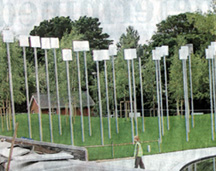
Omagh is preparing for the opening of a special memorial on Friday based on the themes of light and reflection, but it's difficult to see how this striking and imaginative piece of artwork can fully obliterate the long, dark shadow which hangs over my home town.
However much the Garden of Light attempts to signal the start of a new era, many people, and especially those most affected by that terrible atrocity will struggle to emerge from the shade.
Nothing should distract from the solemnity and dignity of what will be an emotional event. But regrettably with the absence of familiar faces that have campaigned long and hard in the quest for the truth, the occasion is sadly diminished. It's a shame, but then was this awful tragedy and scandal ever thus? The bomb went off just up the street where, as a boy, I stood mesmerised by the electric train which circled the huge and magical display in the front window of JB Anderson's toy store, announcing the arrival of Christmas. Opposite the barber's shop where the slight, silver-haired Hughie Doran never compromised on a short, back and sides. It wasn't far from the bridge under which the town's Drumragh and Camowen rivers collide to become the Strule and where men of a different generation fished for pearls.
As well as climbing over the hedge to rob old Bob Kane's apple orchard at Campsie, playing football and cricket on the neighbouring pitches, building tree huts down Bells Lane and camping at Rash Wood, our gang of six from the Hospital Road side of town spent ages on the banks of those waterways using worms to tease the trout.
Table-tennis in the YMCA, and warm summer Saturday nights were spent at the Showgrounds in Sedan Avenue, identifying Irish League soccer players who used assumed names as they competed for a winning cheque of £250 and the Battisti Cup, presented by an Italian family which settled in Omagh to open the Cafe Rex in High St.
A time of such simplicity and innocence and years in advance of my introduction to the harsh realities of life as a journalist transferred 35 years ago this October to the frontline of a dark and tense city at the far end of the Ml Motorway.
The Ulster Workers Council strike which brought down the first power-sharing executive was just months away and the Shankill Butchers were running wild. The rest as they say, is history. La Mon, the IRA hunger strikes, Warrenpoint, Ballykelly, Enniskillen, Loughgall, Gibraltar, Milltown Cemetery, the Shankill, Greysteel and especially Loughisland made for some grim days as we assembled at the front doors to intrude on grieving families. But nothing could compare with what awaited us in Omagh.
Even 10 years on it is still hard to comprehend the scale of the carnage, the courage, the bravery and the heroics of the emergency services and ordinary civilians who went to the aid of the dead and dying.
A strengthened PA team of journalists had their hotel rooms already booked before they reached the Lissan Bridge and by the time the first of their images and reports were transmitted world-wide, Omagh changed forever.
I'll leave the views and reflections of August 15, 2008 to my colleagues who have been to the town as well to prepare anniversary articles, but an hour's walk through the streets yesterday only reinforced my belief that this is a place which may never again find peace of mind, certainly not in my lifetime.
It was so utterly depressing. You didn't have to stray too far to detect the recrimination and anger - shared by those who won't forget but who are desperate to move on with their lives, free of the unfinished business that is Omagh and the controversy which surrounds it.
And those, especially in Michael Gallagher's Support and Self Help Group, considered by some to be a dissident faction of malcontents, but who
won't settle until they get their day in court and closure. It's no secret there is little love lost with Omagh District Council, after it was left up to the group to acknowledge in the memorial narrative and inscriptions that it was Irish republicans who abandoned the car bomb.
Even the dogs in the streets of Canondale, Winters Gardens, Queens Parade and O'Kane Park know WHERE, WHEN, WHY and WHO bombed Omagh, but after two failed major police investigations and a plethora of reviews and reports, I fear that the men responsible for the slaughter have got away with murder.
The relatives' High Court civil action against the five they claim were to blame is expected to end in Belfast next month and even if the judge finds in their favour, they are unlikely to get as much as a penny of the multi-million pound compensation they are seeking.
And the chances of the British and Irish governments meeting their primary demand for a full cross-border judicial inquiry are I believe, virtually nil.
I recall a lunch in Dublin with a senior minister in Bertie Ahern's cabinet two years ago, a fortnight after a particularly stressful meeting with the Self Help Group, when he declared in a raised voice: "Gallagher will never, and I mean never, cross my door again."
Norman Baxter, the detective who headed up the second criminal investigation which ended with the acquittal of Sean Hoey, is likely to leave before the end of the year - effectively the last of the policemen publicly identified with Omagh.
All the others are gone, among them Ronnie Flanagan, Eric Anderson and Brian McVicker, the officer who first exposed the flaws and serious shortcomings of the first inquiry, before the then Ombudsman Nuala O'Loan got her hands on his report to deliver a kicking like no other.
I'm still on first-name terms with them all, but at times it was touch and go if the friendships would survive the cross-fire.
It isn't just the dead and injured. Omagh has taken its toll so many others and on the streets yesterday where I heard of another marriage collapsing because of the stresses and strains linked to the bomb, there was a strange atmosphere; a mood of weariness, despair and disillusionment.
One woman I met is taking her family away for the day to avoid Friday's fuss, and I suspect there will be others looking out as well. The blame game is up and running again, although many expect it to calm down once Friday is out of the way.
I didn't hear anyone who had a good word for the Garden of Light where two giant mirrors known as heliostats controlled by computer track the sun, pouring a beam of sunlight onto 31 small mirrors and which is then transferred via another mirror to light up a Tyrone crystal heart which is set in a glass obelisk at the bomb site.
"Invasive", "vulgar" "a monstrosity" and a "tourist attraction we can do without", was how it was variously described. Outside the hugely impressive Strule Arts Centre where a wonderful exhibition has just opened of high quality copies of the art pieces created from the many floral tributes left in the aftermath of the bombing, an old friend from my days on the Tyrone Constitution newspaper told me how his family was forbidden to talk about the atrocity. "Is Omagh always going to be remembered for the bomb?" he asked.
And then I listened to Kevin Magee's brilliant and moving interview on Radio Ulster with Claire Gallagher, who was blinded that day and who I first met with her parents in Washington a year later when she played the piano so beautifully for Bill and Hillary Clinton at a special White House reception for Senator George Mitchell, one of the finest men I've ever interviewed.
Now married and getting on with her life, without the faintest hint of bitterness, even against the men who maimed her, she won't be in Omagh on Friday, but this is what she had to say: "It's something that happened. It happened for a reason. I have to get on with it the best I can. It's not going to do me any favours feeling bitter.
"If I was still caught up in that, I don't think I would have come on as far as I have over the past 10 years. I consciously try and not let those thoughts take over, because if it did then I wouldn't be able to get on with things.
"I am constantly looking to the future and trying to make the most of what I've got and make the most of my life.
"I see myself as one of the lucky ones as I'm still here and for a lot of people that wasn't the case."
What an inspiration, and maybe those are words which should be engraved in stone in the memorial garden.
Further Information
Related Images