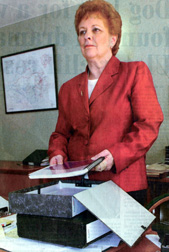
NUALA O'LOAN: THE JOB I DIDN'T WANT TO LEAVE
Nuala O'Loan: the job I didn't want to leave
Ulster's Police Ombudsman reflects on her tumultuous seven-year term
CHRIS THORNTON
CHIEF REPORTER
cthornton@belfasttelegraph.co.uk
AS she leaves her office in central Belfast for the last time today, two items stand out among the mementoes Nuala O'Loan has collected during her seven years as Police Ombudsman. One is an email, more of which later.
The other is a glass clock given to her during her last days in office by the family of Samuel Devenny, whose death in 1969 was the subject of one of Mrs O'Loan's first reports. Mrs O'Loan found that Mr Devenny had been wrongfully beaten by police, and that senior officers at the time knew that. The family, whose account was finally vindicated, inscribed the clock: 'To Nuala, the woman with the courage of ten men'.
This kind of tribute is one reason why Mrs O'Loan considers her time as Ombudsman to have been "a massive privilege" - in spite of "terrible" assaults on her children, political attacks on her, high profile conflicts with police, and the moment when she feared for her life.
She doesn't want to leave. If it had not been written in law that the Ombudsman must leave after seven years, she would go on.
"No, I have wonderful colleagues and my experience has generally been so positive, even through the bad days when they were howling about me and being unpleasant," she says
"I never set foot out of this office without someone speaking to me. And it still happens. People speak to me constantly. They always just tell me I'm doing a good job and don't be afraid and that sort of stuff. That has been a constant support from right across the community.
"I'll be very sad to leave. I've worked with people like the current Chief Constable, for whom I have a huge regard, the Deputy and the ACCs - wonderful people who are really committed to changing policing, to moving it on, to making it the best it can be, to acknowledging that in the past things were done which shouldn't have been done."
Her supporters share her sorrow but her critics - including the Police Federation, a collection of former officers and unionist politicians - are glad to see the back of her. The federation severed relations with her office earlier this year, and is expected to renew them after her successor, former Canadian Mountie Al Hutchinson, moves in tomorrow.
But it is undeniable that her period in office has been transformational. It has seen a new era of police accountability, most notably in the groundbreaking reports on the Omagh bomb investigation and the murder of Raymond McCord Jnr. Those reports are in some senses book-ends to her work: the official discomfort that greeted one and the official support that greeted the other show how the policing climate has changed.
"I think there's been a maturing and acceptance," she says. "With Omagh, the ferocity with which I was attacked and the fact that Government didn't come out in support - nobody did - it was the community and me, and that really was rather difficult.
"It was different when I did Ballast, the McCord report. The Prime Minister, the Taoiseach, everybody came out in support - the Secretary of State, the Chief Constable, everyone.
"What I think we did with Omagh was we took the set of facts and we dealt with them on the evidence, but we also said the RUC is an organisation which is fallible, which is capable of making mistakes and there must be a process by which mistakes are addressed in any organisation.
"So it was kind of changing the consciousness and the thinking and the language of how we contemplated the RUC. And I think that was what precipitated the ferocity of the attack."
The worst moment she describes as Lord Maginnis' outburst on Newsnight after the Omagh report, when he said she had gone through "police interests and community interests like a suicide bomber", and had "outlived her usefulness".
"Nothing could prepare you for the Ken Maginnis-type suicide bomber statement, the 'outlived her usefulness statement'," she said. She felt the statements could be seized upon by paramilitaries as an excuse to attack her. "That is really what it looked like to me and I was afraid." Lord Maginnis has previously denied putting Mrs O'Loan's life at risk.
Legend has it bad weather brought Nuala O'Loan to her office. At the time storms wrecked power lines across Northern Ireland on Boxing Day in 1998, the then Secretary of State Mo Mowlam had not decided on who to appoint as Ombudsman. Stormont sources say she saw Mrs O'Loan, then chairman of the NI Consumer Committee for Electricity, on television laying into NIE's performance. She liked what she saw.
Not everyone else did. As a former member of the Police Authority and a lecturer who taught law to many senior RUC officers - not to mention being English-born and the survivor of an IRA bomb attack - Mrs O'Loan started from a "zero base" with republicans. Unionists were suspicious of her nationalist political connections (her husband, Declan, is an SDLP MLA).
"I didn't expect the depth of the kind of bitter political conflict," she says. "I knew, because I had been in the Police Authority, that policing was a very sacred thing for a lot of people here.
"But I didn't grow up in Northern Ireland, I'm not of Northern Ireland, so for me that depth of understanding of how people might react wasn't there," the mother of five said. "And that was a significant asset, not least because when people sit down in front of me I don't actually know in most cases if they're Catholic or Protestant. It's never been part of my consciousness."
She adds: "Declan was dragged in repeatedly. Because we've both had professional jobs, we've always lived with this division between work and home.
"So I would never talk to him about cases and he would never talk to me about some of the things he's involved in. it just becomes part of your modus operandi.
"The boys, for example, sometimes things would come up in the media in the early days and they would say 'what's that about mum?' And I would say 'You can go and look on the website.' And that cut the lines for them very clearly.
"The boys were attacked, several of them. We know three of the attacks were sectarian. We know at least two of them were related to my work and that is very difficult, particularly with the younger boys. It's terrible."
Her work raised hackles with some police officers, some former officers and supporters of the RUC because they said her reports failed to take account of extenuating circumstances, of the special conditions the Troubles brought to policing.
"I don't think there are too many extenuating circumstances when you don't arrest someone who admits to murder, or when you don't pass on information about where murderers have gone," she says in response. "I just think that's bizarre.
"The assumption that if you're fighting terrorists you can do anything you like is I think a very dangerous assumption, because you end up growing support for that which you seek to defeat."
The withdrawal of contact by the Police Federation, which represents rank and file officers, for her final months in office was, she says, "bizarre". They complained her work "was destructive to the reputation of the RUC and would inevitably undermine public confidence in the PSNI".
"The more I thought about it, what they were saying was 'if you didn't do your statutory duty, we would talk to you, but since you are doing your statutory duty, we're going to play silly games with you'. To me that is just mystifying. I don't it's a personal reflection on me, I think it's a personal reflection on senior officer holders in the federation."
She expects the federation to renew contact after Mr Hutchinson takes up office. She also expects them to drop longstanding opposition to mediation in police complaints. Her failure to bring in mediation for some complaints is her "one regret".
She says she leaves a Police Service behind with "much, much better systems, much clearer training, much better and more inclusive management".
"At chief officer level, there is a clear leadership which is saying 'we get policing right, but if we don't get it right we won't cover it up'," she adds.
The future remains elusive - "I've been working so hard that I haven't really thought about it" - but she is also clear that the past should not be forgotten.
Prior to his appointment, Mr Hutchinson raised concerns about the "continual debilitating drip-feed of speculation, inquires and investigations into past police practice".
"The law says that if a grave or exceptional allegation is made, the Police Ombudsman shall investigate," says Mrs O'Loan. "And I'm sure that he'll comply with the law. If he doesn't, he'll be judicially reviewed."
She acknowledges that there are problems with investigating the past - imperfect memories, the loss of evidence, incomplete outcomes - that "you have to factor in".
"But that doesn't mean you don't investigate," she says. "I have an email I've kept from someone whose case we investigated, which says 'after 30 years, I can sleep'.
"What we were able to tell them was actually very limited, but it's telling them what there is to be told and leaving them without what must be wrenching uncertainty. So I think that there is something that must be done there.
"The range of outcomes from those investigations is huge. It runs from the Devenney family, who were told, Yes it did happen, yes it was the police, yes you were all beaten, and yes there was an amnesty so there was no prosecution to, more recently, Rita Restorick, the mother of (murdered soldier) Stephen Restorick. She had this terrible period when she didn't know whether her son had been sacrificed by the British Army and police. And they hadn't.
"I think that ability to change people's perceptions, to change their consciousness, to help move forward has been particularly important. I think we won't move forward if we try and bury the past.
"We think we're in a relatively stable position, but as I watch the goings on up the hill, it seems to me that it's not as stable as people might think it is. We don't want anything which will leave the opportunity for anybody to move back into violence."
Ulster's Police Ombudsman reflects on her tumultuous seven-year term
CHRIS THORNTON
CHIEF REPORTER
cthornton@belfasttelegraph.co.uk
AS she leaves her office in central Belfast for the last time today, two items stand out among the mementoes Nuala O'Loan has collected during her seven years as Police Ombudsman. One is an email, more of which later.
The other is a glass clock given to her during her last days in office by the family of Samuel Devenny, whose death in 1969 was the subject of one of Mrs O'Loan's first reports. Mrs O'Loan found that Mr Devenny had been wrongfully beaten by police, and that senior officers at the time knew that. The family, whose account was finally vindicated, inscribed the clock: 'To Nuala, the woman with the courage of ten men'.
This kind of tribute is one reason why Mrs O'Loan considers her time as Ombudsman to have been "a massive privilege" - in spite of "terrible" assaults on her children, political attacks on her, high profile conflicts with police, and the moment when she feared for her life.
She doesn't want to leave. If it had not been written in law that the Ombudsman must leave after seven years, she would go on.
"No, I have wonderful colleagues and my experience has generally been so positive, even through the bad days when they were howling about me and being unpleasant," she says
"I never set foot out of this office without someone speaking to me. And it still happens. People speak to me constantly. They always just tell me I'm doing a good job and don't be afraid and that sort of stuff. That has been a constant support from right across the community.
"I'll be very sad to leave. I've worked with people like the current Chief Constable, for whom I have a huge regard, the Deputy and the ACCs - wonderful people who are really committed to changing policing, to moving it on, to making it the best it can be, to acknowledging that in the past things were done which shouldn't have been done."
Her supporters share her sorrow but her critics - including the Police Federation, a collection of former officers and unionist politicians - are glad to see the back of her. The federation severed relations with her office earlier this year, and is expected to renew them after her successor, former Canadian Mountie Al Hutchinson, moves in tomorrow.
But it is undeniable that her period in office has been transformational. It has seen a new era of police accountability, most notably in the groundbreaking reports on the Omagh bomb investigation and the murder of Raymond McCord Jnr. Those reports are in some senses book-ends to her work: the official discomfort that greeted one and the official support that greeted the other show how the policing climate has changed.
"I think there's been a maturing and acceptance," she says. "With Omagh, the ferocity with which I was attacked and the fact that Government didn't come out in support - nobody did - it was the community and me, and that really was rather difficult.
"It was different when I did Ballast, the McCord report. The Prime Minister, the Taoiseach, everybody came out in support - the Secretary of State, the Chief Constable, everyone.
"What I think we did with Omagh was we took the set of facts and we dealt with them on the evidence, but we also said the RUC is an organisation which is fallible, which is capable of making mistakes and there must be a process by which mistakes are addressed in any organisation.
"So it was kind of changing the consciousness and the thinking and the language of how we contemplated the RUC. And I think that was what precipitated the ferocity of the attack."
The worst moment she describes as Lord Maginnis' outburst on Newsnight after the Omagh report, when he said she had gone through "police interests and community interests like a suicide bomber", and had "outlived her usefulness".
"Nothing could prepare you for the Ken Maginnis-type suicide bomber statement, the 'outlived her usefulness statement'," she said. She felt the statements could be seized upon by paramilitaries as an excuse to attack her. "That is really what it looked like to me and I was afraid." Lord Maginnis has previously denied putting Mrs O'Loan's life at risk.
Legend has it bad weather brought Nuala O'Loan to her office. At the time storms wrecked power lines across Northern Ireland on Boxing Day in 1998, the then Secretary of State Mo Mowlam had not decided on who to appoint as Ombudsman. Stormont sources say she saw Mrs O'Loan, then chairman of the NI Consumer Committee for Electricity, on television laying into NIE's performance. She liked what she saw.
Not everyone else did. As a former member of the Police Authority and a lecturer who taught law to many senior RUC officers - not to mention being English-born and the survivor of an IRA bomb attack - Mrs O'Loan started from a "zero base" with republicans. Unionists were suspicious of her nationalist political connections (her husband, Declan, is an SDLP MLA).
"I didn't expect the depth of the kind of bitter political conflict," she says. "I knew, because I had been in the Police Authority, that policing was a very sacred thing for a lot of people here.
"But I didn't grow up in Northern Ireland, I'm not of Northern Ireland, so for me that depth of understanding of how people might react wasn't there," the mother of five said. "And that was a significant asset, not least because when people sit down in front of me I don't actually know in most cases if they're Catholic or Protestant. It's never been part of my consciousness."
She adds: "Declan was dragged in repeatedly. Because we've both had professional jobs, we've always lived with this division between work and home.
"So I would never talk to him about cases and he would never talk to me about some of the things he's involved in. it just becomes part of your modus operandi.
"The boys, for example, sometimes things would come up in the media in the early days and they would say 'what's that about mum?' And I would say 'You can go and look on the website.' And that cut the lines for them very clearly.
"The boys were attacked, several of them. We know three of the attacks were sectarian. We know at least two of them were related to my work and that is very difficult, particularly with the younger boys. It's terrible."
Her work raised hackles with some police officers, some former officers and supporters of the RUC because they said her reports failed to take account of extenuating circumstances, of the special conditions the Troubles brought to policing.
"I don't think there are too many extenuating circumstances when you don't arrest someone who admits to murder, or when you don't pass on information about where murderers have gone," she says in response. "I just think that's bizarre.
"The assumption that if you're fighting terrorists you can do anything you like is I think a very dangerous assumption, because you end up growing support for that which you seek to defeat."
The withdrawal of contact by the Police Federation, which represents rank and file officers, for her final months in office was, she says, "bizarre". They complained her work "was destructive to the reputation of the RUC and would inevitably undermine public confidence in the PSNI".
"The more I thought about it, what they were saying was 'if you didn't do your statutory duty, we would talk to you, but since you are doing your statutory duty, we're going to play silly games with you'. To me that is just mystifying. I don't it's a personal reflection on me, I think it's a personal reflection on senior officer holders in the federation."
She expects the federation to renew contact after Mr Hutchinson takes up office. She also expects them to drop longstanding opposition to mediation in police complaints. Her failure to bring in mediation for some complaints is her "one regret".
She says she leaves a Police Service behind with "much, much better systems, much clearer training, much better and more inclusive management".
"At chief officer level, there is a clear leadership which is saying 'we get policing right, but if we don't get it right we won't cover it up'," she adds.
The future remains elusive - "I've been working so hard that I haven't really thought about it" - but she is also clear that the past should not be forgotten.
Prior to his appointment, Mr Hutchinson raised concerns about the "continual debilitating drip-feed of speculation, inquires and investigations into past police practice".
"The law says that if a grave or exceptional allegation is made, the Police Ombudsman shall investigate," says Mrs O'Loan. "And I'm sure that he'll comply with the law. If he doesn't, he'll be judicially reviewed."
She acknowledges that there are problems with investigating the past - imperfect memories, the loss of evidence, incomplete outcomes - that "you have to factor in".
"But that doesn't mean you don't investigate," she says. "I have an email I've kept from someone whose case we investigated, which says 'after 30 years, I can sleep'.
"What we were able to tell them was actually very limited, but it's telling them what there is to be told and leaving them without what must be wrenching uncertainty. So I think that there is something that must be done there.
"The range of outcomes from those investigations is huge. It runs from the Devenney family, who were told, Yes it did happen, yes it was the police, yes you were all beaten, and yes there was an amnesty so there was no prosecution to, more recently, Rita Restorick, the mother of (murdered soldier) Stephen Restorick. She had this terrible period when she didn't know whether her son had been sacrificed by the British Army and police. And they hadn't.
"I think that ability to change people's perceptions, to change their consciousness, to help move forward has been particularly important. I think we won't move forward if we try and bury the past.
"We think we're in a relatively stable position, but as I watch the goings on up the hill, it seems to me that it's not as stable as people might think it is. We don't want anything which will leave the opportunity for anybody to move back into violence."
Further Information
Publisher: BELFAST TELEGRAPH
Ref: BT/1043
Published Date: 05-Nov-07
Related Images