OMAGH FIVE YEARS ON
Season by season the months lay bare the raw edges of grief
by Eric Waugh
FOR bombers and killers toting guns, life means 20 years or less; but for victims' families, it means life.
So it is with survivors of those who died at ten minutes past three in the afternoon in Omagh on August 15, 1998.
So it is with the blinded, who may hear the words of their dear ones, but may no longer see the warm response to their own smile.
So it is for those bereft of a limb; for others now imprisoned in a wheelchair; and for those with an empty place at the table, whose private agony it is to dwell inescapably upon what might have been.
Season by season the months lay bare the raw edges of grief. The dead still have birthdays. Summer revives memories of holidays in favourite places where anguish now bars the way.
Even the tinsel of Christmas seems to mock. Carols prick tears because she who was alongside in church, she who unfailingly served the feast on the day, or he who carved the meat, is no longer there.
At the time the Prime Minister broke off his French holiday to fly to Belfast. Prince Charles came to Omagh. Blair and Clinton followed. But it has been difficult for those bereft not to be bitter. One way has been to sublimate the hate by struggling to win a better deal. So the victims of Omagh 1998 have never been far from the headlines since.
So much so that the unfeeling, who long ago got on with their lives, wished Omagh would keep quiet. The alleged brigands who planned, and their alleged agents who did the deed, were given access to the taxes paid by the law-abiding - on both sides of the border � to subsidise their defence in court.
Meantime their victims skimped, scraped and begged to raise their own funds to fight back. But they, the law-abiding victims, got not one official penny.
They did not because, once more, the law was shown to be an ass and Government, disgracefully, was willing to take refuge behind its shabby shield: until this month, when Ministers have been shamed into quailing before the strident voice of the Daily Mail � which has championed the Omagh Fund from the moment it became clear Government intended to do nothing. The newspaper was convinced that where there was a will there was a way.
Though any politican seeking an excuse will find one, there comes a point when such excuse becomes self-defeating: and this was it. So now the taxpayer is to fund the balance of the costs of a civil action, directed against those who still are convinced they can wade through Irish blood to something they are deranged enough to believe would be a united Ireland.
One must join the surviving Omagh victims in their welcome of a belated gesture. Michael Gallagher, so often their spokesman, lost his 21-year-old only son; but there was also his brother, shot down in his car by the IRA outside the town in 1984. Hugh Gallagher had been a part-time soldier in the UDR but, after repeated death threats, had resigned three months before.
The republicans who blew up the Grand Hotel in Brighton in the same year, issued their ultimatum, advising the British to "Give Ireland peace and there will be no war".
The first lesson of Omagh is that this is not the road to peace. But the lesson is not learned so long as illegal arms are retained as the corrupt engines of a party's policy in government. The victims attached little importance to who actually assembled the deadly Semtex, fertiliser and fuel oil bomb in Omagh. What matters is that the bombers drew upon some of the same republican dumps of which, to this day, Sinn Fein/IRA declines to divest itself. Who worries what the precise label is? The medium is the message.
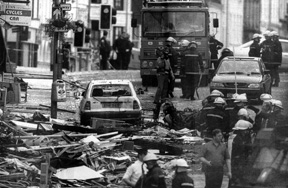
The appalling conclusion must be that the explosives are being hoarded against a purpose which can only be offensive: and this five years after the charnel-house of that August afternoon, when blackened children's bodies and dismembered limbs lay in the gutter; and when young policemen and women in their 20s pressed disposable nappies from a chemist's shop into the gaping entrails of the wounded.
The hoard remains an anti-democratic lever, outrageously effective in extracting concessions from both London and Dublin: so much so that the power-sharing deal struck over the Agreement is now so lop-sided in the republican interest that it teeters upon the brink of burial.
by Eric Waugh
FOR bombers and killers toting guns, life means 20 years or less; but for victims' families, it means life.
So it is with survivors of those who died at ten minutes past three in the afternoon in Omagh on August 15, 1998.
So it is with the blinded, who may hear the words of their dear ones, but may no longer see the warm response to their own smile.
So it is for those bereft of a limb; for others now imprisoned in a wheelchair; and for those with an empty place at the table, whose private agony it is to dwell inescapably upon what might have been.
Season by season the months lay bare the raw edges of grief. The dead still have birthdays. Summer revives memories of holidays in favourite places where anguish now bars the way.
Even the tinsel of Christmas seems to mock. Carols prick tears because she who was alongside in church, she who unfailingly served the feast on the day, or he who carved the meat, is no longer there.
At the time the Prime Minister broke off his French holiday to fly to Belfast. Prince Charles came to Omagh. Blair and Clinton followed. But it has been difficult for those bereft not to be bitter. One way has been to sublimate the hate by struggling to win a better deal. So the victims of Omagh 1998 have never been far from the headlines since.
So much so that the unfeeling, who long ago got on with their lives, wished Omagh would keep quiet. The alleged brigands who planned, and their alleged agents who did the deed, were given access to the taxes paid by the law-abiding - on both sides of the border � to subsidise their defence in court.
Meantime their victims skimped, scraped and begged to raise their own funds to fight back. But they, the law-abiding victims, got not one official penny.
They did not because, once more, the law was shown to be an ass and Government, disgracefully, was willing to take refuge behind its shabby shield: until this month, when Ministers have been shamed into quailing before the strident voice of the Daily Mail � which has championed the Omagh Fund from the moment it became clear Government intended to do nothing. The newspaper was convinced that where there was a will there was a way.
Though any politican seeking an excuse will find one, there comes a point when such excuse becomes self-defeating: and this was it. So now the taxpayer is to fund the balance of the costs of a civil action, directed against those who still are convinced they can wade through Irish blood to something they are deranged enough to believe would be a united Ireland.
One must join the surviving Omagh victims in their welcome of a belated gesture. Michael Gallagher, so often their spokesman, lost his 21-year-old only son; but there was also his brother, shot down in his car by the IRA outside the town in 1984. Hugh Gallagher had been a part-time soldier in the UDR but, after repeated death threats, had resigned three months before.
The republicans who blew up the Grand Hotel in Brighton in the same year, issued their ultimatum, advising the British to "Give Ireland peace and there will be no war".
The first lesson of Omagh is that this is not the road to peace. But the lesson is not learned so long as illegal arms are retained as the corrupt engines of a party's policy in government. The victims attached little importance to who actually assembled the deadly Semtex, fertiliser and fuel oil bomb in Omagh. What matters is that the bombers drew upon some of the same republican dumps of which, to this day, Sinn Fein/IRA declines to divest itself. Who worries what the precise label is? The medium is the message.
The appalling conclusion must be that the explosives are being hoarded against a purpose which can only be offensive: and this five years after the charnel-house of that August afternoon, when blackened children's bodies and dismembered limbs lay in the gutter; and when young policemen and women in their 20s pressed disposable nappies from a chemist's shop into the gaping entrails of the wounded.
The hoard remains an anti-democratic lever, outrageously effective in extracting concessions from both London and Dublin: so much so that the power-sharing deal struck over the Agreement is now so lop-sided in the republican interest that it teeters upon the brink of burial.
Further Information
Publisher: BELFAST TELEGRAPH
Ref: BT/0909
Published Date: 15-Aug-03
Related Images