TODAYS AMERICA IS ULSTER WRIT LARGE
Today's America is Ulster writ large
by Eric Waugh.
A year ago we found ourselves sharing the tears of those laboureres in the rich vineyards of Manhattan...their personal anguish recalled afresh this week, still moves us. But there will be a residual bitterness about the forgotten in the other places, cut down just as callously.
THE Twin Towers anniversary inspires mixed emotions in Northern Ireland. Renewed horror�yes, and in plenty.
But the extent of the global coverage a year later also inspires secret bitterness: so many victims here and in other places are, in the ordinary run of things, forgotten by comparison. That is the way of the 21st Century world. We live in the visual age. The Twin Towers was Hollywood hewn from fiction into fact. In heartless contrast, that which is not ripe and crackling enough to whet the jaded television appetite has a brief media life. Its victims will be advised that life must go on. But that is their precise difficulty Their grief is a life sentence with no release.
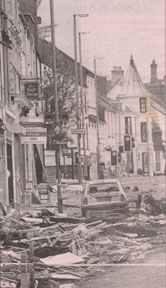
It is also a secret ache, intensely personal. It sears the soul in private. Its jagged blade tears at the innermost self, year after year until, in the passage of time, it is no longer acceptable to admit it. To the larger world a generation of trauma in Northern Ireland is reduced to Bloody Sunday (because the Army was involved); perhaps Enniskillen (because a Remembrance Day commemoration was desecrated) and Omagh (because it was both isolated and recent). For the audience out there, mostly, the other horrors never happened.
A year ago we found ourselves sharing the tears of those labourers in the rich vineyards of Manhattan, one of the hardest-nosed commercial communities on this earth. Their personal anguish, recalled afresh this week, still moves us. But there will be a residual bitterness about the forgotten in the other places, cut down just as callously. Perhaps � I cannot say � this bitterness translates in some cases into a kind of perverse jealousy of the lamentation over the Twin Towers. From this it would be but a short hop to the sort of virulent and unreasoning anti-Americanism which has shown itself, as Bush agonises over Iraq, and from which the local airwaves have not been immune.
To listen to some of it, one would think the US Marines were champing at the bit to get back into the Arabian desert (summer temperatures 120 degrees F, five or six days with rain a year), so that, grilling slowly in their sealed nerve-gas suits and respirators, they can bask in the northern breezes which blow the infernal sand into everything including the weapons upon which their lives depend.
I earnestly hope they do not lave to go back: nor our own brigades. But it may be necessary to go to the brink to uncover a saner alternative.
Bush's brinkmanship already shows signs of producing results. The UN inspectors must be re-admitted to question whom they choose. A regime with nothing sinister to hide will be anxious to prove it before the Western world, whose oil money in better times balanced the Baghdad budget. As for the President, his chosen policy is not the easy one. Declaring war is the most difficult decision he will ever make. He knows it could be politically suicidal.
Afghanistan has been a miserable exercise. But after the Twin Towers, the most plaintive cry was "Why?"
He knows that to virtually all his voters, Europe, let alone the Middle East, is a far off place of which they know little; yet if they were to start travelling to either from California or Oregon, they would be half way there before they left America.
Feeling insecure, they rush to drape their buildings, then-house fronts, even themselves, in the Stars and Stripes. Flag factories have put on night shifts. For flags advertise identity.
When people are alarmed about the future, they clump together and wrap something round them which expresses that identity Bush's critics here should appreciate that today's America is Ulster writ large.
by Eric Waugh.
A year ago we found ourselves sharing the tears of those laboureres in the rich vineyards of Manhattan...their personal anguish recalled afresh this week, still moves us. But there will be a residual bitterness about the forgotten in the other places, cut down just as callously.
THE Twin Towers anniversary inspires mixed emotions in Northern Ireland. Renewed horror�yes, and in plenty.
But the extent of the global coverage a year later also inspires secret bitterness: so many victims here and in other places are, in the ordinary run of things, forgotten by comparison. That is the way of the 21st Century world. We live in the visual age. The Twin Towers was Hollywood hewn from fiction into fact. In heartless contrast, that which is not ripe and crackling enough to whet the jaded television appetite has a brief media life. Its victims will be advised that life must go on. But that is their precise difficulty Their grief is a life sentence with no release.
It is also a secret ache, intensely personal. It sears the soul in private. Its jagged blade tears at the innermost self, year after year until, in the passage of time, it is no longer acceptable to admit it. To the larger world a generation of trauma in Northern Ireland is reduced to Bloody Sunday (because the Army was involved); perhaps Enniskillen (because a Remembrance Day commemoration was desecrated) and Omagh (because it was both isolated and recent). For the audience out there, mostly, the other horrors never happened.
A year ago we found ourselves sharing the tears of those labourers in the rich vineyards of Manhattan, one of the hardest-nosed commercial communities on this earth. Their personal anguish, recalled afresh this week, still moves us. But there will be a residual bitterness about the forgotten in the other places, cut down just as callously. Perhaps � I cannot say � this bitterness translates in some cases into a kind of perverse jealousy of the lamentation over the Twin Towers. From this it would be but a short hop to the sort of virulent and unreasoning anti-Americanism which has shown itself, as Bush agonises over Iraq, and from which the local airwaves have not been immune.
To listen to some of it, one would think the US Marines were champing at the bit to get back into the Arabian desert (summer temperatures 120 degrees F, five or six days with rain a year), so that, grilling slowly in their sealed nerve-gas suits and respirators, they can bask in the northern breezes which blow the infernal sand into everything including the weapons upon which their lives depend.
I earnestly hope they do not lave to go back: nor our own brigades. But it may be necessary to go to the brink to uncover a saner alternative.
Bush's brinkmanship already shows signs of producing results. The UN inspectors must be re-admitted to question whom they choose. A regime with nothing sinister to hide will be anxious to prove it before the Western world, whose oil money in better times balanced the Baghdad budget. As for the President, his chosen policy is not the easy one. Declaring war is the most difficult decision he will ever make. He knows it could be politically suicidal.
Afghanistan has been a miserable exercise. But after the Twin Towers, the most plaintive cry was "Why?"
He knows that to virtually all his voters, Europe, let alone the Middle East, is a far off place of which they know little; yet if they were to start travelling to either from California or Oregon, they would be half way there before they left America.
Feeling insecure, they rush to drape their buildings, then-house fronts, even themselves, in the Stars and Stripes. Flag factories have put on night shifts. For flags advertise identity.
When people are alarmed about the future, they clump together and wrap something round them which expresses that identity Bush's critics here should appreciate that today's America is Ulster writ large.
Further Information
Publisher: BELFAST TELEGRAPH
Ref: BT/0873
Published Date: 11-Sep-02
Related Images