A SECOND WORLD WAR AIR TRAGEDY ON THE LONELY BLUE STACK MOUNATINS... AND THE OMAGH BOMB CONNECTION
A Second World War Air Tragedy on the lonely Blue Stack Mountains... and the Omagh bomb connection
A remembrance story of two generations... Gail Walker reports
IT is an arduous three-hour trek over rough terrain to where the mangled wreckage of the Second World War aircraft lies buried deep in the heart of the Blue Stack Mountains in Co Donegal. You need to know exactly where you are going to locate the final resting place of Flight DW110.
A Belfast-built Sunderland, a flying boat carrying a crew of 12, it lost its way on a stormy night at the end of January, 1944, slamming into the side of one of the towering peaks. Seven of the men on board perished, and this should be a desolate, lonely, God-forsaken spot.
In fact, it is anything but. For there is an extraordinary link between the death of these young airmen and 21-year-old, Adrian Gallagher, who was murdered in the Omagh bomb more than half a century later.
And the remarkable, inspiring story of hope, humanity and quiet reflection that has unfolded in the shadow of these mountains over the years, is one that transcends nationality, religion and politics. Now UTV 's Paul Clark, who stumbled upon this deeply moving series of events, is using it as the basis of a special programme for Remembrance Sunday. The saga dates back to the early 80s when Garry Pentland, from Gortin, Co Tyrone, a man with a passion for locating world war crash sites, stumbled upon the story of Flight DW 110.
He was intrigued by the circumstances of the disaster - many of the details of which have only been made public relatively recently.
It was revealed that during the war the British and Irish Governments had held secret talks to establish a passage to allow Allied aircraft to fly over neutral Irish space. It enabled Sunderlands to take off and land on Lough Erne, at Castle Archdale RAF base, near Enniskillen, asing a route that crossed Ballyshan-non and Bundoran in the Republic, and on out over the Atlantic to do battle with the German U-boats.
Without such an agreement, the aircraft would have been forced to fly across Tyrone, Derry and then around Malin Head, which would have taken up much more time and fuel. The secret air path was used regularly, but remained treacherous. Crews relied on a crystal set, which could pick up a signal sent out from Lough Erne, to guide them in safely.
Tragically the ill-fated Sunderland that was lost on the night of January 31,1944, had been based in Wales and was not fitted with the vital crystal set. And when the aircraft went off course in atrocious weather conditions over the Blue Stack Mountains, it stood virtually no chance.
The five who survived the impact spent a desperate night huddled together on the dark mountainside.
In the morning, two of them, including Jim Gilchrist, the only survivor still alive today, were able to scramble down to a small house in the foot of the hills, the family home of the McDermotts. When they knocked on the door they were offered immediate assistance and comfort.
Garry Pentland was so touched by the untimely deaths of the airmen, and the heroism of those who nearly died but survived, that he set out for the site. He recalls: "I was determined to do something to honour those men."
He resolved to put up a plaque, bearing the names, rank and details of those who perished. He endeavoured to set out each Sunday, carrying a stonecutter to drill a place for his memorial in the rocks that surround the wreckage.
It was, however, tough work and progress was slow...until he confided in his good friend Michael Gallagher about the venture.
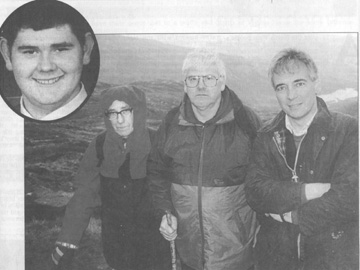
Without hesitation Michael immeimmediately volunteered to help out. Another willing recruit was Michael's young son, Adrian, then only 12, and passionate about aircraft. Week after week the little party, accompanied by a few other pals, including ex-Garda sergeant Liam Briody, would set out for the site. They took it in turns to carry the equipment and toil at the rock face. And in 1988 Jim Gilchrist was invited over to Donegal and the plaque was unveiled. It was a poignant moment - made all the more so today when viewed with hindsight.
Mercifully, though, back then none of the close knit group of friends could have been aware that just over 10 years later they would return to the same spot to unveil a plaque to Adrian, whose life was obliterated with 28 others, and unborn twins, in the Omagh atrocity.
Speaking about the making of the programme, Michael explains: "Adrian loved going up to the Blue Stack Mountains to the crash site. He had a deep love for aircraft and, because this site is so remote and there is still a lot of wreckage there, this really captured his imagination. It was a really worthwhile experience. Adrian revelled in the freedom up there, and I have such good memories of those days.
"Some time after the bomb Garry got in touch with me and said he wanted to put a plaque to Adrian up there too. I thought it was a marvellous idea." And in late 1998, Jim Gilchrist (79) once more made the journey from his home in England to Donegal, all the way up the mountainside to repay the tribute, by unveiling the plaque to Adrian.
Michael continues: "It was a lovely moment. Jim Gilchrist has tremendous humanity. I remember as we were coming down the mountain he started to recall the night of his crash and every time I hear that story I always cry...to think of those young men who died so suddenly, unaware of what had happened..."
The sentence hangs unfinished in the air. Unspoken but evident is the similarity with the death of Michael's boy, Adrian.
"Of course," resumes Michael, " it seems ironic to think of Adrian, helping with the plaque to the airmen, and then dying at about the same age."
UTV Live anchorman Paul Clark first learned about the tragic end of Flight DW110 when a Methodist minister friend, based at Dunkineely in Donegal, asked him if he would be the inspecting officer at the local Brigade display. The centrepiece of the boys' efforts was the retelling of the story of the crash. Captivated, Paul arranged to go on the next trip to the disaster site. Up on the mountain he saw a familiar face.
"I knew that I should know this man...and then it came to me. It was Michael Gallagher who had become so well known after Omagh, and so the
whole story began to unfold..." For Paul, the events resonate on two levels. "Firstly that here on Donegal, in neutral Eire, people did not stop to ask politics, religion, nationality when others were in need of help. They responded at once. "And, secondly,over 50 years later the unquestioning bond that was established back then, still exists today between all these people. Surely it tells us something
about what our priorities in life should be."
High in the Blue Stack Mountains the names of seven dead airmen are mounted on rock. Nearby is the memorial to Adrian. It features two photographs, one the familiar image of the genial-faced lad that was issued to the media in the days after his death, the other ofhim as a grinning 12-year-old boy, hard at work on the crashsite.
It is sombre place, but not necessarily sad. As Michael Gallagher adds: "I'm always glad to get up that mountain with my friends.
"Adrian was happy up there and I feel close to him again. I feel his presence and it is strangely comforting."
A remembrance story of two generations... Gail Walker reports
IT is an arduous three-hour trek over rough terrain to where the mangled wreckage of the Second World War aircraft lies buried deep in the heart of the Blue Stack Mountains in Co Donegal. You need to know exactly where you are going to locate the final resting place of Flight DW110.
A Belfast-built Sunderland, a flying boat carrying a crew of 12, it lost its way on a stormy night at the end of January, 1944, slamming into the side of one of the towering peaks. Seven of the men on board perished, and this should be a desolate, lonely, God-forsaken spot.
In fact, it is anything but. For there is an extraordinary link between the death of these young airmen and 21-year-old, Adrian Gallagher, who was murdered in the Omagh bomb more than half a century later.
And the remarkable, inspiring story of hope, humanity and quiet reflection that has unfolded in the shadow of these mountains over the years, is one that transcends nationality, religion and politics. Now UTV 's Paul Clark, who stumbled upon this deeply moving series of events, is using it as the basis of a special programme for Remembrance Sunday. The saga dates back to the early 80s when Garry Pentland, from Gortin, Co Tyrone, a man with a passion for locating world war crash sites, stumbled upon the story of Flight DW 110.
He was intrigued by the circumstances of the disaster - many of the details of which have only been made public relatively recently.
It was revealed that during the war the British and Irish Governments had held secret talks to establish a passage to allow Allied aircraft to fly over neutral Irish space. It enabled Sunderlands to take off and land on Lough Erne, at Castle Archdale RAF base, near Enniskillen, asing a route that crossed Ballyshan-non and Bundoran in the Republic, and on out over the Atlantic to do battle with the German U-boats.
Without such an agreement, the aircraft would have been forced to fly across Tyrone, Derry and then around Malin Head, which would have taken up much more time and fuel. The secret air path was used regularly, but remained treacherous. Crews relied on a crystal set, which could pick up a signal sent out from Lough Erne, to guide them in safely.
Tragically the ill-fated Sunderland that was lost on the night of January 31,1944, had been based in Wales and was not fitted with the vital crystal set. And when the aircraft went off course in atrocious weather conditions over the Blue Stack Mountains, it stood virtually no chance.
The five who survived the impact spent a desperate night huddled together on the dark mountainside.
In the morning, two of them, including Jim Gilchrist, the only survivor still alive today, were able to scramble down to a small house in the foot of the hills, the family home of the McDermotts. When they knocked on the door they were offered immediate assistance and comfort.
Garry Pentland was so touched by the untimely deaths of the airmen, and the heroism of those who nearly died but survived, that he set out for the site. He recalls: "I was determined to do something to honour those men."
He resolved to put up a plaque, bearing the names, rank and details of those who perished. He endeavoured to set out each Sunday, carrying a stonecutter to drill a place for his memorial in the rocks that surround the wreckage.
It was, however, tough work and progress was slow...until he confided in his good friend Michael Gallagher about the venture.
Without hesitation Michael immeimmediately volunteered to help out. Another willing recruit was Michael's young son, Adrian, then only 12, and passionate about aircraft. Week after week the little party, accompanied by a few other pals, including ex-Garda sergeant Liam Briody, would set out for the site. They took it in turns to carry the equipment and toil at the rock face. And in 1988 Jim Gilchrist was invited over to Donegal and the plaque was unveiled. It was a poignant moment - made all the more so today when viewed with hindsight.
Mercifully, though, back then none of the close knit group of friends could have been aware that just over 10 years later they would return to the same spot to unveil a plaque to Adrian, whose life was obliterated with 28 others, and unborn twins, in the Omagh atrocity.
Speaking about the making of the programme, Michael explains: "Adrian loved going up to the Blue Stack Mountains to the crash site. He had a deep love for aircraft and, because this site is so remote and there is still a lot of wreckage there, this really captured his imagination. It was a really worthwhile experience. Adrian revelled in the freedom up there, and I have such good memories of those days.
"Some time after the bomb Garry got in touch with me and said he wanted to put a plaque to Adrian up there too. I thought it was a marvellous idea." And in late 1998, Jim Gilchrist (79) once more made the journey from his home in England to Donegal, all the way up the mountainside to repay the tribute, by unveiling the plaque to Adrian.
Michael continues: "It was a lovely moment. Jim Gilchrist has tremendous humanity. I remember as we were coming down the mountain he started to recall the night of his crash and every time I hear that story I always cry...to think of those young men who died so suddenly, unaware of what had happened..."
The sentence hangs unfinished in the air. Unspoken but evident is the similarity with the death of Michael's boy, Adrian.
"Of course," resumes Michael, " it seems ironic to think of Adrian, helping with the plaque to the airmen, and then dying at about the same age."
UTV Live anchorman Paul Clark first learned about the tragic end of Flight DW110 when a Methodist minister friend, based at Dunkineely in Donegal, asked him if he would be the inspecting officer at the local Brigade display. The centrepiece of the boys' efforts was the retelling of the story of the crash. Captivated, Paul arranged to go on the next trip to the disaster site. Up on the mountain he saw a familiar face.
"I knew that I should know this man...and then it came to me. It was Michael Gallagher who had become so well known after Omagh, and so the
whole story began to unfold..." For Paul, the events resonate on two levels. "Firstly that here on Donegal, in neutral Eire, people did not stop to ask politics, religion, nationality when others were in need of help. They responded at once. "And, secondly,over 50 years later the unquestioning bond that was established back then, still exists today between all these people. Surely it tells us something
about what our priorities in life should be."
High in the Blue Stack Mountains the names of seven dead airmen are mounted on rock. Nearby is the memorial to Adrian. It features two photographs, one the familiar image of the genial-faced lad that was issued to the media in the days after his death, the other ofhim as a grinning 12-year-old boy, hard at work on the crashsite.
It is sombre place, but not necessarily sad. As Michael Gallagher adds: "I'm always glad to get up that mountain with my friends.
"Adrian was happy up there and I feel close to him again. I feel his presence and it is strangely comforting."
Further Information
Publisher: BELFAST TELEGRAPH
Ref: BT/0765
Published Date: 10-Nov-00
Related Images