OMAGH I WAS THERE
OMAGH I was there
TODAY we publish the first of several extracts from a powerful and disturbing new book about the violence in Northern Ireland over the past 30 years. In it, over 70 contributors from all walks of life speak at first hand about how they have been affected and scarred, either physically or mentally, by the Troubles. Entitled Bear In Mind: Stories Of The Troubles, the book takes its name from the poem Bear In Mind These Dead by the Belfast poet the late John Hewitt.
It has been compiled by the arts-based organisation An Crann The Tree, which was established in 1994 for the purpose of providing a platform and an archive for people's experiences of, and responses to, the violence.
Some of the accounts have been transcribed from taped interviews, others have been written, either in prose or poetry, by the contributors themselves. In his foreword to the collection, the Belfast actor and director James Ellis said that many of them had been manifestly damaged by their physical and mental involvement in the violence.
"It is to be hoped," he went on, "that the shared experience of producing such a work will prove a sound catharsis for the sweetening of bitterness and the softening of sorrow. "At all times, it should prove to be an essential source book for students of our tragic conflict. May the lessons to be learned save lives elsewhere. "Today's first extract from the book is an eye witness's horrific and all too graphically described account of the terrorist bomb explosion which killed 29 people in Omagh on the afternoon of Saturday, August 15,1998.
It is entitled The End Of My Immunity, and the author signs himself by his Christian name only- Stephen.
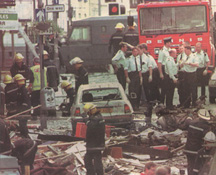
I was there. Right at the moment of ignition. Right at the moment when this man-made piece of hell engulfed its victims. But I was at a safe distance. I was a witness. I am a guilty survivor and this is my account for what it is worth.
I was leaving back a video to Xtravision. I usually park in an alley beside the store. For the first time in ages, I couldn't find a parking space. The carnival, I supposed. After two or three minutes of useless manoeuvring, I decided to just drive back to the top of the alley. I left the car running and dashed into the video store. After returning to the car, I quickly took my place in the traffic lane facing Market Street. I was about five or six cars back from the lights and as I went to adjust the car stereo there was a crack.
My eyes were drawn to a momentary yellow and white flash. Dark shades in the distance hurled from the flash like clay. Almost simultaneously, hundreds of slates were launched straight up in "the air like beads of sweat from a boxer's head.
There was so much happening all at once, but it seemed normal for a second, maybe something to do with the carnival I thought, incredibly.
Those few stunned seconds of silence were overtaken by awful screaming, wailing and shouting.
I looked up at the sun as it beat down unconcerned. Bombs don't go off on sunny days like this, I thought. Bombs! This is a bomb. A big bomb! Reality hit me. It was getting hard to breathe. I had nervous tickles in my stomach.
The strangest things go through my mind at moments of crisis. The image of slates kept flashing through my consciousness, and all I could think of was those little snowstorm paperweights, but the snow was black slate, smoke and dust.
Just after the bomb had exploded, its blast came down towards my line of cars like a wind from hell, shaking my car ever so gently but mowing down pedestrians on both pavements.
Glass, sucked from shop windows, shot back and forth across the street, its glint being caught in the burning sun like slivers of rain.
I felt like someone in a submarine, protected by my car's metal and glass. I was safe in the quiet environment of my car, protecting me like a womb but letting me witness the unfolding mayhem. I sat there, still stunned to a point, but now found myself getting out of the car.
As I opened the door, the volume of noise rocketed. My senses and sanity were swamped and overwhelmed now by women who seemed to be everywhere, bleeding and screaming, some moaning in strange chants as if transported back to infancy by shock and pain.
I could see the bombsite now, ahead in the near distance. The curtain of smoke almost lifted, revealing the stuff of nightmares. Debris, glass, rubble and bodies lay around.
I began to think maybe the few extra moments spent trying to park the car had prevented me from being at the head of the traffic lights, only yards from the bomb. I could see ahead of me the shrapnel-peppered car that was at the foot of the lights.
That could have been me, I thought. My heart seemed to be beating all over my body, my ears, in my chest, in my stomach. Hypnotised into a trance-like state by the pure horror, I started to walk towards the scene.
I tried to run, but I couldn't. People were still screaming around me, wide-eyed, most marked and bloodied to some degree. Some were crying and some couldn't manage it, their mouths just open. Then from the corner of my eye, I saw a man lying on the pavement, rolling about on his spine, his legs trying to reach the foetal position. He was losing blood from his arm and face. A few men stood around, bewildered, with him at their feet. All I could think of from a first aid course years ago, was to put him in the recovery position. I blurted out the suggestion.
The men seemed relieved to hear the idea. We put him on his side. Then my useful suggestions dried up. I tried hard to think. Out of nowhere, a man arrived, introduced himself as a nurse and took control.
His professionalism injected me with self-belief. He found the man's worst injury, which was his arm, and showed me how to cup his elbow with my hand while keeping the arm tight to the body to stem the blood flow all the while explaining his actions to his patient. Then he was gone, his expertise needed elsewhere. Things like this don't happen in Omagh. I cup the man's elbow. Blood oozes down through my fingers, palm and wrist. His blood is warm, but the sun is warmer, drying it into my hands like paint.
I concentrate on informing my patient that he isn't going to die. Again and again I tell him. He cannot tell me if he agrees, as he has not spoken since I have been with him. I don't know this man or his beliefs. All I know about him is his suffering. Everything else is so irrelevant now.
Cops without their caps and clad in black boilersuits arrive. Cars and vans are being commandeered hastily, their owners now ambulance drivers.
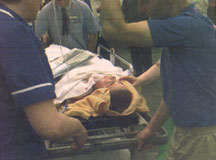
I shout to a passing cop that my man needs help. He scans his condition for a second and away he goes, arriving back in a van from a local business. The man is put into the van with efficiency, if not great ceremony. Soon it is full of the walking wounded and worse. The activity surrounding the van is in contrast with those lying within.
It struck me in my stomach... FIONA! My sister Fiona. She is usually in Omagh on a Saturday. My body weakened as I lurched towards a bomb-site and the bodies. I was almost running now towards what was left of Market Street.
Shops and buildings I knew well, almost unrecognisable now, indistinguishable from each other, no marks of identification remaining, just rubble in the foreground and sinister blackness behind what was left of the doorways and windows.
Then I saw the first pile of bodies. Nothing you have ever seen delivers the same feeling. I realised they were women, but I couldn't seem to see their faces or even their heads. Maybe I didn't let myself see. I don't know. I wanted to run far away, but knew there was no place far enough to hide from horror like this. It occurred to me that I would never forget these scenes or this horrible feeling.
I shook myself, but my head was spinning, my body limp. My mouth was dry. I pressed on up the street where 200 or so had stood, oblivious of the bomb parked among them. I now found myself looking for my sister. I was carrying out the worst task of my life, and I was not alone. Other faced people were doing the same. I kept going up the hill, making promises to God, bargaining for my sister. My eyes were lifted from the ground by the noise of feet tramping on the rubble and short, clipped instructions: 'Steady! Watch that stone. Come on, faster'.
I was finding it very hard to hold it together- occasionally whimpering like a tired child, fighting back a desire to scream and roar.
Another small group of corpses caught my eye. I turned to look, frightened to do so, my sister never far from the private nightmare of my mind while I carried out my inspections. The water which I could now see coming from what must have been the bomb crater, was trying to wash the corpses down the slight hill near the end of Market Street.
'Is there a God?' I questioned myself. 'Who lets this happen to the innocent?'
The dead seemed everywhere, in shops, on the street, good people lying destroyed before me, better people than me, I was sure.
I decided I could not go on trying to find my sister. Coming through the noise, I heard people shouting that the phone lines were down.
Something told me that the public phones at the bus depot would be working, even though all the phones here were out...
I headed down the street, hoping to hear that my sister was not in Omagh. It was my only consolation. Feeling useless among people who could not be helped, I went back down Market Street, trying to ignore things that you can't.
Police and firefighters were covering the dead at the bottom of the street with curtains, or whatever else was at hand. An Ulsterbus now parked in the junction box was filled with bloody survivors.
I was sprinting now past cars, abandoned, with doors lying open like the scene of a nuclear aftermath. I never thought it would come to my door. I thought I had immunity. Newsreel pictures of Bloody Sunday and Enniskillen and all the news reports I had witnessed as a child of the troubles came back to haunt me now. The enormity of it all was beginning to take hold. I was conscious of my hands again, sticky and almost dry. I could see people along the road, their eyes fixed on my bloodied forearms as I pulled at the air to go faster.
The depot came into view. The suspense was building now, choking me, putting pressure on my lungs. I could receive relief or the prospect of even more sickening suspense. I could feel myself getting older as I neared the phone boxes.
A small crowd had gathered around the phones. They all bombarded me with desperate questions: 'Is there people hurt over there? Is there anybody dead? Where was the bomb?'
It seemed as if, in return for my information, I could get using the phone. I blurted out my answers and I might as well have hit them.
There's at least ten or 15 dead. It went off near the bottom of Market Street'.
Some of the women crumpled like paper bags. Finally, I was in the phone box and, like the car, it cocooned me from the noise and the immediate reality. I slotted in the ten pence and punched in my parents' number, my hand shaking.
The phone rang one....two....three times. My mother picked up. For a moment I could not speak, 'Hello?' she said.
'Hello, Hello!' I blurted.
'Is that you, Stephen?'
'Aye. It's me. Jesus Christ, is Fiona there? There's been a massive bomb. Half of Omagh is gone. There's bodies everywhere; Jesus! Jesus! There must be 15 or 20.'
'Hold on Stephen. Now calm down. Talk slowly.'
'Is Fiona there?'
'No.' ' .
'WHAT?'
'But she's okay, she's with Brendan. It's okay. Oh. No. Wait a minute...... they're here.
She's just arrived outside the door in Brendan's car. They're both here. Wait here she is.'
'Hello? Stephen? I'm here. It's Fiona.'
Tears flowed. At last I could cry. And cry I did, like a baby. My mother told me that my father would call up to my flat and to meet him there. I told everybody I loved them before I hung up.
As I neared the site on the way back to the car, it drew me up towards its black heart once more, but the dead were covered now, giving them some dignity. As I walked once more over the debris and glass, I saw a man I recognised standing guard outside a shop, but he was not like a sentry on duty. He was dishevelled, his posture that of defeat, and his face racked in pain and disbelief.
His wife lay within - dead. A fireman was with him. I think he was trying to keep him out of the unsafe building for his own good. His own good! What would that poor man know about the word 'good' now?
I could see the courthouse and the remains of the car bomb in the near distance. I make my way home. I have not been hurt and I lost no one, yet
I cannot count my blessings. I am cold and empty inside."
Bear In Mind: Stories Of The Troubles, is published by Lagan Press at £7:95. Extracts selected and adapted by Neil Johnston.
Further Information
Related Images