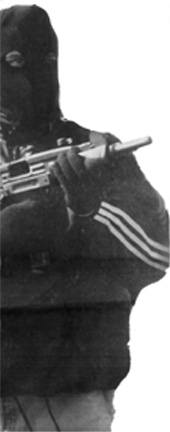
IN THE SHADOW OF THE GUNMAN
In the shadow of the gunman
Chief reporter Darwin Templeton examines the security situation in Northern Ireland in light of Sunday night's bomb in Fermanagh
LENGTHY game of cat and mouse ended when the bomb blasted Mahon's Hotel in Irvinestown on Sunday night. For months now, the RUC and Gardai have been tracking suspects linked to dissident republicans in a bid to prevent them staging the terrorist spectacular they so clearly craved.
Resources were available to concentrate on the dissident threat because, in spite of the turmoil in the peace process, there is no indication the IRA is about to return to war and they have said so quite clearly in recent statements.
Round-the-clock surveillance was posted on figures linked to the Real IRA and Continuity IRA and the intelligence-gathering agencies in both states targeted their structures as a priority.
On the back of the information gleaned, the police scored a remarkable degree of success in keeping the renegades in check.
The Real IRA's attempts to regroup after Omagh were seriously disrupted by a series of operations in the Republic. In October, Gardai seized Semtex and weapons in Wexford and Wicklow.
And later in the month, 10 people were arrested when Garda detectives raided a terrorist firing range near the Meath-Dublin border.
Security chiefs on both sides of the border were astounded - and alarmed - by the sophistication of some of the weapons they uncovered during the crackdown.
A couple of weeks ago fears grew that the dissidents had raided an IRA arms dump when two Semtex drogue bombs were found in Tipperary.
At the same time there were signs that dissidents were re-emerging from the isolation into which they had retreated after Omagh.
The 32 County Sovereignty Movement - whose political analysis is shared by the Real IRA - has been organising more openly and its newspaper, the Sovereign Nation, is on sale in Belfast.
At the end of last month, the Real IRA broke its silence to issue a thinly-veiled rallying cry to Republicans who harboured doubts about the philosophy of the current Sinn Fein leadership.
Its statement said: "We call on all volunteers loyal to the Irish Republic to unite to uphold the Republic and establish a permanent national parliament, representative of all the people."
And in a clear reference to the current Sinn Fein powerbrokers, the renegades added: "Your allegiance is to the Republic, not to an elite clique or a corrupt, treacherous administration.
"To those who have chosen to put self-interest above that of the Irish nation, we treat you with contempt."
Security sources suggested that the call to arms was directed as much to other dissidents as to members of the IRA.
Intelligence north and south of the border pointed to efforts to unite the various factions under the Real IRA umbrella. Both the INLA and the Continuity IRA were quick to deny that they had intentions of merging.
And security sources painted a more intricate picture of a shifting set of relationships between the dissidents in different areas.
One senior RUC. source said: "In one place a single group will have predominance, in another a couple of groups will have an informal alliance.
"We have no doubt that Real IRA elements played a part in car bombings claimed by the CIRA.
"And the Real IRA also lent support when Newtownhamilton was bombed - allegedly by the INLA."
Gardai estimate that the Real IRA is the largest of the dissident groupings with around 100 activists, based in Dublin, North Louth and Wexford, led by a former IRA quartermaster.
The faction is thought to have recently established a foothold north of the border, setting up units in Derry and Belfast.
The INLA is, of course, the best-established of the anti-Good Friday Agreement elements but since its ceasefire has become embroiled in feuding with crime bosses in the Republic.
The Continuity IRA has its powerbase along the border, particularly in Co Fermanagh.
It was in Enniskillen that the CIRA signalled its emergence, when it bombed the Killyhevlin Hotel in My 1996.
So it came as little surprise when another sleepy Lakeland village was selected as the target for its latest attack.
The bombing was obviously tuned to further destabilise the peace process, but it was also intended to pile on the the pressure on the Provisionals.
By carrying out the operation, the Continuity IRA demonstrated that it was still very much active and tried to show it offered a credible alternative for disenchanted Provisionals.
It is widely accepted that the fear of wholesale defections to the ranks of the dissidents has been a major factor in the IRA Army Council's reluctance to be drawn into decommissioning.
A security source said: "There is no doubt that they want to avoid the split in the movement that an arms handover would cause.
"The bombing will not provoke IRA volunteers to leave en masse, but it will cut even further the IRA's room for manoeuvre."
Developments within republican ranks will be watched closely by the loyalist groupings, but there is no immediate threat to the UFF or UVF ceasefires.
Deep suspicion of republican motives remains and was highlighted by the reaction of some UDA brigades - notably North Antrim - to John White's call for a UFF gesture on decommissioning. Ironically tensions between the various loyalist factions seem more dangerous.
The UVF's Brigade Staff believes it has "unfinished business" with the LVF over the murder of Richard Jameson in Portadown.
Security forces are on a high state of alert for reprisals and believe that UVF units have been heavily targetting figures linked to the LVF in preparation. Concern persists in security circles about the volatile state of the LVF and it's understood that a new leadership took control of the group last year. It is feared that the LVF might respond, even without claiming responsibility, to any dissident republican attack on the Protestant community.
Friction is also continuing between the UDA and the UVF in areas across the province and the RUC's crackdown of last year has all but destroyed the loyalist dissident groups. The Orange Volunteers suffered heavy losses of personnel and arms, while the Red Hand Defenders has all but vanished after the arrest of key members.
Chief reporter Darwin Templeton examines the security situation in Northern Ireland in light of Sunday night's bomb in Fermanagh
LENGTHY game of cat and mouse ended when the bomb blasted Mahon's Hotel in Irvinestown on Sunday night. For months now, the RUC and Gardai have been tracking suspects linked to dissident republicans in a bid to prevent them staging the terrorist spectacular they so clearly craved.
Resources were available to concentrate on the dissident threat because, in spite of the turmoil in the peace process, there is no indication the IRA is about to return to war and they have said so quite clearly in recent statements.
Round-the-clock surveillance was posted on figures linked to the Real IRA and Continuity IRA and the intelligence-gathering agencies in both states targeted their structures as a priority.
On the back of the information gleaned, the police scored a remarkable degree of success in keeping the renegades in check.
The Real IRA's attempts to regroup after Omagh were seriously disrupted by a series of operations in the Republic. In October, Gardai seized Semtex and weapons in Wexford and Wicklow.
And later in the month, 10 people were arrested when Garda detectives raided a terrorist firing range near the Meath-Dublin border.
Security chiefs on both sides of the border were astounded - and alarmed - by the sophistication of some of the weapons they uncovered during the crackdown.
A couple of weeks ago fears grew that the dissidents had raided an IRA arms dump when two Semtex drogue bombs were found in Tipperary.
At the same time there were signs that dissidents were re-emerging from the isolation into which they had retreated after Omagh.
The 32 County Sovereignty Movement - whose political analysis is shared by the Real IRA - has been organising more openly and its newspaper, the Sovereign Nation, is on sale in Belfast.
At the end of last month, the Real IRA broke its silence to issue a thinly-veiled rallying cry to Republicans who harboured doubts about the philosophy of the current Sinn Fein leadership.
Its statement said: "We call on all volunteers loyal to the Irish Republic to unite to uphold the Republic and establish a permanent national parliament, representative of all the people."
And in a clear reference to the current Sinn Fein powerbrokers, the renegades added: "Your allegiance is to the Republic, not to an elite clique or a corrupt, treacherous administration.
"To those who have chosen to put self-interest above that of the Irish nation, we treat you with contempt."
Security sources suggested that the call to arms was directed as much to other dissidents as to members of the IRA.
Intelligence north and south of the border pointed to efforts to unite the various factions under the Real IRA umbrella. Both the INLA and the Continuity IRA were quick to deny that they had intentions of merging.
And security sources painted a more intricate picture of a shifting set of relationships between the dissidents in different areas.
One senior RUC. source said: "In one place a single group will have predominance, in another a couple of groups will have an informal alliance.
"We have no doubt that Real IRA elements played a part in car bombings claimed by the CIRA.
"And the Real IRA also lent support when Newtownhamilton was bombed - allegedly by the INLA."
Gardai estimate that the Real IRA is the largest of the dissident groupings with around 100 activists, based in Dublin, North Louth and Wexford, led by a former IRA quartermaster.
The faction is thought to have recently established a foothold north of the border, setting up units in Derry and Belfast.
The INLA is, of course, the best-established of the anti-Good Friday Agreement elements but since its ceasefire has become embroiled in feuding with crime bosses in the Republic.
The Continuity IRA has its powerbase along the border, particularly in Co Fermanagh.
It was in Enniskillen that the CIRA signalled its emergence, when it bombed the Killyhevlin Hotel in My 1996.
So it came as little surprise when another sleepy Lakeland village was selected as the target for its latest attack.
The bombing was obviously tuned to further destabilise the peace process, but it was also intended to pile on the the pressure on the Provisionals.
By carrying out the operation, the Continuity IRA demonstrated that it was still very much active and tried to show it offered a credible alternative for disenchanted Provisionals.
It is widely accepted that the fear of wholesale defections to the ranks of the dissidents has been a major factor in the IRA Army Council's reluctance to be drawn into decommissioning.
A security source said: "There is no doubt that they want to avoid the split in the movement that an arms handover would cause.
"The bombing will not provoke IRA volunteers to leave en masse, but it will cut even further the IRA's room for manoeuvre."
Developments within republican ranks will be watched closely by the loyalist groupings, but there is no immediate threat to the UFF or UVF ceasefires.
Deep suspicion of republican motives remains and was highlighted by the reaction of some UDA brigades - notably North Antrim - to John White's call for a UFF gesture on decommissioning. Ironically tensions between the various loyalist factions seem more dangerous.
The UVF's Brigade Staff believes it has "unfinished business" with the LVF over the murder of Richard Jameson in Portadown.
Security forces are on a high state of alert for reprisals and believe that UVF units have been heavily targetting figures linked to the LVF in preparation. Concern persists in security circles about the volatile state of the LVF and it's understood that a new leadership took control of the group last year. It is feared that the LVF might respond, even without claiming responsibility, to any dissident republican attack on the Protestant community.
Friction is also continuing between the UDA and the UVF in areas across the province and the RUC's crackdown of last year has all but destroyed the loyalist dissident groups. The Orange Volunteers suffered heavy losses of personnel and arms, while the Red Hand Defenders has all but vanished after the arrest of key members.
Further Information
Publisher: BELFAST TELEGRAPH
Ref: BT/0731
Published Date: 08-Feb-00
Related Images