REAL TEST OF LEADERSHIP
The real test of leadership
By Desmond McCartan
SINCE time immemorial, power and sexual attraction have been inextricably linked.
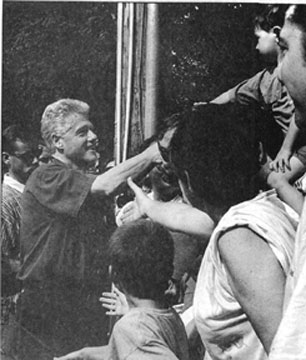
President Bill Clinton arrives for a second high-profile visit to Northern Ireland in seven days' time with his authority tarnished and his foolishness exposed by the Lewinsky affair.
By his own admission, Clinton finds himself judged not on the qualities or his office but on a salacious expectancy that more dirty linen is to be washed in public.
We are promised that the graphic nature of a report, to be delivered by US special prosecutor Kenneth Starr to Congress next month, will make the American people want "to throw up".
While Starr is determined to make a name for himself, a whole swathe of opinion appears to believe that his findings will be the coup-de-grace for a wounded President.
No doubt, across Northern Ireland this Sunday Clinton will be castigated from a pulpit or two for immoral conduct.
More than likely, his visit will be dogged by a wider media interest in ever more lurid details of unusual sexual proclivities at the White House.
Private acts between the West's most powerful figure and a consenting woman are surely an issue of personal judgement; but are they a basis for drumming him from office?
The more significant issue (as yet unproven) is whether the President has lied on oath or sought to thwart justice.
Tony Blair has stood by Clinton, praising him as a "good friend", especially in his support for the peace process.
But, within the past few days, there has been muted Labour criticism that this friendship is dangerously misplaced, given the nature of retaliatory US cruise missile strikes in Sudan.
With the attacks on US embassies in Africa fresh in the mind, both Clinton and Blair have common interest in tackling terrorism.
It would be easy to muddy the issue with humbug about Clinton's effrontery in trying now to convince people, north and south, of the power of right and good over evil.
But, by any moral judgement, the barbarism of Omagh must lie in a different league from his admitted misconduct.
Planners for his visit to the province, coming so soon after that terrible day, could never have envisaged such circumstances.
Yet, coinciding as it does with steps to underpin the choreography of London and Dublin in response to the threat of the Real IRA, it should be a clarion call for hundreds of thousands who are contemptuous of further violence.
Why, therefore, is there a sense of unease - not merely from Sinn Fein and the civil liberties lobby - about the legislation being spurred through Parliament in 48 hours next week?
From experience, legislation which has a touch of "knee-jerk" about it often bodes ill for the future.
By its very nature, the proposals - though rooted in democratic and parliamentary procedure - are a departure from the "normal" process of justice.
In reality, it underscores the point that Northern Ireland cannot yet be convinced that a permanent end of the curse of modern-day terrorism is in sight.
For all the rhetoric accompanying the "new" strategy to squeeze the hardliners, London and Dublin are pursuing a persuasive approach towards mainstream republicanism.
While the aim is to nurture Sinn Fein's progress on a peaceful path, the passage of the latest legislation will give police an extra weapon against those who refuse to join the process.
Clinton, Blair and Ahern realise that their actions and words over the coming weeks, however well-intentioned, must not end up being dismissed as empty gestures.
If Omagh, as Senator George Mitchell suggests, is a watershed in people's minds after three decades of violence, it is also a pivotal moment for political leadership.
By Desmond McCartan
SINCE time immemorial, power and sexual attraction have been inextricably linked.
President Bill Clinton arrives for a second high-profile visit to Northern Ireland in seven days' time with his authority tarnished and his foolishness exposed by the Lewinsky affair.
By his own admission, Clinton finds himself judged not on the qualities or his office but on a salacious expectancy that more dirty linen is to be washed in public.
We are promised that the graphic nature of a report, to be delivered by US special prosecutor Kenneth Starr to Congress next month, will make the American people want "to throw up".
While Starr is determined to make a name for himself, a whole swathe of opinion appears to believe that his findings will be the coup-de-grace for a wounded President.
No doubt, across Northern Ireland this Sunday Clinton will be castigated from a pulpit or two for immoral conduct.
More than likely, his visit will be dogged by a wider media interest in ever more lurid details of unusual sexual proclivities at the White House.
Private acts between the West's most powerful figure and a consenting woman are surely an issue of personal judgement; but are they a basis for drumming him from office?
The more significant issue (as yet unproven) is whether the President has lied on oath or sought to thwart justice.
Tony Blair has stood by Clinton, praising him as a "good friend", especially in his support for the peace process.
But, within the past few days, there has been muted Labour criticism that this friendship is dangerously misplaced, given the nature of retaliatory US cruise missile strikes in Sudan.
With the attacks on US embassies in Africa fresh in the mind, both Clinton and Blair have common interest in tackling terrorism.
It would be easy to muddy the issue with humbug about Clinton's effrontery in trying now to convince people, north and south, of the power of right and good over evil.
But, by any moral judgement, the barbarism of Omagh must lie in a different league from his admitted misconduct.
Planners for his visit to the province, coming so soon after that terrible day, could never have envisaged such circumstances.
Yet, coinciding as it does with steps to underpin the choreography of London and Dublin in response to the threat of the Real IRA, it should be a clarion call for hundreds of thousands who are contemptuous of further violence.
Why, therefore, is there a sense of unease - not merely from Sinn Fein and the civil liberties lobby - about the legislation being spurred through Parliament in 48 hours next week?
From experience, legislation which has a touch of "knee-jerk" about it often bodes ill for the future.
By its very nature, the proposals - though rooted in democratic and parliamentary procedure - are a departure from the "normal" process of justice.
In reality, it underscores the point that Northern Ireland cannot yet be convinced that a permanent end of the curse of modern-day terrorism is in sight.
For all the rhetoric accompanying the "new" strategy to squeeze the hardliners, London and Dublin are pursuing a persuasive approach towards mainstream republicanism.
While the aim is to nurture Sinn Fein's progress on a peaceful path, the passage of the latest legislation will give police an extra weapon against those who refuse to join the process.
Clinton, Blair and Ahern realise that their actions and words over the coming weeks, however well-intentioned, must not end up being dismissed as empty gestures.
If Omagh, as Senator George Mitchell suggests, is a watershed in people's minds after three decades of violence, it is also a pivotal moment for political leadership.
Further Information
Publisher: BELFAST TELEGRAPH
Ref: BT/0292
Published Date: 27-Aug-98
Related Images