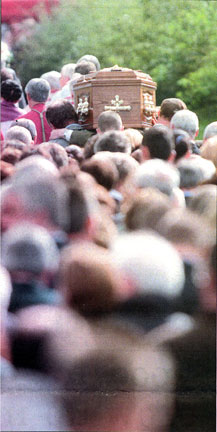
HARROWING SCENES ETCHED IN MIND
Harrowing scenes that are etched in the mind
The grief and pain from the Omagh bombing are still almost as tangible as they were a week ago. Reporter ENDA McCLAFFERTY gives his personal reflection on the tragedy, while JANET DEVLIN examines how people can cope with feelings of guilt and blame.
A NUMBER of weeks ago I left Omagh with a deep rooted sickness in my stomach.
I had just attended the funeral of the slain teenager Sylvia Fleming, and had shared in the grief of a previously untarnished town.
I remember thinking that such barbarity was still relatively rare in a country that was now on the road to peace.
How wrong I was.
Last week that same barbarity returned to haunt Omagh once more.
Only this time the scale and nature of the evil deed had plummeted to new depths - even by Northern Ireland's standards.
I set off for Omagh that Saturday evening to cover what I thought was just another bombing.
At worst. I expected to see the town centre reduced to rubble.
My plan was to collect a few eyewitness accounts, a word with a local businessman, and then back down the road as soon as possible.
Within minutes of arriving. I knew that this was something very different.
The talk was of fatalities and not injuries, and figures being reported were climbing by the hour.
As the full extent of the devastation began to filter through. I soon realised there was more to life than deadlines and bylines.
There I was searching for a story that exclusive interview, while all around me distraught relatives searched for information about their loved ones.
A whole cross-section of the community removed from this earth in one cruel swoop.
Ordinary men, women and children, cut down while going about their daily routine.
Listening to those grieving relatives recount the final movements of their loved ones brought tears to my eyes on more than one occasion.
Some stories more than others had a particular poignancy for me.
Like the young man who lost his fiancee Esther Gibson telling how they, like myself, were due to be married next year.
Or the story of Gareth Conway who, like my own brother, was waiting for his examination results.
The grief was like a tidal wave swamping Omagh within minutes and then speading right across the country.
Standing in the foyer of the Tyrone County Hospital. I remember watching one young Spanish girl wearing a blue gown wandering through the crowds.
She was without a bed and, in the chaos, was having to make do, temporarily, on her own.
Here was a child who, up until Saturday, was enjoying the hospitality and warmth this country is renowned for.
But then in five seconds of madness, her image of Ireland was tarnished forever - underscored by the fact that two of her young friends would be returning home in coffins.
Little did I know then that this atrocity had also stretched to my own birthplace - Donegal.
For so long, we in Donegal have watched the conflict from a safe distance.
We have condemned atrocity after atrocity without ever having experienced at first hand the human cost.
But the deaths of Oran Doherty (8), Sean McLaughlin and James Barker have changed all that.
The two days I spent with the families of three young Buncrana school pals will always live with me.
Listening to them recount the last days they shared with their children, and of the hopes and dreams they had for their bright young boys.
A catalogue of harrowing images and scenes have now become permanently etched in my memory.
Like the sight of James Barker laid out in his coffin wearing his Tazmanian Devil tie, and a silver plated yo-yo by his side.
The sight of the letter he wrote, telling how he planned to follow in the footsteps of the father he idolised by becoming a lawyer.
The sight of eight-year-old Oran Doherty in his Celtic jersey and scarf.
His distraught father by his side, rocking in a chair, immersed in his own grief.
At his feet two ashtrays, one filled with unsmoked cigarettes the other with butts.
The image of Sean McLaughlin's battered and bruised body beneath the picture of his proudest moment - the day he met the President, Mary McAleese.
And then the funerals and the massive outpouring of grief.
The haunting sound of women and children wailing uncontrollably as the bodies of Sean and Oran were brought together on the streets where they had so often played.
After the funerals I met a priest who, in just a few words, captured the mood of the past week.
He said: "We have had the elation of Good Friday, the devastation of Bloody Saturday, and all we look forward to now is the salvation of Resurrection Sunday."
The grief and pain from the Omagh bombing are still almost as tangible as they were a week ago. Reporter ENDA McCLAFFERTY gives his personal reflection on the tragedy, while JANET DEVLIN examines how people can cope with feelings of guilt and blame.
A NUMBER of weeks ago I left Omagh with a deep rooted sickness in my stomach.
I had just attended the funeral of the slain teenager Sylvia Fleming, and had shared in the grief of a previously untarnished town.
I remember thinking that such barbarity was still relatively rare in a country that was now on the road to peace.
How wrong I was.
Last week that same barbarity returned to haunt Omagh once more.
Only this time the scale and nature of the evil deed had plummeted to new depths - even by Northern Ireland's standards.
I set off for Omagh that Saturday evening to cover what I thought was just another bombing.
At worst. I expected to see the town centre reduced to rubble.
My plan was to collect a few eyewitness accounts, a word with a local businessman, and then back down the road as soon as possible.
Within minutes of arriving. I knew that this was something very different.
The talk was of fatalities and not injuries, and figures being reported were climbing by the hour.
As the full extent of the devastation began to filter through. I soon realised there was more to life than deadlines and bylines.
There I was searching for a story that exclusive interview, while all around me distraught relatives searched for information about their loved ones.
A whole cross-section of the community removed from this earth in one cruel swoop.
Ordinary men, women and children, cut down while going about their daily routine.
Listening to those grieving relatives recount the final movements of their loved ones brought tears to my eyes on more than one occasion.
Some stories more than others had a particular poignancy for me.
Like the young man who lost his fiancee Esther Gibson telling how they, like myself, were due to be married next year.
Or the story of Gareth Conway who, like my own brother, was waiting for his examination results.
The grief was like a tidal wave swamping Omagh within minutes and then speading right across the country.
Standing in the foyer of the Tyrone County Hospital. I remember watching one young Spanish girl wearing a blue gown wandering through the crowds.
She was without a bed and, in the chaos, was having to make do, temporarily, on her own.
Here was a child who, up until Saturday, was enjoying the hospitality and warmth this country is renowned for.
But then in five seconds of madness, her image of Ireland was tarnished forever - underscored by the fact that two of her young friends would be returning home in coffins.
Little did I know then that this atrocity had also stretched to my own birthplace - Donegal.
For so long, we in Donegal have watched the conflict from a safe distance.
We have condemned atrocity after atrocity without ever having experienced at first hand the human cost.
But the deaths of Oran Doherty (8), Sean McLaughlin and James Barker have changed all that.
The two days I spent with the families of three young Buncrana school pals will always live with me.
Listening to them recount the last days they shared with their children, and of the hopes and dreams they had for their bright young boys.
A catalogue of harrowing images and scenes have now become permanently etched in my memory.
Like the sight of James Barker laid out in his coffin wearing his Tazmanian Devil tie, and a silver plated yo-yo by his side.
The sight of the letter he wrote, telling how he planned to follow in the footsteps of the father he idolised by becoming a lawyer.
The sight of eight-year-old Oran Doherty in his Celtic jersey and scarf.
His distraught father by his side, rocking in a chair, immersed in his own grief.
At his feet two ashtrays, one filled with unsmoked cigarettes the other with butts.
The image of Sean McLaughlin's battered and bruised body beneath the picture of his proudest moment - the day he met the President, Mary McAleese.
And then the funerals and the massive outpouring of grief.
The haunting sound of women and children wailing uncontrollably as the bodies of Sean and Oran were brought together on the streets where they had so often played.
After the funerals I met a priest who, in just a few words, captured the mood of the past week.
He said: "We have had the elation of Good Friday, the devastation of Bloody Saturday, and all we look forward to now is the salvation of Resurrection Sunday."
Further Information
Publisher: BELFAST TELEGRAPH
Ref: BT/0262
Published Date: 25-Aug-98
Related Images