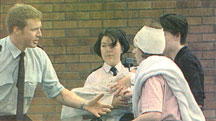
HOW EMRGENCY SERVICES DEALT WITH HORROR
How emergency services dealt with horror beyond the textbook
'It was so very distressing to see dead kids'
THEY have been trained to deal with any emergency.
But the words "any emergency" do not cover the carnage of Omagh on Saturday.
And those members of the emergency services who rushed immediately to the scene found themselves dealing with a horror beyond anything in the handbook.
But the professionalism and sheer heroism of police, ambulance workers, Army, medical volunteers who joined the rescue operation undoubtedly saved many lives.
The scenes they witnessed and the cries of the people they helped will live with many of them for years.
Even those who have previously been caught up in major atrocities had never experienced anything on this scale.
One aid worker described it as "Enniskillen times three".
For police officers stationed at the local base it was a particularly harrowing task. Many of them had friends or family among the victims. And some of them had faced the aftermath of bomb attacks in the past.
Among them is one young officer who was stationed in Lurgan when two police colleagues were gunned down in the town centre. More recently he was stationed in Moira during the recent bomb attack there.
But Saturday, he says was beyond any thing he had ever experienced in his life.
He was among those who arrived first on the scene and joined in the desperate fight to save lives.
He was among those who later searched nearby buildings for the bodies of the dead.
And. horrifically. he was among those involved in what is officialy termed "the clearance operation" - the removal of limbs in the aftermath of the explosion. This is his story: "When the bomb warning came in, I went up to the control room and while I was up there the bomb went off. I went out immediately with the duty inspector and another person.
"When we arrived at the scene about four or five minutes later . . . well, you saw what happened.
"There were easily about 800 people there. And pandemonium. Just pandemonium.
There were dead people living in the street.Smoke all over the place.People screaming. Other people just sitting dazed in the street. They didn't know what had happened to them.
"I have to say when I first got there I felt a bit like that myself. Dazed. This can't be happening.
"Immediately I saw that there were at least nine people dead in the area where the car had been. And then we started to realisethat
there were quite a few more, in total we thought, about a dozen or 15. That didn't include obviously the people who had been in the buildings and who hadn't been accounted for at that time.
"There were horrific injuries. I tended to a couple of people who had badly gashed abdomens. We were literally using Pampers from the chemist's shop to try and curtail the bleeding and, to be blunt, to try to keep them alive.
"I have first aid training. It was enough in the short term. But there was nothing you could do for some of the people.
"Most of those I saw who had lost limbs were taken away to hospital right away.
"The injured were being carried out on shop shelves, bits of boards, doors, anything that people could get. They were being taken away in cars, a bus. anything that was available. There were ambu lances, taxis, vans, any thing.
"The children were the worst. It's so distressing to see dead children lying there. Others were crying out, crying for their parents and obviously it's very distressing for other people to see that too, to hear children in that state.
"People are always protective of children so it's terrible to witness that sort of thing.
"How did I cope? I was numb. I was just numb. I just couldn't believe it was happening at all. You almost went on to automatic pilot. You didn't think about what you were doing. It was just an automatic reaction - to get people treated, to get them away and move on to the next person.
"When all the injured had been taken away and we started searching the building, that's probably when it started hitting me.
"I thought we're going in here to look for survivors. And I knew there weren't going to be any survivors. Anybody who had survived had been brought out of the shops by that time.
"It was dead people we were going in to look for. I started think ing to myself; "They're going to be dead.' I was thinking; 'This is just one horrendous nightmare.'
"It never actually got to the stage where I said to myself; 'I can't cope.' but all the time I just kept saying to myself that I didn't want to be there. I just wanted to be some place else.
"Professional is the right word to describe all those who took part in the operation. Nobody allowed themselves to become so emotional that they weren't capable of doing anything. They carried out their duties.
"The fire service, the ambulance service, the Army and the police they all acted in the proper manner. They did what had to be done.
"Ordinary members of the public were outstanding. It was a case of, it didn't matter who you were, you just got in there and helped. It was on such a scale that it was an immediate response. People didn't have to be asked to help. They just went to the first person they could reach and they did all they could.
"When it was over, I stayed at the scene for the clearance operation. We removed parts of people's bodies from the area, limbs . . .
"The body recovery teams take the bodies out of the various buildings and take them to the temporary mortuary.
"I have been in other incidents, yeah, several times. But you never get used to it. Never.
"What happened on Saturday will probably play on my mind in the same way as the other incidents I have been through in the service.
"It's something that you reflect on from time to time. We have a good counselling service that we can avail of if we feel the need to. And I probably will.
"I have a wee nephew, he is seven-months-old. I was with him yesterday, and I was thinking how I would feel if that sort of thing had happened to him.
"You can't ever say how you react until it happens with someone close to you. You can sympathise with people, surely, but unless it affects you directly you just cannot understand what people have gone through. What they're going through.
"It help to be working. You're better keeping busy than sitting about dwelling on things.
"Even if I had been on days off over the weekend I would have come in anyway. An atrocity on this scale affects you so much. It would tear your heart out. You want to be in there doing something.
"Some of my colleagues in Omagh have lost relatives. The whole station's in a state of shock. There's a terrible atmosphere in the place."
'It was so very distressing to see dead kids'
THEY have been trained to deal with any emergency.
But the words "any emergency" do not cover the carnage of Omagh on Saturday.
And those members of the emergency services who rushed immediately to the scene found themselves dealing with a horror beyond anything in the handbook.
But the professionalism and sheer heroism of police, ambulance workers, Army, medical volunteers who joined the rescue operation undoubtedly saved many lives.
The scenes they witnessed and the cries of the people they helped will live with many of them for years.
Even those who have previously been caught up in major atrocities had never experienced anything on this scale.
One aid worker described it as "Enniskillen times three".
For police officers stationed at the local base it was a particularly harrowing task. Many of them had friends or family among the victims. And some of them had faced the aftermath of bomb attacks in the past.
Among them is one young officer who was stationed in Lurgan when two police colleagues were gunned down in the town centre. More recently he was stationed in Moira during the recent bomb attack there.
But Saturday, he says was beyond any thing he had ever experienced in his life.
He was among those who arrived first on the scene and joined in the desperate fight to save lives.
He was among those who later searched nearby buildings for the bodies of the dead.
And. horrifically. he was among those involved in what is officialy termed "the clearance operation" - the removal of limbs in the aftermath of the explosion. This is his story: "When the bomb warning came in, I went up to the control room and while I was up there the bomb went off. I went out immediately with the duty inspector and another person.
"When we arrived at the scene about four or five minutes later . . . well, you saw what happened.
"There were easily about 800 people there. And pandemonium. Just pandemonium.
There were dead people living in the street.Smoke all over the place.People screaming. Other people just sitting dazed in the street. They didn't know what had happened to them.
"I have to say when I first got there I felt a bit like that myself. Dazed. This can't be happening.
"Immediately I saw that there were at least nine people dead in the area where the car had been. And then we started to realisethat
there were quite a few more, in total we thought, about a dozen or 15. That didn't include obviously the people who had been in the buildings and who hadn't been accounted for at that time.
"There were horrific injuries. I tended to a couple of people who had badly gashed abdomens. We were literally using Pampers from the chemist's shop to try and curtail the bleeding and, to be blunt, to try to keep them alive.
"I have first aid training. It was enough in the short term. But there was nothing you could do for some of the people.
"Most of those I saw who had lost limbs were taken away to hospital right away.
"The injured were being carried out on shop shelves, bits of boards, doors, anything that people could get. They were being taken away in cars, a bus. anything that was available. There were ambu lances, taxis, vans, any thing.
"The children were the worst. It's so distressing to see dead children lying there. Others were crying out, crying for their parents and obviously it's very distressing for other people to see that too, to hear children in that state.
"People are always protective of children so it's terrible to witness that sort of thing.
"How did I cope? I was numb. I was just numb. I just couldn't believe it was happening at all. You almost went on to automatic pilot. You didn't think about what you were doing. It was just an automatic reaction - to get people treated, to get them away and move on to the next person.
"When all the injured had been taken away and we started searching the building, that's probably when it started hitting me.
"I thought we're going in here to look for survivors. And I knew there weren't going to be any survivors. Anybody who had survived had been brought out of the shops by that time.
"It was dead people we were going in to look for. I started think ing to myself; "They're going to be dead.' I was thinking; 'This is just one horrendous nightmare.'
"It never actually got to the stage where I said to myself; 'I can't cope.' but all the time I just kept saying to myself that I didn't want to be there. I just wanted to be some place else.
"Professional is the right word to describe all those who took part in the operation. Nobody allowed themselves to become so emotional that they weren't capable of doing anything. They carried out their duties.
"The fire service, the ambulance service, the Army and the police they all acted in the proper manner. They did what had to be done.
"Ordinary members of the public were outstanding. It was a case of, it didn't matter who you were, you just got in there and helped. It was on such a scale that it was an immediate response. People didn't have to be asked to help. They just went to the first person they could reach and they did all they could.
"When it was over, I stayed at the scene for the clearance operation. We removed parts of people's bodies from the area, limbs . . .
"The body recovery teams take the bodies out of the various buildings and take them to the temporary mortuary.
"I have been in other incidents, yeah, several times. But you never get used to it. Never.
"What happened on Saturday will probably play on my mind in the same way as the other incidents I have been through in the service.
"It's something that you reflect on from time to time. We have a good counselling service that we can avail of if we feel the need to. And I probably will.
"I have a wee nephew, he is seven-months-old. I was with him yesterday, and I was thinking how I would feel if that sort of thing had happened to him.
"You can't ever say how you react until it happens with someone close to you. You can sympathise with people, surely, but unless it affects you directly you just cannot understand what people have gone through. What they're going through.
"It help to be working. You're better keeping busy than sitting about dwelling on things.
"Even if I had been on days off over the weekend I would have come in anyway. An atrocity on this scale affects you so much. It would tear your heart out. You want to be in there doing something.
"Some of my colleagues in Omagh have lost relatives. The whole station's in a state of shock. There's a terrible atmosphere in the place."
Further Information
Publisher: BELFAST TELEGRAPH
Ref: BT/0123
Published Date: 20-Aug-98
Related Images