TOWN'S NAME JOINS ROLL CALL OF INFAMY
Town's name joins the roll call of infamy
Another town is made famous across the world for all the wrong reasons.
LINDY McDOWELL reports on how the name of Omagh has been sadly thrust into the limelight
Enniskillen. Loughinisland, Shankill, Greysteel, Teebane. . .
They are not just place names anymore, names that evoke images of a country town here, a busy city street there, a quiet little townland.
For they have become bywords for horror and carnage and human suffering on a scale most of us can only attempt to imagine.
On Saturday afternoon at around 3.15, another name was added to that roll call of atrocity.
"Some breaking news," said the presenter on Sky News, "Reports are coming in of an explosion at Omagh in Co Tyrone."
She pronounced the name in the way that English newsreaders have always done - OMAA."
And then throughout the afternoon, as the story, and the horror grew, the screen became filled with the voices of the people of the town.
A pub landlord trying to convey the sheer scaleof the carnage, hospital workers providing information on where the dead and injured had been taken, local politicians trying to sum up the feelings of a community torn apart, reporters attempting to relay the facts.
There were no words.
One eye witness used an old country expression of searing understatement to measure the despair and the sorrow.
"It's a bad handlin', now," he said softly.
A younger man who had witnessed the immediate aftermath came close to describing what he had seen but veered off as emotion engulfed him.
"Just horror," was all he could manage, "Just horror."
Even John Hume, that master of language, fell back again and again on "appalling" to describe the killings, the killers, the effect on the community.
And as journalists, hardened by years of reporting the troubles, struggled to hold back tears, all the old phrases of shock and condemnation that all of us have used so many times, suddenly seemed inadequate.
For there are no words.
No words to sum up the enormity of the horror visited upon the town of Omagh and its people. Upon us all.
This week Omagh awoke to its bleakest dawns, to learn not just the statistics of the carnage but the names of those of their families, friends and neighbours who have been killed or so grieviously injured.
"You do what you can," said a priest who maintained a constant vigil at the incident centre where people were still coming this morning for news of the dead and injured, "You just talk to them."
"It's not about counselling at this stage." says a social worker. "You just offer support."
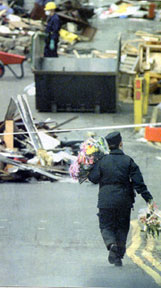
On the bridge close to the streets where the bomb exploded, flowers have been laid in tribute.
As people come and go and gather in small groups, you catch snatches of their conversation and their loss.
"It's his brother that's dead. A good man he was too . . . '
"They say her neck's badly injured . . "
The world's media file reports in a dozen languages before cameras, into mobile phones.
A radio reporter thrusts a microphone towards a mother with a young child carrying her posy of flowers to the bridge.
He asks her what she's feeling. She has only one word. "Shock."
That sense of shock, that sense of pain is still everywhere in Northern Ireland today.
No words can convey the depth of loss and bewilderment.
But you hear echoes of it in the faltering voice of the big, burly policeman who has to stop mid sentence to compose himself. In the soft murmur of a clergyman, praying with a local woman in the Incident Centre hastily organised in the town's leisure centre.
And most hauntingly of all, in the cries of a young girl captured on video as she runs from the scene with blood spilling down her face. "Where's Mammy? Where's Mammy?"
So much will be written and spoken of what happened in this quiet country town in the days, the months, the years ahead.
But again and again it will come back to the word that on Saturday acquired a new meaning. That, now and forever, will be synonymous with atrocity and terror, with suffering and an evil deed beyond all our comprehension.
OMAGH
Another town is made famous across the world for all the wrong reasons.
LINDY McDOWELL reports on how the name of Omagh has been sadly thrust into the limelight
Enniskillen. Loughinisland, Shankill, Greysteel, Teebane. . .
They are not just place names anymore, names that evoke images of a country town here, a busy city street there, a quiet little townland.
For they have become bywords for horror and carnage and human suffering on a scale most of us can only attempt to imagine.
On Saturday afternoon at around 3.15, another name was added to that roll call of atrocity.
"Some breaking news," said the presenter on Sky News, "Reports are coming in of an explosion at Omagh in Co Tyrone."
She pronounced the name in the way that English newsreaders have always done - OMAA."
And then throughout the afternoon, as the story, and the horror grew, the screen became filled with the voices of the people of the town.
A pub landlord trying to convey the sheer scaleof the carnage, hospital workers providing information on where the dead and injured had been taken, local politicians trying to sum up the feelings of a community torn apart, reporters attempting to relay the facts.
There were no words.
One eye witness used an old country expression of searing understatement to measure the despair and the sorrow.
"It's a bad handlin', now," he said softly.
A younger man who had witnessed the immediate aftermath came close to describing what he had seen but veered off as emotion engulfed him.
"Just horror," was all he could manage, "Just horror."
Even John Hume, that master of language, fell back again and again on "appalling" to describe the killings, the killers, the effect on the community.
And as journalists, hardened by years of reporting the troubles, struggled to hold back tears, all the old phrases of shock and condemnation that all of us have used so many times, suddenly seemed inadequate.
For there are no words.
No words to sum up the enormity of the horror visited upon the town of Omagh and its people. Upon us all.
This week Omagh awoke to its bleakest dawns, to learn not just the statistics of the carnage but the names of those of their families, friends and neighbours who have been killed or so grieviously injured.
"You do what you can," said a priest who maintained a constant vigil at the incident centre where people were still coming this morning for news of the dead and injured, "You just talk to them."
"It's not about counselling at this stage." says a social worker. "You just offer support."
On the bridge close to the streets where the bomb exploded, flowers have been laid in tribute.
As people come and go and gather in small groups, you catch snatches of their conversation and their loss.
"It's his brother that's dead. A good man he was too . . . '
"They say her neck's badly injured . . "
The world's media file reports in a dozen languages before cameras, into mobile phones.
A radio reporter thrusts a microphone towards a mother with a young child carrying her posy of flowers to the bridge.
He asks her what she's feeling. She has only one word. "Shock."
That sense of shock, that sense of pain is still everywhere in Northern Ireland today.
No words can convey the depth of loss and bewilderment.
But you hear echoes of it in the faltering voice of the big, burly policeman who has to stop mid sentence to compose himself. In the soft murmur of a clergyman, praying with a local woman in the Incident Centre hastily organised in the town's leisure centre.
And most hauntingly of all, in the cries of a young girl captured on video as she runs from the scene with blood spilling down her face. "Where's Mammy? Where's Mammy?"
So much will be written and spoken of what happened in this quiet country town in the days, the months, the years ahead.
But again and again it will come back to the word that on Saturday acquired a new meaning. That, now and forever, will be synonymous with atrocity and terror, with suffering and an evil deed beyond all our comprehension.
OMAGH
Further Information
Publisher: BELFAST TELEGRAPH
Ref: BT/0064
Published Date: 18-Aug-98
Related Images