THE DAY WE'LL NEVER FORGET
THE DAY WE'LL NEVER FORGET
GAIL WALKER charts the horror filled hours immediately following the bomb attack as the full scale of the tragedy became apparent to the
unsuspecting people of Omagh
MY next-door neighbour is dead. She worked in a store not far from the one I work in. And now she's dead. Gone. And she was the very best of a woman. I knew her all my life.
The shop assistant.
My wife and son are badly hurt. She has multiple fractures but he's lost a leg. He loved rugby, too. I'm 57. He's only 12. Why couldn't it have been me ?
The father.
My wife and her sister are injured. They'd just gone in for a look round town. The wife's in intensive care but they say I can see her soon. At least she's alive, isn't she?
The husband.
My best pal. We were working in the shop together when it went off. She went out and sat with a young girl whose stomach had been blown open. I couldn't have done it. Isn't that awful? Imagine, I couldn't face it.
The friend.
My work tonight? One child, about ten or 11, we amputated a foot. I can't remember whether it was a girl or a boy. There's been so many.
The doctor.
My worst moment? That would be the time with the grandparents. Their grand-daughter, wee lassie, 18 months, dead. The mother's bad as well. Been moved to Belfast, I think. Och, there's no words at all.
The priest.
My friend, a lovely woman. She's lost an arm and a leg. An arm and a leg. How will she face that? Tell me ? Omagh's my town. We've good relationships here. We may just share the grief together.
The local MP, Willie Thompson.
This was the searingly painful legacy of the evil that men - and women - do with a massive bomb in a bustling west Tyrone market town with a community festival, with back-to-school shopping, with a rare burst of Saturday afternoon sunshine to bring them out on to the streets.
It is the appalling innocence of these victims that is so galling. Men, women, teenagers, children, babies. They wanted to shepherd them out of harm's way. They had, through no fault of their own, swept them towards the blast.
Hours after the slaughter, the screams and cries of the dying and me horrifically injured that had rent the air had been replaced in the hospital corridors, in the hastily set-up information room at the leisure centre, in the near-empty streets with a terrible silence of muted despair, grief, and above all, bewilderment. Why?
Down at the ticker tape, where an almost unbelievably unscathed youngster's pushchair would have cut the eyes from you, a cluster of workers could make no sense of it at all.
"Aye, we got the warning but of course everyone thought it was at the other end of the street. They started bringing them down this direction and we stayed in our shop. We thought it was far enough away. And it's a long shop, too, so we thought we'd be okay at the back of it," said one.
"But then the bang and then the cries of the people. Wee'uns."
Her voice faltered and another continued: "What we saw. Blood, limbs, bodies. They put some in a bus to get them to hospital. But there was so many. What I saw today beggared belief."
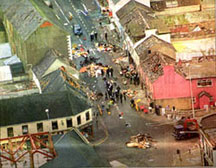
Looking through skiffs of rain to the debris, all you could see were the bloodied rags, the twisted metal, rubble and glass; signposts to take you on a journey into the "freedom" fighters' heart of darkness.
The road to Omagh on Saturday night was strewn with indications of the horror that had gone before.
Every now and again the clatter of a helicopter overhead, another airlift to another hospital, another fight for life.
Occasionally an ambulance, its blue lights flashing, swallowing up the miles.
I wasn't sure how to reach the hospital but there was no need to stop and ask directions. Once you rounded a comer, the lines of cars hit you.
They had been abandoned everywhere. At the roadside, on grass verges. Relatives and friends and hospital workers on a desperate mission. Someone had left their lights on and a passer-by paused and tried to open the door and switch them off.
"Well, maybe their child's dying. They don't need to come back to a car that won't start."
And everywhere, up the blood-smeared steps into accident and emergency, were many more small, inexplicable acts of kindness.
One woman, a retired nurse, had been visiting her mother in the geriatric ward when word of the atrocity reached the hospital.
"Myself and another woman immediately took over looking after the old people to let the nurses go to help," she explained. "I went out and looked at what was going on."
"It was a dreadful scene. They lined them up down either side of that corridor. The place was awash with blood. And the screaming and the moaning.
I saw one young man rushing past me. A strapping big fella. He was in an awful state. I just hope he made it but I don't know: he was bad.
I worked here at the time of the young soldiers at Ballygawley and that was bad. But what I saw here today was worse, much worse.
There were just so many. Electricians and plumbers working in the hospital used upturned doors to help ferry people. Oh, it was a dreadful scene."
A homely woman, she was packing up to go at 10pm.
"I'll be back tomorrow to help again. Sure we must all do what we can now. What else is it all about, if we couldn't help?"
Everywhere, anxiety lined the faces of those family and friends who could only stand and wait.
All night, they kept arriving, looking down lists of names for loved ones.
Yards away Father John Gilmore, of the town's Sacred Heart Church, stood on late into the night. He'd been there since 3pm and had lost count of the numbers of patients he had anointed.
"Well, I could go home now but I'll stay a while long. At home, you sit and think. Here, well if anyone wants a priest, I'm here."
Like so many others, when he is finally alone, the curate will surely be haunted by this day for a long time to come.
"When I arrived, the bodies everywhere on mattresses on the floor. They literally had to walk down them and take the worst first. The staff here were incredible.
"You know. This bomb will speak for itself. When people see this round the world. I mean, if we could all get into the mind of a terrorist."
Outside on the steps Bishop Francis Lagan, Auxiliary Bishop of Derry, just back from touring the wards, struggled to find any words. Three times he began to speak to me; three times he paused and asked for a moment to reflect on what he should say.
"Ask me a question," he said, finally. "Maybe that would be the best way into it."
"The sense of outrage that this could be done, that this horror could be wreaked on such innocent people. The sense of disbelief. That a number of people could be so evil as to kill and maim."
Yards away sat three ambulancemen, stunned and exhausted, dragging heavily on their cigarettes, the lighted butts moving back and forward steadily in the gloom, as they talked it out amongst themselves.
Another man shook his head and said quietly, to no one in particular: "Well, I suppose we should be thankful we're still in the land of the living."
Just a few yards beyond that, MP Willie Thompson spoke of his anger and sadness to a phalanx of reporters. When one asked him about politics, he replied: "It's not really the time for that now, is it?"
Afterwards we chatted in the still, evening air. A big country man in his tidy dark suit, he talked about his friend, so badly hurt, and how doubtless time would reveal other friends among the dead and injured.
"I remember Enniskillen. This is worse, worse. I never thought this would happen here. I really hope these perpetrators will be caught."
And he turned his face into the darkness, unfolded his neat cloth handkerchief and self- consciously wiped away the tears running down his face.
GAIL WALKER charts the horror filled hours immediately following the bomb attack as the full scale of the tragedy became apparent to the
unsuspecting people of Omagh
MY next-door neighbour is dead. She worked in a store not far from the one I work in. And now she's dead. Gone. And she was the very best of a woman. I knew her all my life.
The shop assistant.
My wife and son are badly hurt. She has multiple fractures but he's lost a leg. He loved rugby, too. I'm 57. He's only 12. Why couldn't it have been me ?
The father.
My wife and her sister are injured. They'd just gone in for a look round town. The wife's in intensive care but they say I can see her soon. At least she's alive, isn't she?
The husband.
My best pal. We were working in the shop together when it went off. She went out and sat with a young girl whose stomach had been blown open. I couldn't have done it. Isn't that awful? Imagine, I couldn't face it.
The friend.
My work tonight? One child, about ten or 11, we amputated a foot. I can't remember whether it was a girl or a boy. There's been so many.
The doctor.
My worst moment? That would be the time with the grandparents. Their grand-daughter, wee lassie, 18 months, dead. The mother's bad as well. Been moved to Belfast, I think. Och, there's no words at all.
The priest.
My friend, a lovely woman. She's lost an arm and a leg. An arm and a leg. How will she face that? Tell me ? Omagh's my town. We've good relationships here. We may just share the grief together.
The local MP, Willie Thompson.
This was the searingly painful legacy of the evil that men - and women - do with a massive bomb in a bustling west Tyrone market town with a community festival, with back-to-school shopping, with a rare burst of Saturday afternoon sunshine to bring them out on to the streets.
It is the appalling innocence of these victims that is so galling. Men, women, teenagers, children, babies. They wanted to shepherd them out of harm's way. They had, through no fault of their own, swept them towards the blast.
Hours after the slaughter, the screams and cries of the dying and me horrifically injured that had rent the air had been replaced in the hospital corridors, in the hastily set-up information room at the leisure centre, in the near-empty streets with a terrible silence of muted despair, grief, and above all, bewilderment. Why?
Down at the ticker tape, where an almost unbelievably unscathed youngster's pushchair would have cut the eyes from you, a cluster of workers could make no sense of it at all.
"Aye, we got the warning but of course everyone thought it was at the other end of the street. They started bringing them down this direction and we stayed in our shop. We thought it was far enough away. And it's a long shop, too, so we thought we'd be okay at the back of it," said one.
"But then the bang and then the cries of the people. Wee'uns."
Her voice faltered and another continued: "What we saw. Blood, limbs, bodies. They put some in a bus to get them to hospital. But there was so many. What I saw today beggared belief."
Looking through skiffs of rain to the debris, all you could see were the bloodied rags, the twisted metal, rubble and glass; signposts to take you on a journey into the "freedom" fighters' heart of darkness.
The road to Omagh on Saturday night was strewn with indications of the horror that had gone before.
Every now and again the clatter of a helicopter overhead, another airlift to another hospital, another fight for life.
Occasionally an ambulance, its blue lights flashing, swallowing up the miles.
I wasn't sure how to reach the hospital but there was no need to stop and ask directions. Once you rounded a comer, the lines of cars hit you.
They had been abandoned everywhere. At the roadside, on grass verges. Relatives and friends and hospital workers on a desperate mission. Someone had left their lights on and a passer-by paused and tried to open the door and switch them off.
"Well, maybe their child's dying. They don't need to come back to a car that won't start."
And everywhere, up the blood-smeared steps into accident and emergency, were many more small, inexplicable acts of kindness.
One woman, a retired nurse, had been visiting her mother in the geriatric ward when word of the atrocity reached the hospital.
"Myself and another woman immediately took over looking after the old people to let the nurses go to help," she explained. "I went out and looked at what was going on."
"It was a dreadful scene. They lined them up down either side of that corridor. The place was awash with blood. And the screaming and the moaning.
I saw one young man rushing past me. A strapping big fella. He was in an awful state. I just hope he made it but I don't know: he was bad.
I worked here at the time of the young soldiers at Ballygawley and that was bad. But what I saw here today was worse, much worse.
There were just so many. Electricians and plumbers working in the hospital used upturned doors to help ferry people. Oh, it was a dreadful scene."
A homely woman, she was packing up to go at 10pm.
"I'll be back tomorrow to help again. Sure we must all do what we can now. What else is it all about, if we couldn't help?"
Everywhere, anxiety lined the faces of those family and friends who could only stand and wait.
All night, they kept arriving, looking down lists of names for loved ones.
Yards away Father John Gilmore, of the town's Sacred Heart Church, stood on late into the night. He'd been there since 3pm and had lost count of the numbers of patients he had anointed.
"Well, I could go home now but I'll stay a while long. At home, you sit and think. Here, well if anyone wants a priest, I'm here."
Like so many others, when he is finally alone, the curate will surely be haunted by this day for a long time to come.
"When I arrived, the bodies everywhere on mattresses on the floor. They literally had to walk down them and take the worst first. The staff here were incredible.
"You know. This bomb will speak for itself. When people see this round the world. I mean, if we could all get into the mind of a terrorist."
Outside on the steps Bishop Francis Lagan, Auxiliary Bishop of Derry, just back from touring the wards, struggled to find any words. Three times he began to speak to me; three times he paused and asked for a moment to reflect on what he should say.
"Ask me a question," he said, finally. "Maybe that would be the best way into it."
"The sense of outrage that this could be done, that this horror could be wreaked on such innocent people. The sense of disbelief. That a number of people could be so evil as to kill and maim."
Yards away sat three ambulancemen, stunned and exhausted, dragging heavily on their cigarettes, the lighted butts moving back and forward steadily in the gloom, as they talked it out amongst themselves.
Another man shook his head and said quietly, to no one in particular: "Well, I suppose we should be thankful we're still in the land of the living."
Just a few yards beyond that, MP Willie Thompson spoke of his anger and sadness to a phalanx of reporters. When one asked him about politics, he replied: "It's not really the time for that now, is it?"
Afterwards we chatted in the still, evening air. A big country man in his tidy dark suit, he talked about his friend, so badly hurt, and how doubtless time would reveal other friends among the dead and injured.
"I remember Enniskillen. This is worse, worse. I never thought this would happen here. I really hope these perpetrators will be caught."
And he turned his face into the darkness, unfolded his neat cloth handkerchief and self- consciously wiped away the tears running down his face.
Further Information
Publisher: BELFAST TELEGRAPH
Ref: BT/0012
Published Date: 17-Aug-98
Related Images