SAVING LIVES AMIDST CHAOS
Saving lives chaos
How the health services coped with the carnage
By Nigel Gould
Health Correspondent
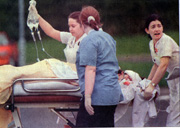
IT WAS by far the biggest emergency health services' operation witnessed in Ulster's troubled history.
Every aspect of the service was represented as a mammoth trauma aftermath plan swung into action.
Hundreds of doctors, nurses and surgeons were deployed across the province to cope with casualty after casualty rushed to hospital accident and emergency units.
They were joined by scores of laboratory staff, radiographers, pharmacy workers, hospital porters, security workers and caterers.
All worked frantically around the clock in a desperate bid to save life and limb.
Ulster's full 18-strong fleet of ambulances were also called upon.
Thirty-six paramedics and ambulance drivers took part in the operation, along with seven operational officers and other staff called in to help out in ambulance control.
Seven hospitals, which between them dealt with 220 casualties, activated their Emergency Incident Plans - only introduced in a major trauma situation.
Staff at Tyrone County Hospital - in the frontline of the emergency operation - worked flat out to cope with the long catalogue of casualties.
For many the task was doubly difficult because relatives and friends had been caught up in the blast.
At the peak of the crisis, when more than 100 of the injured poured in, immediate staff in the hospital were supported by scores who were off-duty and responded to a request for assistance.
And they were also supported by the main emergency services including paramedics, local GPs and volunteers.
At the South Tyrone Hospital in Dungannon, about 16 miles away, off-duty staff were also being called in from all over the area.
Normally, three nurses and a single doctor would be the norm for a Saturday night in the accident and emergency unit.
Last night, no fewer than 100 staff - 20 of them nurses took part in the emergency operation.
Clinical nurse specialist at the hospital Robert Sowney described the overall staff effort as "mammoth".
The Royal Victoria Hospital in Belfast dealt with the most seriously injured as the regional trauma centre for Northern Ireland.
Teams of surgeons, doctors and nurses worked around the clock as major casualties poured into the hospital's accident and emergency units.
They were joined by social workers, pharmacists, lab workers, porters and hospital chaplains.
At one point Army helicopters ferried the injured to the hospital grounds.
And as night fell ambulances and jeeps used their headlights to direct the helicopter to a makeshift helipad.
"It was a huge team effort," hospital spokesman Gerry Carson said. "Every one played a part."
Around 22 casualties - among them several children received emergency treatment for a variety of extremely serious injuries - including severe head injuries.
Altnagelvin Hospital in Londonderry also treated many of the seriously injured.
A total of 25 patients were ferried to the hospital - 17 of them were female, five male.
Six of the injured were aged between 12 and 14-years-old.
Last night three were described as "critically ill" and three "seriously ill".
A spokeswoman said: "The three operating theatres were working flat out. All our elective (non-urgent) surgery is cancelled."
Several of the injured had to have limbs amputated.
Others suffered from shrapnel injuries and serious fractures.
How the health services coped with the carnage
By Nigel Gould
Health Correspondent
IT WAS by far the biggest emergency health services' operation witnessed in Ulster's troubled history.
Every aspect of the service was represented as a mammoth trauma aftermath plan swung into action.
Hundreds of doctors, nurses and surgeons were deployed across the province to cope with casualty after casualty rushed to hospital accident and emergency units.
They were joined by scores of laboratory staff, radiographers, pharmacy workers, hospital porters, security workers and caterers.
All worked frantically around the clock in a desperate bid to save life and limb.
Ulster's full 18-strong fleet of ambulances were also called upon.
Thirty-six paramedics and ambulance drivers took part in the operation, along with seven operational officers and other staff called in to help out in ambulance control.
Seven hospitals, which between them dealt with 220 casualties, activated their Emergency Incident Plans - only introduced in a major trauma situation.
Staff at Tyrone County Hospital - in the frontline of the emergency operation - worked flat out to cope with the long catalogue of casualties.
For many the task was doubly difficult because relatives and friends had been caught up in the blast.
At the peak of the crisis, when more than 100 of the injured poured in, immediate staff in the hospital were supported by scores who were off-duty and responded to a request for assistance.
And they were also supported by the main emergency services including paramedics, local GPs and volunteers.
At the South Tyrone Hospital in Dungannon, about 16 miles away, off-duty staff were also being called in from all over the area.
Normally, three nurses and a single doctor would be the norm for a Saturday night in the accident and emergency unit.
Last night, no fewer than 100 staff - 20 of them nurses took part in the emergency operation.
Clinical nurse specialist at the hospital Robert Sowney described the overall staff effort as "mammoth".
The Royal Victoria Hospital in Belfast dealt with the most seriously injured as the regional trauma centre for Northern Ireland.
Teams of surgeons, doctors and nurses worked around the clock as major casualties poured into the hospital's accident and emergency units.
They were joined by social workers, pharmacists, lab workers, porters and hospital chaplains.
At one point Army helicopters ferried the injured to the hospital grounds.
And as night fell ambulances and jeeps used their headlights to direct the helicopter to a makeshift helipad.
"It was a huge team effort," hospital spokesman Gerry Carson said. "Every one played a part."
Around 22 casualties - among them several children received emergency treatment for a variety of extremely serious injuries - including severe head injuries.
Altnagelvin Hospital in Londonderry also treated many of the seriously injured.
A total of 25 patients were ferried to the hospital - 17 of them were female, five male.
Six of the injured were aged between 12 and 14-years-old.
Last night three were described as "critically ill" and three "seriously ill".
A spokeswoman said: "The three operating theatres were working flat out. All our elective (non-urgent) surgery is cancelled."
Several of the injured had to have limbs amputated.
Others suffered from shrapnel injuries and serious fractures.
Further Information
Publisher: BELFAST TELEGRAPH
Ref: BT/0009
Published Date: 17-Aug-98
Related Images