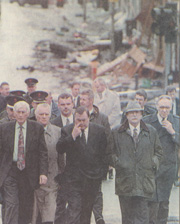
CHIEF CONSTABLE PLEDGES JUSTICE
CHIEF CONSTABLE IN PLEDGE TO BRING THE BOMBERS TO JUSTICE
Security Correspondent CHRIS THORNTON reports
A massive RUC investigation to find the killers is under way.
IN keeping with the toll of death and injuries, the RUC investigation into the Omagh bombing is likely to be the biggest inquiry in the force's history.
As soon as the scale of devastation became clear. Chief Constable Ronnie Flanagan set up a special task force and placed Eric Anderson his most senior detec-tive, in direct charge of the hunt for the bombers.
And Mr Flanagan pledged that the acting Assistant Chief Constable will have what ever resources he needs for what he called "a massive investigative task".
"No stone will be left unturned until we bring these people to justice." the Chief Con-stable said.
Mr Anderson, a chief superintendent, is one of the RUC's most experienced detectives with significant anti-terrorist experience and knowledge of the Omagh area.
He was in charge of the Criminal Investigation Department (CID) in North Region, which includes west Tyrone, until last year, when he was given overall control of RUC detectives.
Mr Anderson, who was credited with cracking the Greysteel massacre, outlined the huge scale of the Omagh inquiry yesterday.
He said it would be "a mammoth police investigation".
"We will work tirelessly to bring the killers to justice," he vowed.
Mr Anderson, who is married with a grown-up family, said nothing prepared even hardened policemen for the carnage.
"You think of your own children," he said. "You try to put emotions to one side but it's very difficult. We're all part of this community and we all feel the suffering.
"I, like so many other people, thought this was over. I never thought I would be back to heading this sort of investigation.
"But I can assure people that everything will be done, all resources will be poured into this investigation. I am of the opinion every contact leaves a trace."' The immediate task facing police and forensic investigators was a fingertip search through tons of rubble.
Much of the material was taken away to be sifted carefully in laboratory conditions. That task could take months.
The aim of the search is to find material from 'the actual bomb, including components. These may include small electronic parts and tiny shards of metal.
The bomb parts give some clues about how the bomb was built and detonated - and. when compared with earlier devices, may even suggest the person who built it.
The rubble will also be tested for traces of explosives to confirm if as suspected, the bomb was made from home-made explosives with a primer of Semtex-based detonating cord.
Detectives will also carry out hundreds of interviews to collate as much information as possible about the circumstances of the bombing.
By talking to the injured survivors and others who were in Omagh just before the blast, they hope to get clues about how and when the car bomb was parked and who left it.
Mr Anderson said information from members of the public will be the vital component in the investigation.
"I think it will be eased greatly if the public is prepared to come forward with information. If the public help us, it will be brought to a speedy conclusion." he said.
Other car bomb investigations have been hampered by the lack of evidence to directly connect the blast to the people who built the device.
Police often have firm suspicions about the identity of the bombers, but terrorist skills developed over 30 years often erase crucial parts of evidence.
Mr Anderson said he recognises the difficulties but is confident that his officers will track down the men responsible for the Omagh massacre.
"It's a long slog ahead but we win tirelessly pursue that objective " he said.
Security Correspondent CHRIS THORNTON reports
A massive RUC investigation to find the killers is under way.
IN keeping with the toll of death and injuries, the RUC investigation into the Omagh bombing is likely to be the biggest inquiry in the force's history.
As soon as the scale of devastation became clear. Chief Constable Ronnie Flanagan set up a special task force and placed Eric Anderson his most senior detec-tive, in direct charge of the hunt for the bombers.
And Mr Flanagan pledged that the acting Assistant Chief Constable will have what ever resources he needs for what he called "a massive investigative task".
"No stone will be left unturned until we bring these people to justice." the Chief Con-stable said.
Mr Anderson, a chief superintendent, is one of the RUC's most experienced detectives with significant anti-terrorist experience and knowledge of the Omagh area.
He was in charge of the Criminal Investigation Department (CID) in North Region, which includes west Tyrone, until last year, when he was given overall control of RUC detectives.
Mr Anderson, who was credited with cracking the Greysteel massacre, outlined the huge scale of the Omagh inquiry yesterday.
He said it would be "a mammoth police investigation".
"We will work tirelessly to bring the killers to justice," he vowed.
Mr Anderson, who is married with a grown-up family, said nothing prepared even hardened policemen for the carnage.
"You think of your own children," he said. "You try to put emotions to one side but it's very difficult. We're all part of this community and we all feel the suffering.
"I, like so many other people, thought this was over. I never thought I would be back to heading this sort of investigation.
"But I can assure people that everything will be done, all resources will be poured into this investigation. I am of the opinion every contact leaves a trace."' The immediate task facing police and forensic investigators was a fingertip search through tons of rubble.
Much of the material was taken away to be sifted carefully in laboratory conditions. That task could take months.
The aim of the search is to find material from 'the actual bomb, including components. These may include small electronic parts and tiny shards of metal.
The bomb parts give some clues about how the bomb was built and detonated - and. when compared with earlier devices, may even suggest the person who built it.
The rubble will also be tested for traces of explosives to confirm if as suspected, the bomb was made from home-made explosives with a primer of Semtex-based detonating cord.
Detectives will also carry out hundreds of interviews to collate as much information as possible about the circumstances of the bombing.
By talking to the injured survivors and others who were in Omagh just before the blast, they hope to get clues about how and when the car bomb was parked and who left it.
Mr Anderson said information from members of the public will be the vital component in the investigation.
"I think it will be eased greatly if the public is prepared to come forward with information. If the public help us, it will be brought to a speedy conclusion." he said.
Other car bomb investigations have been hampered by the lack of evidence to directly connect the blast to the people who built the device.
Police often have firm suspicions about the identity of the bombers, but terrorist skills developed over 30 years often erase crucial parts of evidence.
Mr Anderson said he recognises the difficulties but is confident that his officers will track down the men responsible for the Omagh massacre.
"It's a long slog ahead but we win tirelessly pursue that objective " he said.
Further Information
Publisher: BELFAST TELEGRAPH
Ref: BT/0007
Published Date: 17-Aug-98
Related Images